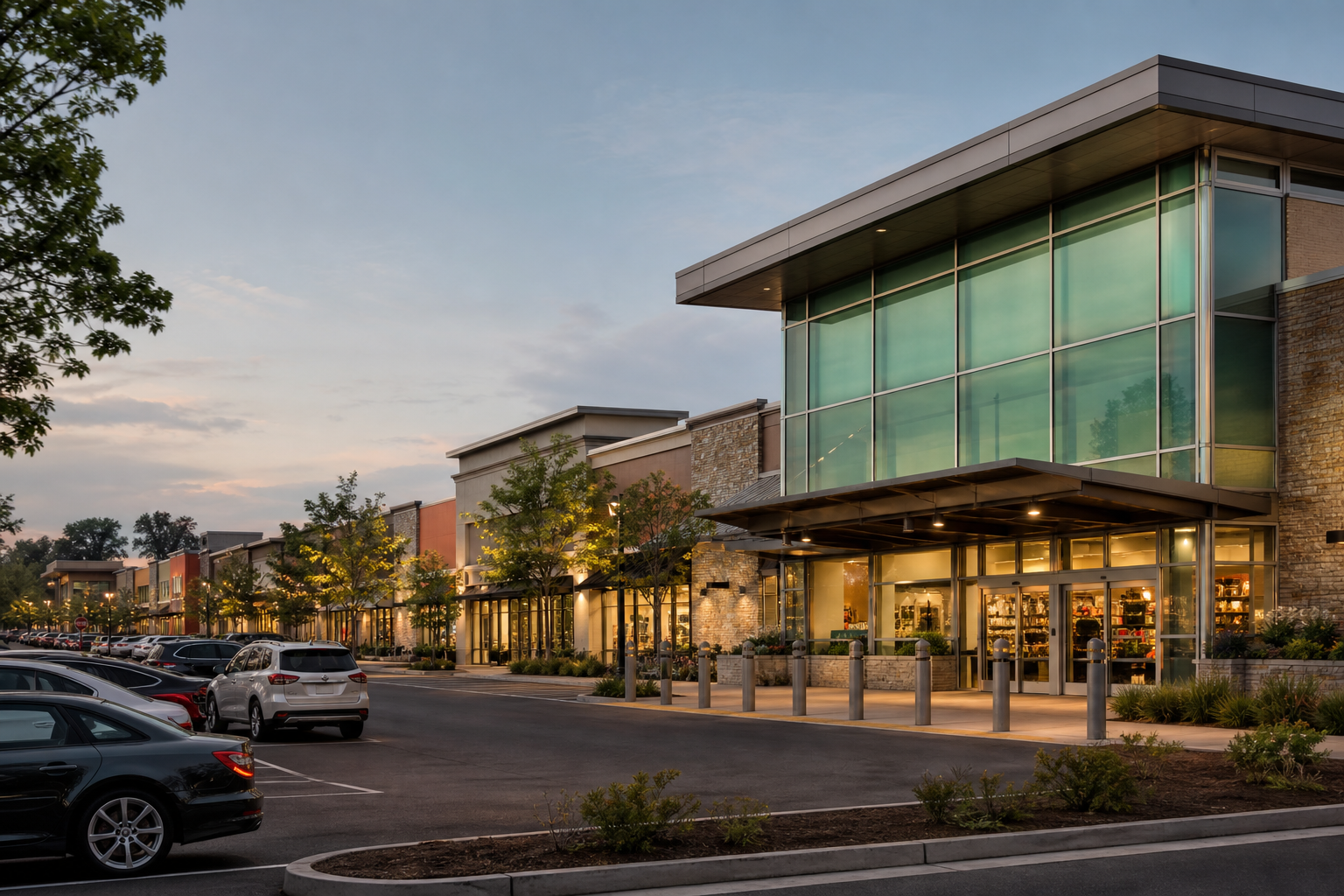
For a decade, “retail” was shorthand for decline — e-commerce was going to hollow out the strip center, and capital treated the whole category as a value trap. That verdict is now inverted. National shopping-center vacancy sits near a record low, leasing is running at a two-decade high, and the best grocery-anchored centers are trading at cap rates that used to be reserved for prime industrial. The story isn’t a comeback. It’s scarcity.
CRE360 Signal™ — Thursday, July 2, 2026
a deep-dive signal on the retail scarcity trade, with CoStar data showing record-low ~4.4% vacancy and two-decade-high leasing while the best grocery-anchored centers clear sub-6% cap rates — plus a stakeholder-by-stakeholder breakdown of what the scarcity means for owners, buyers, and developers, and the one question the thesis still hinges on: the consumer.
Busy to read? Catch the Daily Podcast.
THE SIGNAL
National shopping-center vacancy is running around 4.4% — comfortably below the ~5.3% long-run average — and overall retail availability, near 4.8%, is the lowest on record, according to CoStar. U.S. shopping-center leasing is at its strongest pace in roughly 20 years. This is not a sentiment rebound; it’s a supply fact.
The demand is deliberately defensive. Off-price and grocery names — TJX, Ross, Burlington, ALDI, Lidl, Sprouts, Trader Joe’s — are driving a disproportionate share of net absorption, per brokerage and ICSC data. These are needs-based, recession-tested tenants, and they are competing for space in a market where almost nothing new has been built since 2008.
Capital has noticed. Best-in-class grocery-anchored centers are clearing sub-6% cap rates as institutional buyers and 1031 exchange money converge on the same limited pool of quality assets. The institutional conviction isn’t new, either: back in early 2025, Blackstone took grocery REIT ROIC private in a ~$4B deal, funding it with a $2.8B single-borrower CMBS on 85 grocery-anchored centers that were 95.6% leased. The smart money started paying up for essential retail before the vacancy numbers made headlines.
IMPLICATIONS
The mechanism here matters more than the momentum. Retail’s tightness isn’t the product of a demand surge — it’s the product of a decade of non-construction. Development effectively stopped after 2008, e-commerce fear kept it stopped, and the pandemic cleared out the weakest centers. When demand recovered, it recovered into a supply base that had been frozen for fifteen years. You cannot easily add a well-located neighborhood center; entitlement, anchor commitments, and construction costs make new open-air retail slow and expensive. That is what turns surviving centers into irreplaceable assets.
That reframes the whole asset class as an underwriting problem, not a growth story. The income is durable because the tenants are essential and the space can’t be replicated. But durability is being priced aggressively — a sub-6% cap on grocery-anchored income is a bet that occupancy and rents are near a floor, not a peak. The margin for error is thin.
So the discipline is basis, not conviction. The thesis is right: essential retail is scarce and defensible. The risk is paying a price that assumes both record occupancy and continued rent growth, then meeting a consumer that softens. The best-underwritten deals in this market aren’t the ones chasing the tightest cap rate — they’re the ones buying irreplaceable location at a basis that survives a flat-rent year.
STAKEHOLDER LENS
Owners of well-located open-air centers hold pricing power they haven’t had since before the financial crisis — leasing leverage, mark-to-market upside, and a bid under their asset. Buyers and 1031 investors are the ones most exposed: the convergence of exchange capital and institutions on a thin pool of quality product is exactly what compresses caps past the point of prudence. Developers face the paradox that the tightest asset class is also the hardest to build — the returns are visible, but the entitlement and cost path to new supply is not.
KEY TAKEAWAY
Retail didn’t recover — it stopped being built. Scarcity turned the survivors into the safest income in the market, and the only real risk left is the price of admission.
Related coverage
Key Takeaways
The open question is the consumer. Record-low vacancy and two-decade-high leasing describe a supply-constrained market at what may be peak fundamentals. If discretionary spending weakens into 2027, the essential-tenant base holds — but the sub-6% cap rates underwritten today assume a floor that hasn’t been stress-tested by a real downturn.
Get Retail Is Now the Scarcity Trade in your inbox
The asset class the last cycle wrote off is the tightest real estate in America.