📢 CRE 360 Signal™.
The two largest pure-play apartment REITs in the country are considering combining into a $50B platform. The market read it as opportunistic M&A — the actual story is that the standalone public multifamily REIT model has stopped earning its cost of capital.
🎧 Busy to read? Catch the Daily Podcast (Subscribe on YouTube, Apple, Spotify)➤ SIGNALS
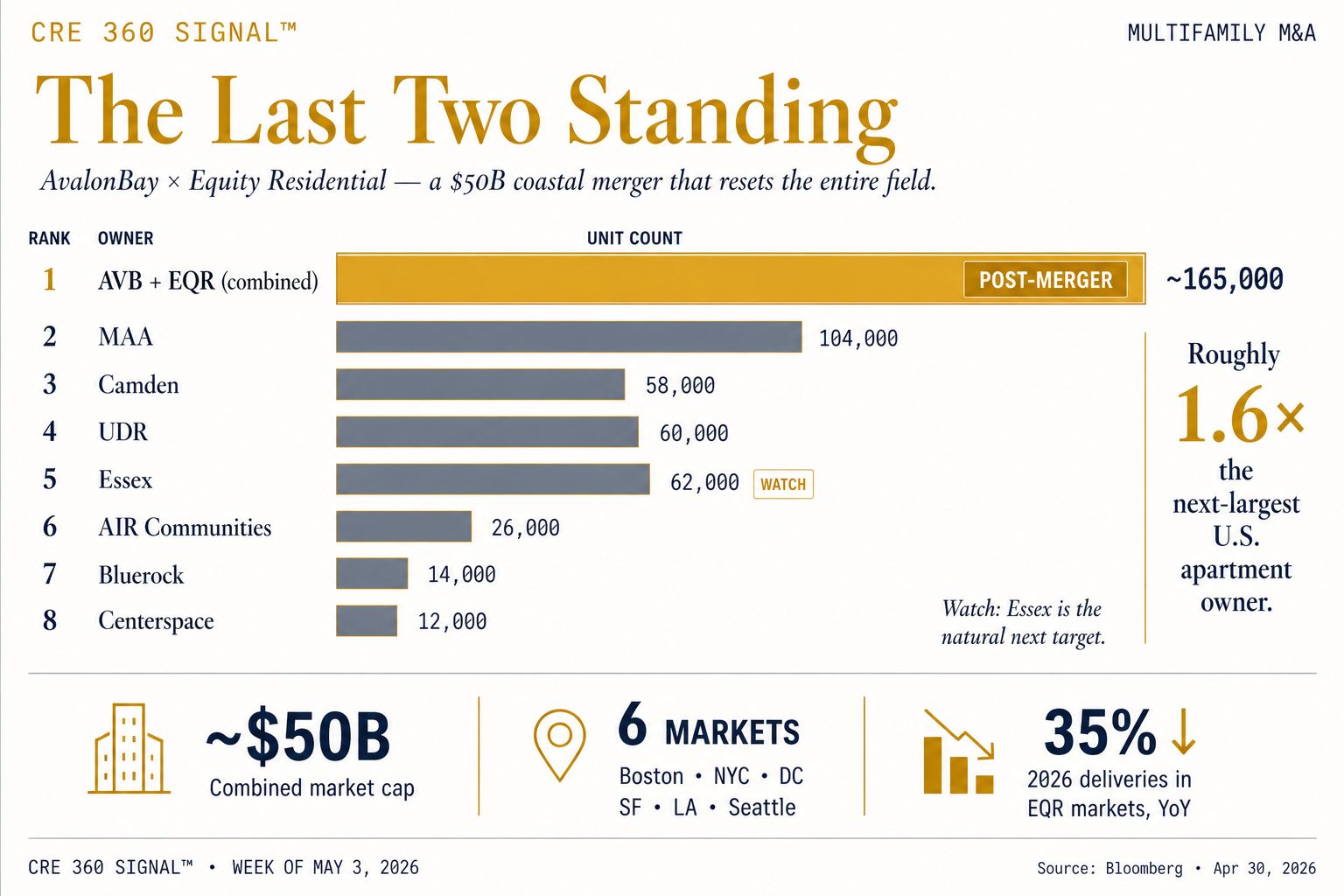
On April 30, Bloomberg reported that AvalonBay (NYSE: AVB) and Equity Residential (NYSE: EQR) — each near $25B in market cap — are in early-stage discussions on a combination. Neither company has confirmed a definitive transaction. AVB closed +2.2% and EQR +1.2% on the report.
The combined platform would total roughly 165,000 units concentrated in six gateway-coastal markets: Boston, NYC, DC, San Francisco, Los Angeles, and Seattle. That makes it nearly double the size of the next-largest U.S. apartment owner and among the largest real estate transactions in U.S. history if completed.
The timing is what matters. The Bloomberg report dropped two days after EQR's Q1 earnings call, where the company disclosed that deliveries in its markets were down 35% YoY, San Francisco concessions had become "virtually nonexistent" tied to AI hiring, and gateway markets were outperforming Sun Belt for the first time since pre-pandemic. The strategic logic was telegraphed before the talks were reported.
When two companies that have spent fifteen years competing for the same renter on the same six blocks decide they would rather merge than continue operating separately, the message isn't bullish growth — it's defensive. Three forces converged to force the conversation: a persistent public-private NAV discount the public market won't close, a mandatory rebuild of revenue management infrastructure post-RealPage litigation that neither wants to absorb alone, and a 2026–2027 supply-cliff window that rewards scale. Merging is cheaper than fixing both balance sheets independently. That's the real synergy — not rent growth, not procurement savings. Cost of capital and cost of operating, dropped through scale.
Implications for CRE
New comp set for every Class A coastal trade. Sellers will price against the implied merger NAV; buyers should challenge it as a control-premium number, not a market clearing price.
Antitrust-driven divestitures become forced-seller signals. Expect required asset sales in Boston, DC, and SF submarkets where AVB and EQR overlap. The cap rates on those forced sales will set comps for every Class A coastal trade in 2027.
Mid-cap apartment REITs become consolidation targets. Camden, MAA, UDR, and Essex now face investor pressure to articulate why they shouldn't merge. Essex is the natural target given West Coast portfolio overlap.
Discount fee income across the board. The DC AG vs. MAA suit the same week confirms ancillary fees are in legal play nationally. Apply a 30–50% haircut to projected fee income on any 2026 multifamily acquisition pro-forma until the regulatory picture clarifies.
Key Takeaways
When the two largest pure-play apartment REITs would rather combine than continue competing, that's the market admitting the public REIT model can't carry its own operating cost structure anymore. Underwrite the next coastal apartment deal to that reality — scale is now the defense, not the upside.
CRE 360 Signal™ — Commercial Real Estate Intelligence
▼ EDITORIAL DESK TOP PICKS
🏢 Office / Leasing / Urban Markets
WTC district now rivals Midtown with $140+ rents — Downtown Manhattan leasing has surged, pushing rents above $100–$160 PSF with ~95% occupancy.
Office towers selling at up to 95% discounts — Distressed office assets across major cities are trading at fractions of prior values, signaling structural repricing.
Dallas office building sale tied to renovation strategy — A 115K SF office asset is being repositioned to Class A quality amid ongoing demand shifts.
⚡ Industrial / Data Centers
$2B data center expansion in Texas backed by Oracle demand — DataBank is scaling a 600K SF campus with 180 MW capacity, reflecting AI-driven infrastructure demand.
ICE warehouse acquisitions creating new CRE asset class — Federal purchases of industrial assets for detention facilities are reshaping warehouse demand and pricing.
🔗 https://www.wsj.com/business/logistics/ice-dhs-detention-center-warehouses-ac0af8e4
🏗️ Development / Mixed-Use / Adaptive Reuse
Dodgers stadium land seen as major CRE development opportunity — Large-scale mixed-use potential tied to transit infrastructure could unlock billions in value.
Oceanwide Plaza $470M deal faces financing and legal hurdles — One of LA’s largest stalled projects continues through bankruptcy with multiple bidders.💰 Capital Markets / Debt / Regulation
Fed examining banks’ exposure to private credit funds — Regulators are concerned about growing links between banks and nonbank CRE lending structures.
Private credit exposure flagged as “growing and opaque” — CRE lending risk is increasingly shifting outside traditional banking channels.
🏢 Brokerage / Industry Structure
Re/Max to be acquired in ~$880M deal — Consolidation continues as tech-enabled brokerages scale nationally.
🌍 Market Trends / Investment Signals
CRE increasingly tied to AI and tech infrastructure demand — Data centers are becoming one of the fastest-growing asset classes globally.
95% of investors planning increased data center allocation — Institutional capital is aggressively shifting toward digital infrastructure.
Office leasing showing early recovery signals in multiple markets — Positive absorption is spreading across U.S. metros despite elevated vacancy.
Luxury retail expansion up 65% year-over-year — High-end retail is outperforming due to resilient high-income consumers.
🏠 Housing / Multifamily / Spillover Effects
Housing slowdown creating buying opportunity for investors — Reduced competition and slower sales are improving acquisition conditions.
Mortgage rates stabilizing around 6.3%–6.5% range — Elevated but predictable rates are shaping acquisition and development strategies.
🏦 Macro / Structural CRE Shifts
CRE debt market now exceeds $5 trillion — Banks still dominate but non-bank lenders continue gaining share.
Banks hold ~$1.89T of income-producing CRE loans — Traditional lenders remain core but are losing relative dominance.
🏬 Retail / Experiential / Distress
American Dream mall faces $800M debt dispute — Bondholders allege manipulation of property value amid financial stress.
Saks Fifth Avenue closing stores tied to CRE restructuring — Retail bankruptcies continue to reshape mall tenancy and valuation dynamics.

Get When Competitors Merge, the Model Is Broken in your inbox
AvalonBay and Equity Residential confirmed early talks on a ~$50B merger that would reshape Class A coastal multifamily.