📢 CRE 360 Signal™.
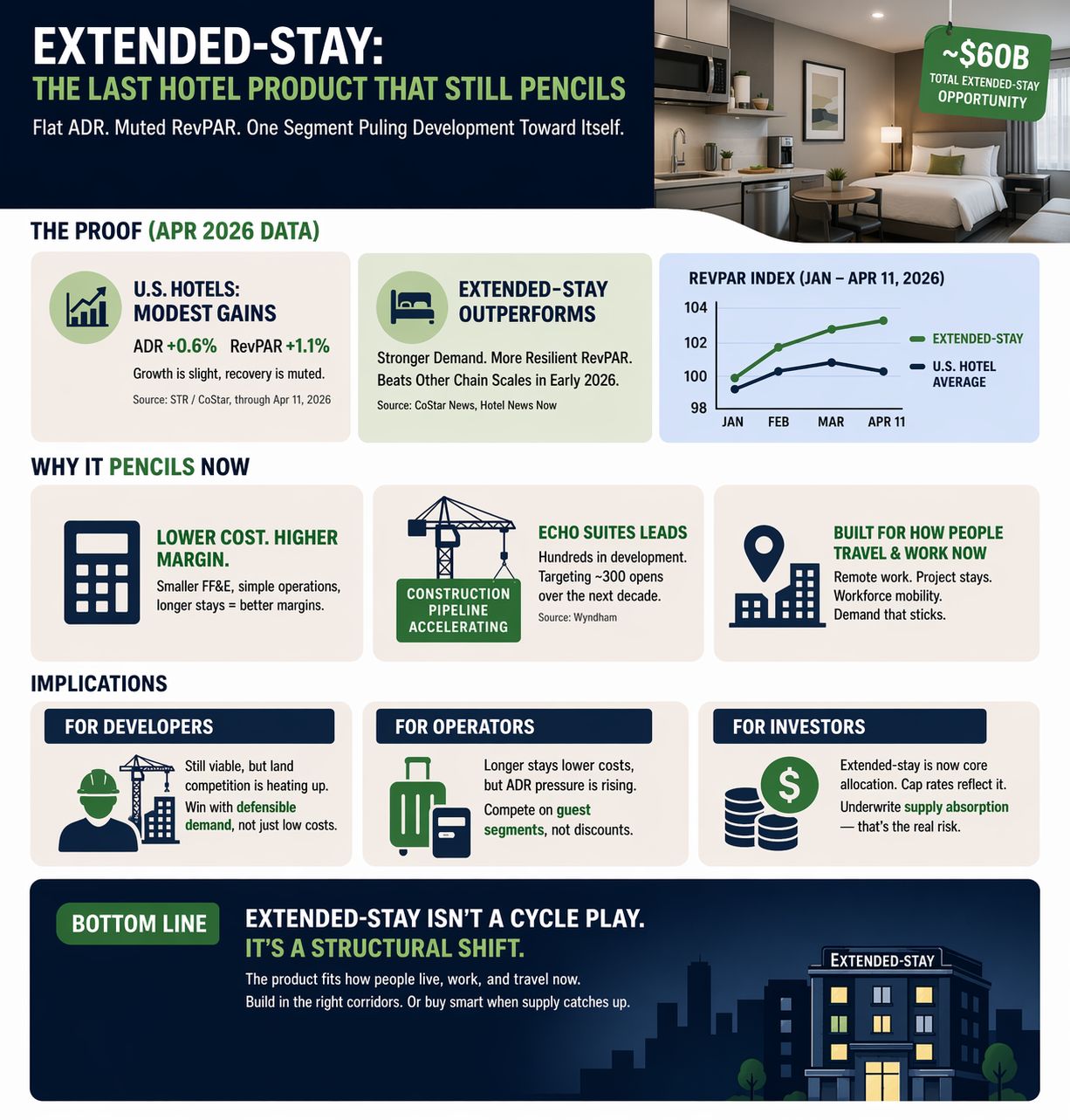
U.S. hotels are posting modest ADR and RevPAR gains through mid-April 2026 per STR/CoStar, but extended-stay continues to outperform other chain scales on both demand and RevPAR resilience. With major franchisors — Wyndham's ECHO Suites in particular — aggressively expanding construction-only extended-stay pipelines into a roughly $60B segment, the near-term story isn't cyclical recovery. It's a structural reallocation of development capital toward the one product type that still pencils.
🎧 Busy to read? Catch the Daily Podcast (Subscribe on YouTube, Apple, Spotify)➤ SIGNALS
Per STR/CoStar weekly data through April 11, 2026, U.S. hotels posted only slight ADR and RevPAR growth — consistent with full-year 2026 forecasts calling for muted positive RevPAR rather than a meaningful demand rebound.
Independent segment research cited in CoStar News and Hotel News Now shows extended-stay posted stronger demand growth and smaller RevPAR declines than comparable chain scales earlier in 2026. ADR remains pressured relative to luxury, but occupancy and length-of-stay dynamics are keeping top-line healthier than the rest of the industry.
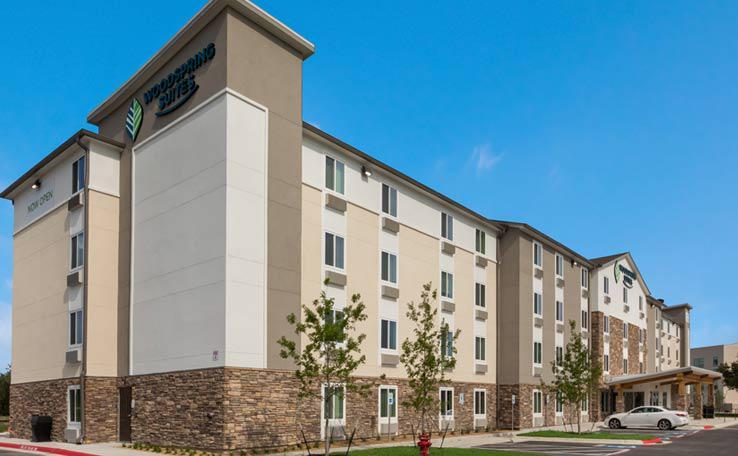
On the pipeline side, Wyndham Hotels & Resorts reports ECHO Suites Extended Stay — its construction-only brand — has hundreds of hotels in development across the U.S. and Canada, targeting roughly 300 open over the next decade. Segment research sizes the total extended-stay opportunity at ~$60B.
The Signal Underneath — What The Data Isn't Saying
The reporting gives you the numbers. The underwriting questions sit one layer below:
ADR pressure in extended-stay while luxury holds rate means the segment is commoditizing faster than most pipelines assume. When a segment's demand story is strong but its pricing power isn't, you're watching supply catch up to demand in real time. That's a late-cycle signal, not an early-cycle one.
ECHO's construction-only model makes its pipeline rate-insensitive. Those rooms deliver regardless of where RevPAR goes between now and opening day. Existing operators in ECHO's target markets are underwriting against new supply that is not going to pause.
The $60B TAM is a ceiling, not a runway. Franchisor pipelines are already priced against that number. The marginal new extended-stay deal is no longer competing for an untapped market — it's competing for share inside a segment that institutional capital has already identified.
Implications — What This Means
Developers, extended-stay is still viable with lower FF&E, simpler service models, and higher margins. However, land competition is intensifying, and future deals will need defensible demand drivers, not just favorable cost structures.
Operators, longer stays reduce variable costs and smooth labor, but ADR pressure is increasing, and they’ll lose against ECHO Suites and similar new-builds. The defensible play is guest segmentation, not rate discounts.
Investors, the segment has shifted from niche to core allocation, and entry pricing reflects it. Cap rate compression relative to select-service is visible. The real underwriting question is supply absorption: if ECHO and peers deliver on schedule, sub-market saturation is the downside case most pro formas underweight.
Key Takeaways
Extended-stay isn't outperforming because the cycle favors it. It's outperforming because the product fits how people actually travel and work now. The development thesis is sound — but the window where every extended-stay project pencils is also the window where smart capital starts underwriting for supply risk, not demand risk. Build into undersupplied corridors with defensible demand drivers, or wait for the next correction to buy stabilized product at a discount.
CRE 360 Signal™ — Commercial Real Estate Intelligence
▼ EDITORIAL DESK TOP PICKS
Capital Markets / Debt / Macro
Capital Markets / Debt / Distress
“CRE financing deals getting harder as borrowing costs stay elevated” — Higher interest rates are still complicating underwriting and slowing deal velocity across multiple asset classes.
“$875B in CRE loans maturing continues to pressure refinancing markets” — A large share of outstanding commercial mortgages due in 2026 is keeping lenders cautious and selective.
“CRE debt markets remain fragmented despite signs of recovery” — Capital is available but unevenly distributed across asset classes and borrower profiles.
“Private lenders continue gaining share in CRE financing” — Non-bank capital is filling gaps left by traditional lenders in higher-risk transactions.
“Loan workouts replacing extensions as lenders enforce discipline” — Distress strategies are shifting toward restructuring and recapitalization instead of extensions.
Transactions / Deals
“Industrial portfolios continue trading between institutional players” — Large logistics portfolios remain one of the most liquid segments of the market.
“Multifamily transactions remain active despite rent pressure” — Investors are still targeting apartments, especially in Sun Belt markets with long-term growth.
“Net-lease assets continue to attract capital for stable income” — Ground leases and single-tenant properties remain favored for predictable cash flow.
“Hotel sector seeing selective investment activity in gateway markets” — Investors are targeting repositioning opportunities in hospitality assets.
“Mixed-use development deals continue to anchor urban investment” — Large-scale mixed-use projects remain a primary deployment strategy for capital.
Office / Leasing
“Office market recovery remains highly uneven by geography” — Trophy assets outperform while secondary offices continue to struggle.
“Sublease inventory stabilizing in some U.S. office markets” — Companies are beginning to commit to long-term footprints after years of downsizing.
“Office-to-residential conversions accelerating nationwide” — Adaptive reuse is becoming a major strategy to address vacancy and housing shortages.
Industrial / Data Centers
“Power constraints becoming key bottleneck for data center growth” — Energy availability is now a primary limiting factor for new development.
Multifamily / Housing
“Multifamily supply surge continues pressuring rents in major metros” — New deliveries are temporarily increasing vacancy and slowing rent growth.
“Affordable housing demand remains strong despite policy challenges” — Workforce housing continues attracting institutional capital due to persistent demand.
Retail
“Retail fundamentals remain tight with limited new construction” — Low vacancy rates are supporting stable performance in retail assets.
Development / Construction
“Construction cost volatility easing but still impacting feasibility” — Pricing has stabilized, but projects remain sensitive to cost swings and financing.
Technology / Market Direction
“Technology and AI reshaping CRE underwriting and operations” — Data-driven decision-making is becoming central to investment and asset management strategies.

Related coverage
Key Takeaways
Whether structural demand drivers (remote work, workforce mobility, project-based deployment) hold through the next cycle, and whether franchisor pipelines actually deliver on schedule given current construction financing conditions.
Get How Extended-Stay Became The Last Hotel Product That Still Pencils in your inbox
Flat ADR, muted RevPAR, and one segment quietly pulling the industry's development pipeline toward itself.