📢 CRE 360 Signal™.
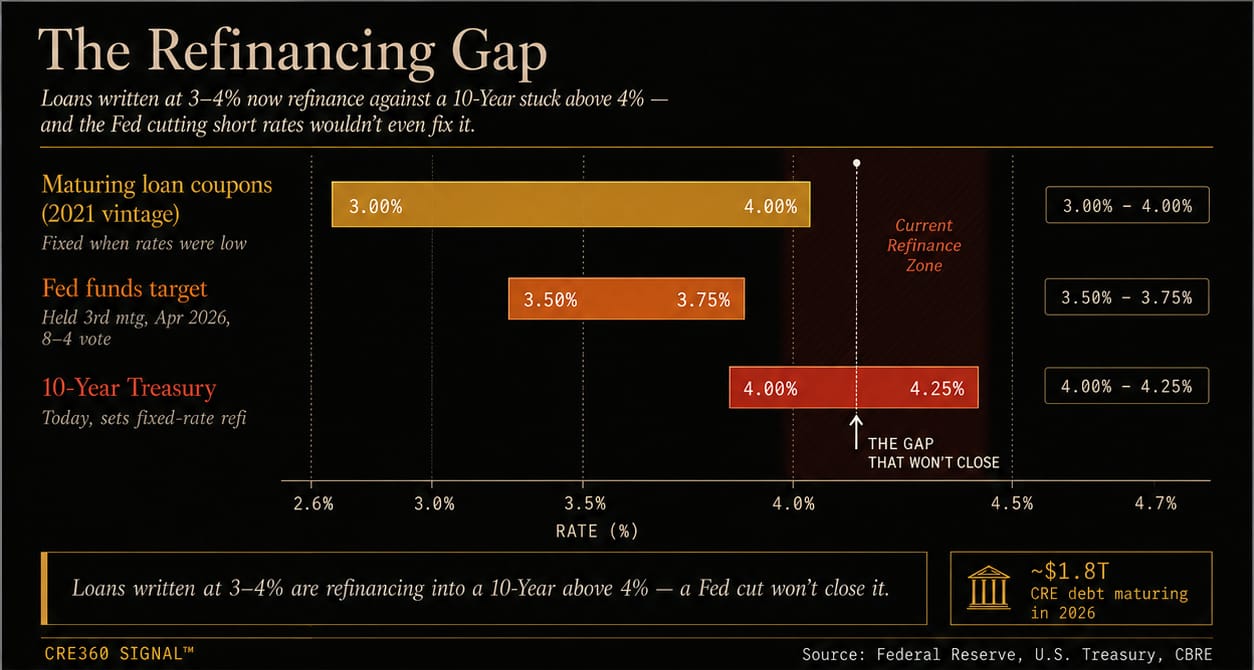
As commercial real estate enters the final month of Q2, the defining force isn’t a property-market event — it’s a geopolitical one. The 2026 Iran war and the late-February closure of the Strait of Hormuz triggered what the IEA has called one of the largest oil-supply disruptions on record, pushing Brent to roughly $80–82. That shock pinned the Federal Reserve, which held its policy rate at 3.50–3.75% for a third straight meeting in April on an 8–4 vote — the most dissents at one meeting since 1992. The 10-Year Treasury has held near 4.00–4.25%. Rate relief got pushed out again — at the precise moment an estimated $1.8 trillion of CRE debt comes due in 2026.
🎧 Catch the Wekkly Podcast (Subscribe on YouTube, Apple, Spotify)➤ SIGNALS
Here is what actually changed at the half-year mark: the reason rates are high flipped from domestic to geopolitical, and that makes the path far less predictable. For two years the market underwrote a clean story — inflation cools, the Fed cuts, the maturity wall refinances into lower rates. An energy-supply shock breaks that story. The Fed can’t cut into oil-driven inflation without risking a 1970s-style mistake, and it can’t tighten without deepening a slowdown. So it freezes — and the four dissents tell you even the Fed can’t agree on the exit.
For CRE the timing is brutal. Roughly $1.8 trillion in debt matures in 2026, including about $146 billion of CMBS — $76 billion of it on hard maturities with no extension option. Most of that paper was written at 3–4% and now refinances against a 10-Year stuck above 4%. The Fed cutting short rates wouldn’t even fix it: fixed-rate CRE loans price off the long end, and the long end isn’t moving. This is the gap the market keeps misreading — “Fed cuts” and “CRE refinances cheaply” are no longer the same sentence.
And yet — capital is not retreating. Global transaction volume rose roughly 18% year over year in Q1 to about $216 billion, the CBRE Lending Momentum Index hit a five-year high in its fifth straight quarter of expansion, and office investment alone rose about 61%. Blackstone is filing to take a roughly $2 billion data-center REIT public. The wall and the boom are happening in the same market, at the same time.
Implications
The defining feature of this cycle is dispersion. Capital isn't absent — it's selective to a degree we haven't seen since the GFC. It is flooding into AI infrastructure, trophy office, and stabilized industrial while it refuses to refinance commodity assets at any reasonable price. The maturity wall won't produce a uniform crash; it will produce a sorting. Assets with durable cash flow and investment-grade tenancy clear easily. Everything else negotiates extensions, takes rescue capital, or trades at a reset basis.
For operators and sponsors, the move is defensive on the debt side and opportunistic on the equity side. If you have a 2026 maturity, you are not waiting for the Fed — you are solving it now, with extensions, paydowns, or fresh equity, underwriting an exit cap 75–150 bps above today and a 10-Year that stays sticky. On the buy side, the same forces that are punishing over-levered owners are creating the best entry basis in years for unlevered or lightly levered capital, particularly where replacement cost now sits above acquisition price.
The oil shock adds a second-order squeeze most pro formas miss: it re-loads construction costs and insurance just as debt peaks, which tilts the build-versus-buy decision decisively toward buying existing, cash-flowing assets below the cost to replace them.
Stakeholder lens. Lenders: separate your office and your data-center credit boxes — "CRE" is no longer one risk. Developers: re-run feasibility with current steel, copper, and insurance inputs before committing. LP investors: the dispersion is the opportunity — mandate submarket and tenant-credit selection, not sector bets. Owners with 2026 maturities: time, not rate, is your scarce resource.
Key Takeaways
The Fed froze for a reason no one underwrote — so stop waiting for the cut and start sorting your assets, because this maturity wall rewards the prepared and punishes the patient.
CRE 360 Signal™ — Commercial Real Estate Intelligence
▼ EDITORIAL DESK TOP PICKS
1. Commercial Real Estate Lending Activity Reaches Five-Year High. CBRE's Lending Momentum Index reached its strongest level since 2021, signaling increased lending activity across CRE sectors.
2. Commercial & Multifamily Borrowing Increased 52% in Q1 2026. MBA reported commercial and multifamily mortgage borrowing rose 52% year-over-year in the first quarter.
3. Kayne Anderson Closes $5.12 Billion Opportunistic Real Estate Fund. The firm announced the final close of an oversubscribed opportunistic equity fund with $5.12 billion in commitments.
4. CMBS Special Servicing Rate Reaches 11%. Trepp data shows the CMBS special servicing rate climbed to approximately 11% in May.
5. FDIC Reports Rising Nonperforming Commercial Real Estate Loans. The FDIC's Q1 banking report showed continued deterioration in nonfarm nonresidential CRE credit performance.
6. I Squared Acquires Data Center Portfolio From Cogent. I Squared Capital agreed to acquire U.S. data center assets from Cogent for approximately $225 million.
7. Edged Secures Nearly $2 Billion for U.S. Data Center Expansion. Edged announced approximately $2 billion in financing to support its U.S. data center development pipeline.
8. Prime Data Centers Breaks Ground on $3 Billion Phoenix Campus. Prime Data Centers started construction on three buildings within its $3 billion Metro Phoenix development.
9. PJM Accelerates Timeline for New Data Center Power Connections. PJM announced changes designed to speed up power delivery to large-scale data center projects.
10. AI Could Add 330 Million Square Feet of CRE Demand. Cushman & Wakefield projects AI-related growth could generate 330 million square feet of demand over the next decade.
11. JLL Arranges $300 Million Sale of FedEx Industrial Portfolio. A multi-state FedEx logistics portfolio traded for approximately $300 million.
12. Colliers Brokers $140 Million Industrial Facility Sale. A 1.6 million-square-foot industrial property in Tennessee sold for $140 million.
13. Newmark Arranges Sale and Financing of Logistics Portfolio. Newmark completed the sale and acquisition financing of a 1.38 million-square-foot shallow-bay logistics portfolio.
14. Industrial Asset in Northern Virginia Data Center Corridor Sells for $42 Million. Marcus & Millichap closed the sale of two industrial properties located within Northern Virginia's data center market.
15. ACRE Provides $351 Million Refinance for Multifamily Portfolio. ACRE supplied refinancing for a multifamily portfolio spanning four states.
16. HUD Expands Role in Multifamily Finance. HUD announced updates designed to increase its participation in multifamily lending programs.
17. Freddie Mac Issues Affordable Housing Forward Commitment. Freddie Mac provided a forward commitment supporting the development of new affordable housing in Arizona.
18. Avison Young Arranges $404 Million Permanent Loan in Manhattan. The firm secured financing for The Archive, a 479-unit multifamily property in Manhattan.
19. U.S. Office Vacancy Falls to 17.6%. Yardi Matrix reported national office vacancy declined modestly in April 2026.
20. Law Firms Continue Driving Premium Office Leasing. Savills reported legal-sector tenants remain among the most active users of high-end office space.

Related coverage
Key Takeaways
The entire outlook hinges on the duration of the Hormuz disruption. The Dallas Fed's modeling suggests a one-quarter closure adds ~0.6 ppt to headline and ~0.2 ppt to core inflation in 2026 — manageable. A longer closure changes the regime, and with it the Fed's hand and the shape of the back half of the year.
Get The Fed Freezes as the Wall Arrives in your inbox
Rate relief got pushed out again — just as the year's biggest refinancing wave hits and AI capital floods in.