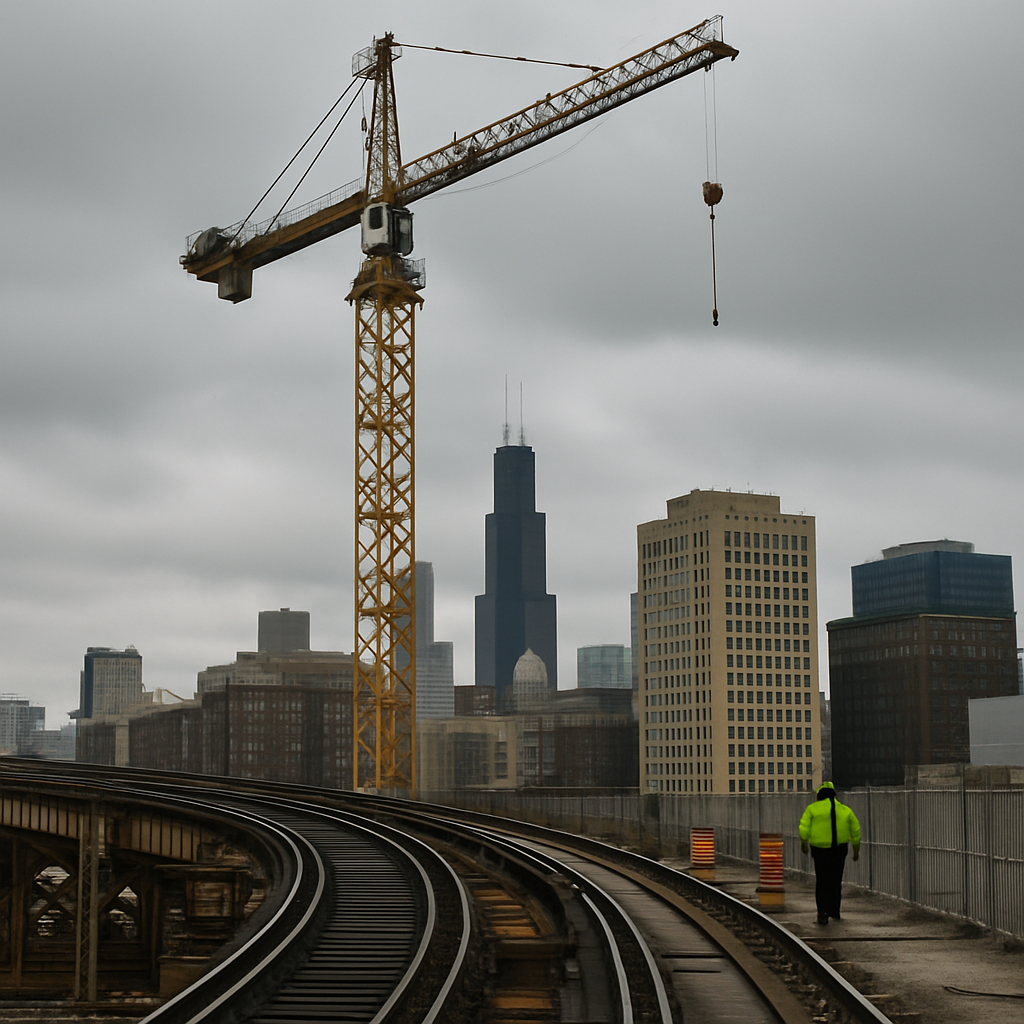


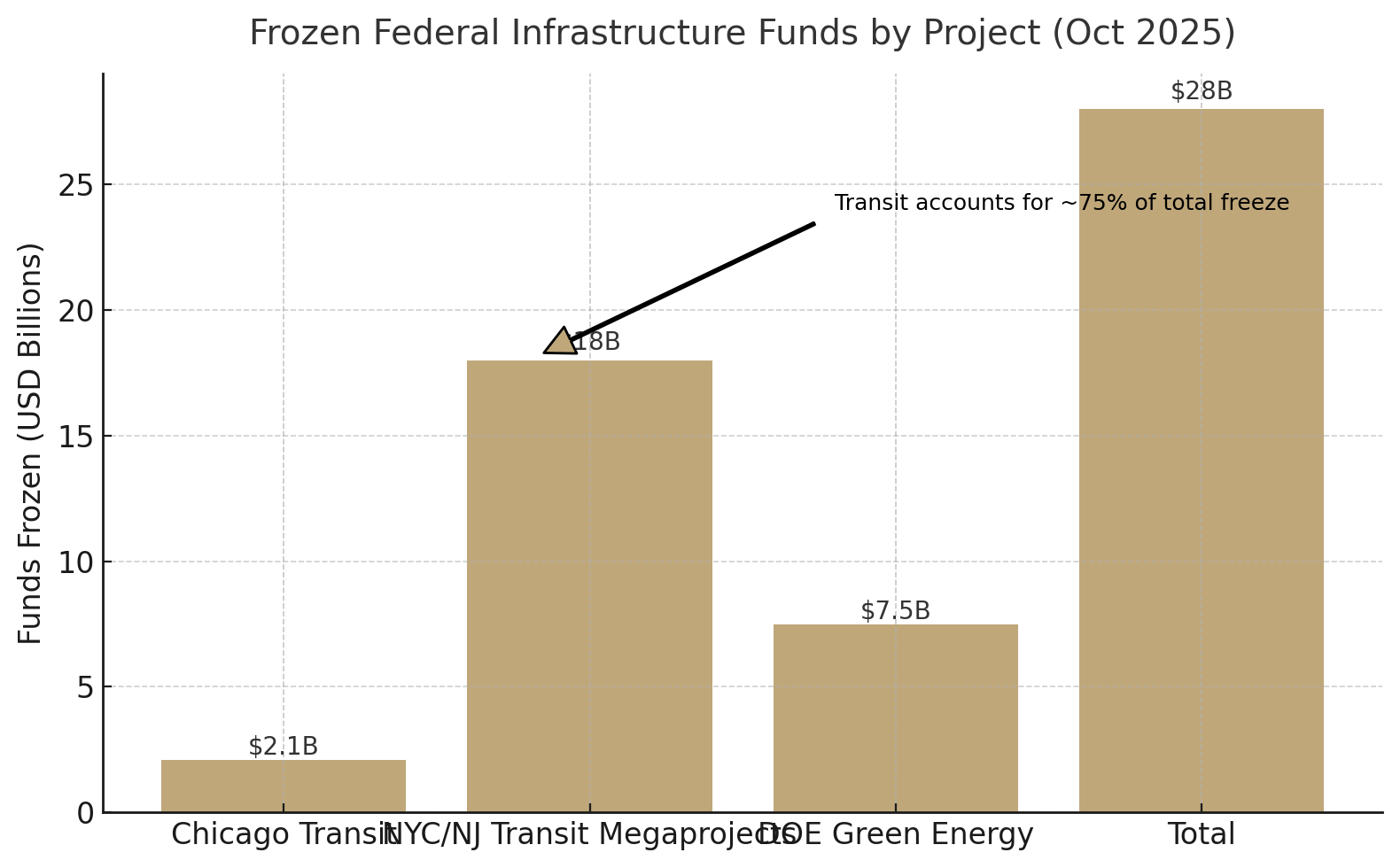
🚨The U.S. DOT’s suspension of $2.1 billion in federal grants for Chicago’s Red Line Extension and Red/Purple Modernization has effectively frozen two of the city’s largest transit works mid-stream. The pause, part of a broader $28 billion federal funding freeze targeting major urban projects, introduces a new counterparty risk into U.S. infrastructure finance. Without restored funds, the $5 billion build program faces cost escalation, demobilization penalties, and bond yield pressure as investors price political risk into muni paper.

Federal funds frozen: $2.1 B (Chicago transit projects, Oct 2025) — [Source: Reuters].
Broader freeze scope: ≈ $28 B nationwide (transport + energy grants) — [Source: ENR].
Red Line Extension value: $2.9 B (5.5 mi expansion; 4 stations) — [Source: ENR].
Annual construction cost inflation: +2–4 % (ENR 2025 Index) — [Source: ENR].

Loan Performance. Suspension forces liquidity gaps for CTA and contractors; bridge financing may be needed to meet payables. Delay risks inflate carry costs and threaten DSCR on related bond issues.
Demand Dynamics. Transit-linked redevelopment (TOD corridors along new stations) faces slower absorption and pushed-out rent growth timelines; construction labor could reallocate elsewhere.
Asset Strategies. Developers should re-sequence capex to fund low-cost tasks under local control, minimize demobilization losses, and maintain site preservation.
Capital Markets. Muni yields for CTA-linked credits tick higher (~10 bps week-over-week). Future issuances likely carry political-risk premiums or require state backstops.

Federal funding certainty no longer risk-free.
Mixed-funded projects (state/private) now favored.
Lenders tighten “funding milestone” covenants.
Expect temporary rise in infra yields until review resolves.
🛠 Operator’s Lens
Refi. Transit agencies should preserve liquidity lines; avoid new issuance until funds resume.
Value-Add. Focus on maintaining partially built assets (weatherproofing, security) to limit degradation.
Development. Re-phase work and extend GC timelines 6–12 months in models.
Lender POV. Treat federal grants as conditional capital; require force-majeure coverage for funding pauses.

Resolution hinges on shutdown negotiations; funds could thaw with budget deal.
Each quarter of delay adds ≈ $50–100 M to costs.
Expect state-level bridge funding or P3 structures if freeze extends into 2026.

Reuters — “$2.1 B Chicago Transit Upgrade Frozen Amid Federal Standoff” (Oct 3 2025). https://www.reuters.com ENR — “Transit Projects in Chicago and NYC Face Funding Suspension” (Oct 2025). https://www.enr.com USDOT — FTA Capital Investment Grant Program Database (2025). https://www.transit.dot.gov

Never miss a Signal
Get the daily brief that busy CRE professionals rely on.