The Signal:
- The buildings are incidental. The interconnect is the asset.
- Industrial sellers are now competing against a bid that does not care about clear height.
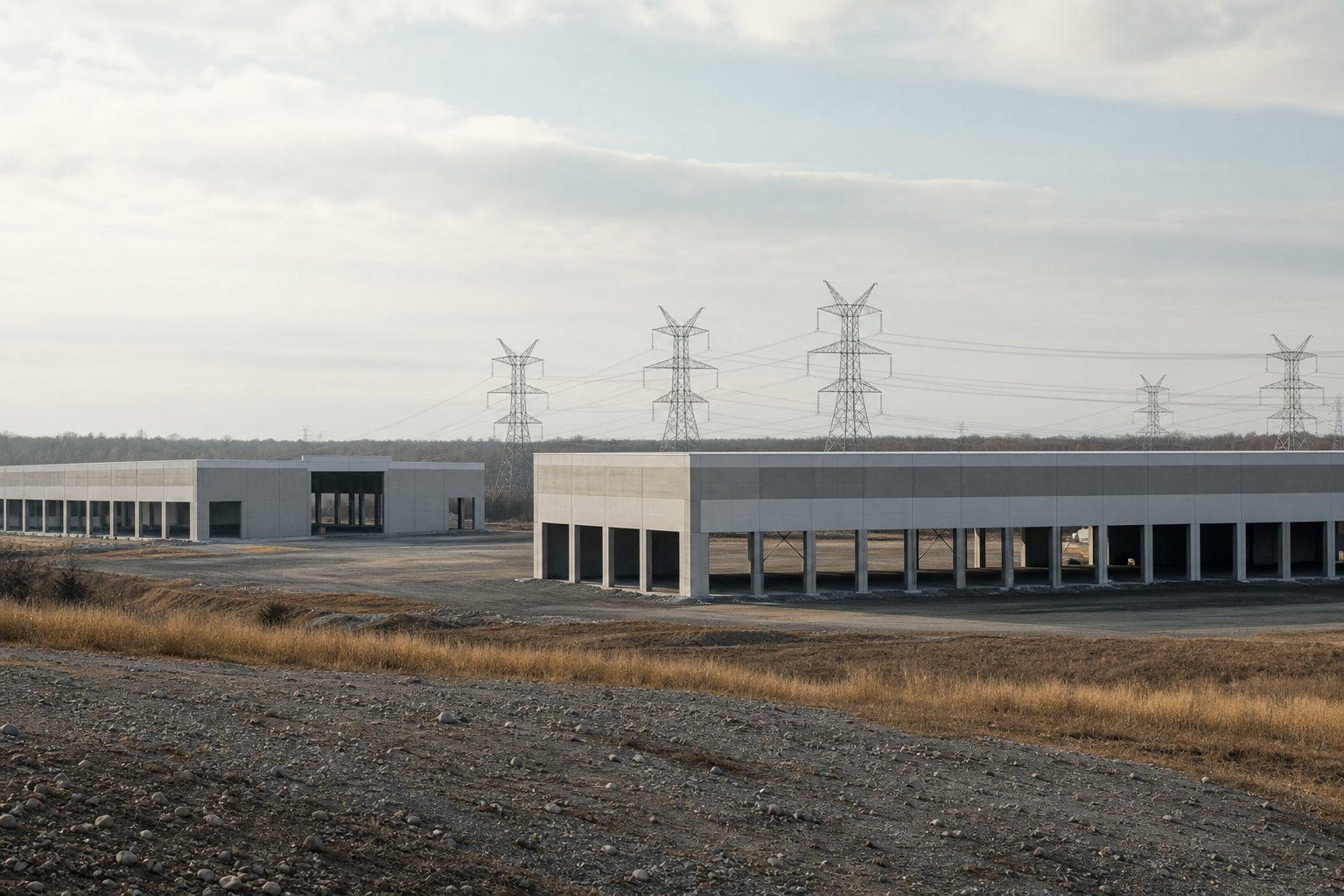
Sixty million dollars for two second-generation industrial buildings in a rural North Carolina county is not an industrial price. It is a power price. At a floor of 60 megawatts and a path toward 200 megawatts, the buyer is underwriting utility capacity and paying for the real estate as the wrapper it happens to arrive in.
This is the clearest expression yet of a repricing that has been building quietly. Grid interconnection queues in most US markets now run years. A site with existing service, adequate substation capacity and a utility willing to talk carries value that has no relationship to warehouse fundamentals, no relationship to clear height, dock doors, trailer parking or proximity to a freight corridor.
The retrofit-first framing is the strategic core. Greenfield data center development means land, entitlement, construction and an interconnection request that may date from before the shovel. Buying an existing shell with power already delivered collapses the timeline. The stated path from a fourth-quarter 2026 close to third-quarter 2027 ready-for-service is roughly nine months, a schedule greenfield cannot approach.
The 55-mile distance from the existing NC-1 campus matters operationally. Close enough for shared staffing, spares and regional utility relationships, far enough for separate substation feeds and genuine failure-domain separation.
North Carolina's Piedmont is not a legacy data center market. That is precisely the point. Power availability is relocating digital infrastructure demand into counties that have never underwritten it.
Implications: For industrial owners, there is now a buyer pool for functionally obsolete boxes that prices on utility service rather than logistics utility, and any disposition of a well-powered asset that does not solicit it is leaving money on the table. For industrial buyers, competing for the same shells at logistics cap rates against a power bid is a losing trade, so check the substation before bidding. For developers, site selection has inverted: secure power first, then find a building. For lenders, collateral value tied to an interconnect is a genuinely new risk profile, and the non-binding letters of intent mean tenancy is not yet contractual.
Related coverage
Key Takeaways
- When a shell trades on megawatts instead of square feet, the substation has become the most valuable improvement on the site.
- The purchase prices utility capacity, not warehouse fundamentals
- Existing power collapses the development timeline to roughly nine months from close to service
- Well-powered second-generation industrial shells now attract a bid unrelated to logistics utility
- Site selection has inverted: secure power first, then find a building
- Collateral value tied to an interconnect is a new risk profile, and tenancy here is not yet contractual
PR Newswire - WhiteFiber Expands North Carolina Data Center Footprint with Agreement to Acquire Two New Development Sites, August 17 2026
Never miss a Signal
Get the daily brief that busy CRE professionals rely on.