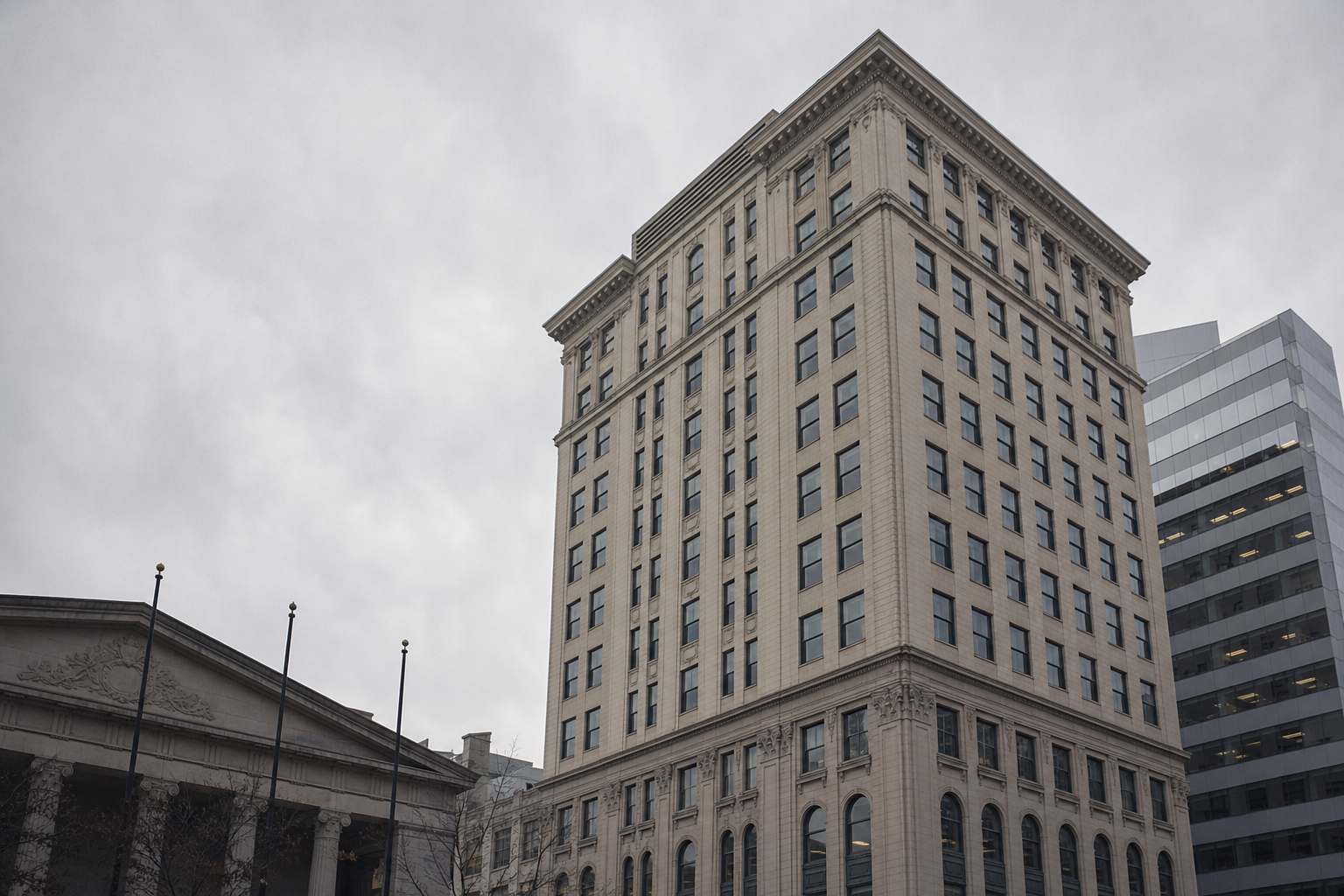
Montclif and FCP acquired Hamilton Square at 600 14th Street NW in Washington, D.C., for $126 million from CommonWealth Partners. The building is 278,000 square feet and 100% leased; tenants include IBM, GE and the National Trust for Historic Preservation. CommonWealth Partners paid $198 million — approximately $712 per square foot — in 2012.
The deal was financed with an $84.6 million loan from Athene Annuity and Life Co., an Apollo Global Management subsidiary. The building was completed in 1929 by Starrett & Van Vleck as the Garfinckel's department store flagship and is listed on the National Register of Historic Places. Montclif was founded in April 2026 by a former FCP partner and a Carr Properties and MRP Realty veteran.
Derived: $453.24 per square foot — a 36.4% nominal discount to the 2012 basis, before any inflation adjustment. Debt is 67.1% of purchase price. The equity check is $41.4 million, or $148.92 per square foot.
Strip out the usual office-distress explanations and none apply. There is no lease-up risk, no anchor rolling, no disclosed deferred capital event. A 100%-leased historic asset in the D.C. core, with investment-grade names in the stack, cleared at barely more than half its 2012 price.
What repriced was not the building. It was the cost of capital and the exit assumption. In 2012 a buyer could underwrite terminal cap rate compression and cheap refinancing. In 2026 neither is available, so the same cash flows support a materially smaller number.
The debt tells the rest. Leverage of 67.1% on a fully leased core office asset, from an insurance-company balance sheet rather than a bank or the CMBS market, is the current shape of office lending. Insurance capital is taking the low-risk office paper banks have vacated, at conservative-but-not-punitive proceeds.
The buyer profile matters as much as the price. A firm formed five months ago just bought a landmark for $126 million. That is what a repriced market does — it hands trophy assets to new entrants with clean balance sheets and no legacy basis to defend, alongside an established partner supplying credibility.
Implications. For owners holding 2012-vintage core office basis, this is the mark: a fully leased, well-located, historically significant asset is worth roughly 64 cents on the 2012 dollar. Anyone modeling a hold-to-recovery thesis should test it against that number rather than against appraisal. For buyers, the opportunity is precisely here — occupied, financeable, boring office at a basis where the going-in yield does the work and no lease-up execution is required. For lenders, note who wrote the loan.
Related coverage
Key Takeaways
- Full occupancy no longer protects office basis — it just makes the discount financeable
- A fully leased core D.C. asset is worth roughly 64 cents on the 2012 dollar; test hold-to-recovery theses against that number, not against appraisal
- Insurance balance sheets are now writing the low-risk office paper banks vacated
Bisnow Washington D.C., "Real Estate Firm Debuts With $126M Purchase Of Historic D.C. Building", Sept 2026 — https://www.bisnow.com/news/washington-dc/office/hamilton-square-sale-montclif-fcp-commonwealth-partners · Capdex, "Montclif and FCP Acquire Hamilton Square in Downtown Washington, D.C. for $126 Million" — https://capdex.com/news/montclif-and-fcp-acquire-hamilton-square-in-downtown · CommonWealth Partners property record, Hamilton Square — https://www.commonwealth-partners.com/properties/hamilton-square/
Never miss a Signal
Get the daily brief that busy CRE professionals rely on.