

🚨Key Highlights
Manhattan Q3 CRE sales reached $4.9 B, up +54% YoY and nearly 3× Q2.
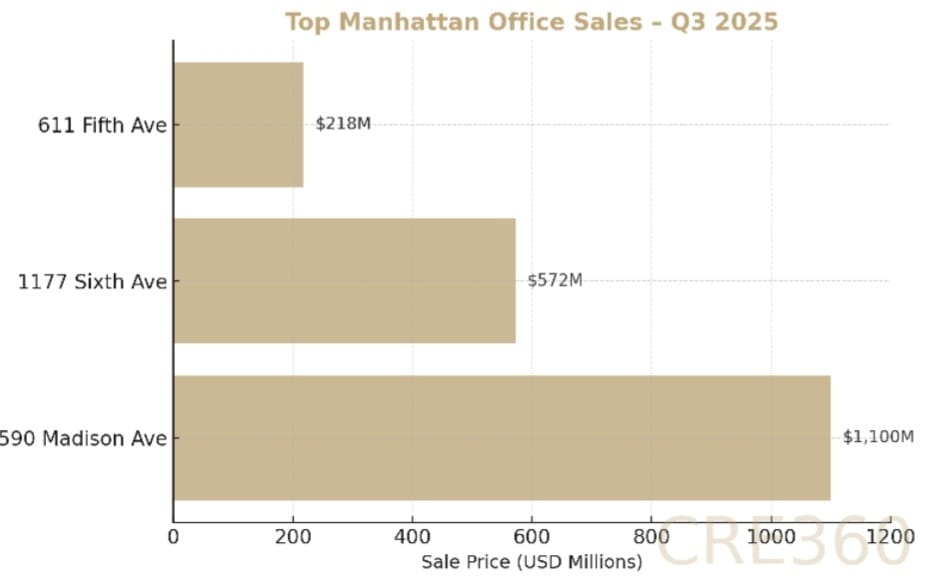
Two major office deals—590 Madison ($1.1 B) and 1177 Sixth ($572 M)—accounted for half of total volume.
Foreign capital inflows into U.S. offices surged 6× to $877 M, concentrated in NYC and San Francisco.
Class B/C office pricing has reset −57% from pre-pandemic levels, prompting opportunistic buying.
Institutional multifamily returns held +1.44% QoQ, signaling durable income even as rent growth flattens.
signal
After two years of retreat, Manhattan’s capital pulse has returned. Q3’s $4.9 B in commercial transactions—its busiest since early 2022—underscores that investors now see price discovery, not decline. As the Fed’s 150 bps of easing filters through debt markets, spreads are compressing just enough to unfreeze underwriting. “It finally pencils again,” said one Midtown debt broker. The pace of recovery remains uneven, but conviction capital is back where liquidity counts most: prime New York real estate.
Supply shock, not demand bust
U.S. multifamily delivered ~608k units in 2024, the most since 1986, and 2025 remains heavy. Inventory growth is concentrated in Class A and Sunbelt submarkets, where lease-ups face the fiercest competition. Meanwhile, household formation has cooled alongside a softer labor tape. As a result, absorption is positive but insufficient to clear the pipeline. In turn, operators are leaning on targeted concessions rather than deeper face-rent cuts to hold street rents.
Foreign and Opportunistic Capital
Cross-border inflows have accelerated sharply. Foreign investment in U.S. office assets rose sixfold to $877 M last quarter, targeting discounted trophy buildings in Manhattan and San Francisco. Buyers such as Vornado’s $218 M purchase of 611 Fifth Ave show a new hybrid logic: buy core addresses, but pivot their use. Plans to convert upper floors to residential illustrate how global capital is now underwriting flexibility as a value driver. Still, only assets with strong physical and locational moats are clearing.
The Value Reset
Older Midtown towers tell the other side of the story. Recent Class B/C trades have closed at ≈57% below pre-COVID valuations. Landlords facing expiring debt or energy-code upgrades are capitulating to cash buyers. Meanwhile, the city’s political turn toward tenant-friendly policies—after a progressive mayoral win—has made some developers more cautious on office-to-residential pipelines. Nonetheless, discounted pricing is attracting new entrants who view stabilized basis as its own form of upside. In practice, obsolescence is now an investable condition.
Multifamily Steadiness
Amid office volatility, multifamily returns remain strikingly stable. Q3’s institutional apartment performance of +1.44% kept total 2025 returns positive despite higher insurance and tax loads. Rent growth has flattened, but occupancy near 97% provides dependable income. New expense-cap legislation may further preserve yields. For long-horizon capital—pensions, insurers, and core funds—NYC apartments still read as scarcity assets in an inflation-hedged portfolio. On balance, multifamily steadiness is giving lenders confidence to re-engage across other asset types.

With Treasury yields below 4% and risk spreads tightening, Manhattan’s repricing phase is turning into a reallocation phase. Expect more institutional bids in Q4 as refinancing pipelines unclog and syndication risk eases. However, debt selectivity will persist: only stabilized or convertible assets will price efficiently. Watch for sovereign and REIT capital to expand joint-venture structures rather than outright buys, protecting downside while retaining upside to recovery. For now, liquidity is cautious, but it’s liquid again—and that marks a cycle shift.
Capital discipline—not optimism—is now New York’s competitive edge.

Bisnow — Manhattan Q3 CRE Sales Surge. CRE Daily — Foreign Capital Re-enters U.S. Office Market.

Never miss a Signal
Get the daily brief that busy CRE professionals rely on.