📢Good morning, today’s Signals are brought to you by CRE 360 Signal™.
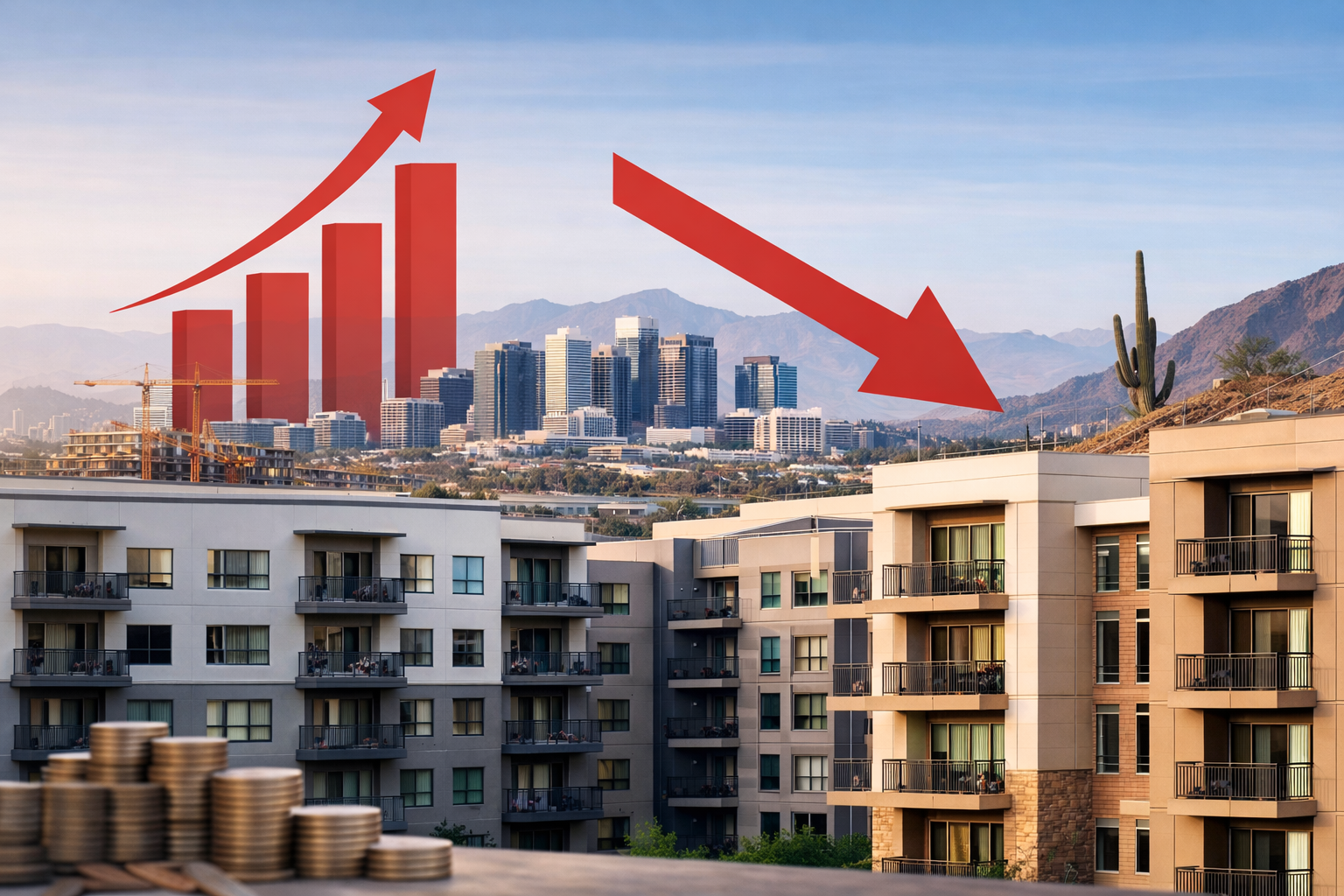
Phoenix’s multifamily sector has entered a temporary oversupply phase driven by record construction deliveries during the past two years. Vacancy has climbed to roughly 12.5%, while rents have declined approximately 2–3% year-over-year, reflecting a supply wave that has temporarily outpaced tenant demand. Despite this imbalance, leasing activity remains strong, with tens of thousands of units absorbed annually, demonstrating that demand has not collapsed—it is simply being overwhelmed by the pace of new completions.
🎧 Busy to read? Catch the Daily Podcast (Subscribe on YouTube, Apple, Spotify)➤ SIGNAL
Supply Expansion Meets Strong but Insufficient Demand
The Phoenix metropolitan area has been one of the fastest-growing multifamily development markets in the United States since the pandemic, fueled by rapid population growth, corporate relocation, and migration from higher-cost states. Developers responded aggressively to this demand surge, resulting in one of the most active apartment construction pipelines in the country.
That development wave is now reaching completion. Over the past year, thousands of new units have been delivered across major submarkets such as Downtown Phoenix, Tempe, and the West Valley. While leasing activity has remained healthy, the pace of new supply has temporarily exceeded absorption levels. As a result, vacancy has increased across the metro area and rents have softened modestly.
Colliers’ market research shows that effective rents in the Phoenix market declined roughly 2–3% year-over-year, reflecting increased competition among landlords as newly delivered properties compete for tenants. Many properties are also offering concessions to maintain occupancy while protecting headline rental rates.
Importantly, the demand side of the market remains resilient. Leasing activity has remained strong despite the surge in deliveries, and occupancy across stabilized properties remains above 93%, indicating that the fundamental renter base in the region remains robust.
Phoenix Is Experiencing a Construction Cycle, Not a Demand Collapse
The most important takeaway from the current data is that Phoenix’s multifamily sector is not weakening due to declining demand. Instead, it is undergoing the late stage of a construction cycle.
During the low-interest-rate environment of 2020–2022, developers initiated a significant number of apartment projects across the metro area. Because multifamily developments typically take 18–30 months to deliver, these projects are now completing simultaneously, creating a temporary surge in supply.
In practical terms, the market is currently experiencing the “supply crest” phase of the development cycle. Deliveries are peaking while construction starts have already slowed dramatically due to higher financing costs and more cautious underwriting.
Key Takeaway
The pipeline data suggests the oversupply will not persist indefinitely. Developers have already pulled back on new starts due to rising construction costs, elevated interest rates, and weaker rent growth projections.
Colliers notes that projects currently under construction will continue delivering through 2026, meaning elevated vacancy and modest rent pressure could persist over the next 18–24 months.
However, once this wave of deliveries passes, the market should begin tightening again. Several forecasts indicate that as the pipeline contracts and population growth continues, Phoenix could return to positive rent growth around late-2026 or 2027.
CRE 360 Signal™ — Commercial Real Estate Intelligence
▼ EDITORIAL DESK TOP PICKS
Small-town commercial property prices outperform big cities — Secondary-market CRE prices rose 1.3% in January, while major-city assets remain 17% below their 2022 peak, highlighting a widening market divergence.
Self-storage REITs rebound strongly in early 2026 — The sector is up 17% year-to-date, outperforming broader REIT indices as supply growth slows.
Industrial real estate value increasingly tied to power capacity — Electrical infrastructure is becoming as important as location and size as automated warehouses and data centers drive demand.
Kansas City CRE deal activity gaining momentum into 2026 — Improved liquidity and easing rate volatility are boosting transactions across multiple property sectors.
Commercial real estate deals picking up despite AI disruption concerns — Major brokerage CEOs report strong earnings while acknowledging growing questions about AI’s impact on real estate services.
San Francisco’s Transamerica Pyramid put up for sale again — Financial pressures and weak office demand are forcing another ownership shift for the iconic tower.
“Great Office Reinvention” summit highlights office transformation strategies — Industry leaders are meeting March 4 to discuss how the sector must adapt to new tenant expectations.
Office conversions continue reshaping Manhattan skyline — Large office towers are increasingly being converted into housing as office demand struggles to fully recover.
Houston pipeline adds millions of square feet of mixed-use and retail projects — New developments across the metro area represent billions in investment and reshape the regional CRE landscape.
Large mixed-use districts continue expanding in tech-driven cities — Projects combining office, residential, and retail are emerging as the dominant development model.
FRP Holdings to release Q4 earnings on March 4 — The real estate investment firm is expected to provide updates on development and leasing performance.
ACRES Commercial Realty to report quarterly results — The CRE lender will announce Q4 earnings and outlook amid shifting debt markets.
Janus International to report full-year 2025 results — The building products firm tied to self-storage development will release results this week.
AI fears ripple into real estate and logistics stocks — Investors are re-evaluating sectors vulnerable to automation and digital disruption.
CRE legal outlook warns high interest rates still complicate deals — Even with stronger fundamentals, capital costs and volatility continue to challenge development and acquisitions.

Get Phoenix Multifamily Market Hits the Supply Crest in your inbox
Record deliveries push vacancy higher as Phoenix apartments absorb demand but struggle to keep pace with new supply.