📢 CRE 360 Signal™.
Flexspace continues to attract landlord interest due to its revenue potential, but many investments are being mispriced at the underwriting stage. Unrealistic assumptions around occupancy ramp-up, ancillary revenue, and tenant retention are creating a disconnect between projected and actual performance, positioning execution—not demand—as the primary risk factor.
🎧 Busy to read? Catch the Daily Podcast (Subscribe on YouTube, Apple, Spotify)➤ SIGNALS
Lease-Up Reality
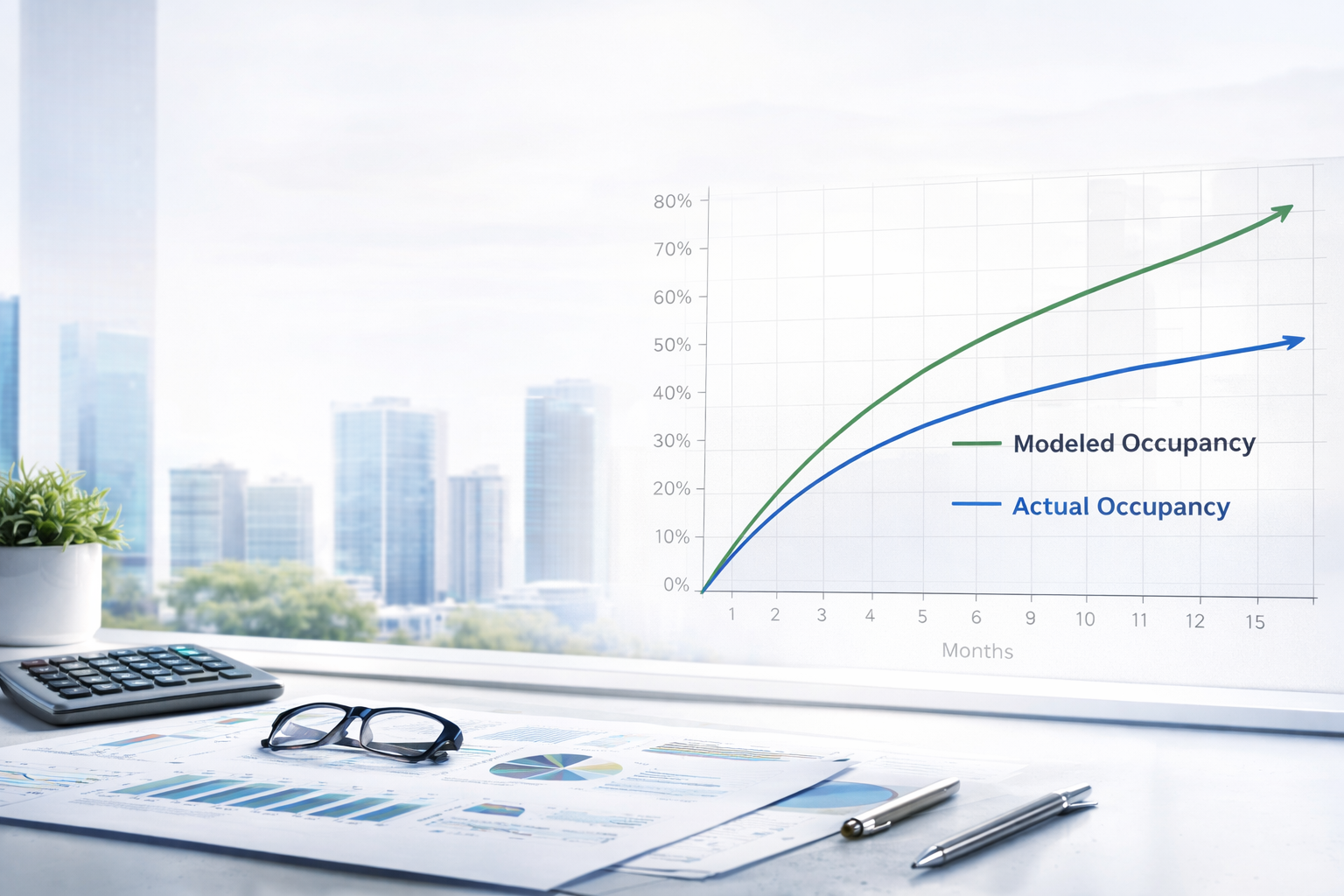
A key issue in flexspace underwriting is the miscalculation of occupancy ramp-up. While many feasibility models assume rapid lease-up, actual performance follows a much slower trajectory.
New flexible workspaces typically launch at approximately 20% occupancy and require 12 to 15 months to stabilize near 85%. When this ramp-up period is underestimated, early-stage revenue projections become inflated, creating pressure on cash flow during the most critical phase of the investment.
This mismatch is not a marginal error—it directly impacts capital planning, return timing, and overall deal viability.
Revenue Assumptions
Beyond occupancy, revenue projections are often distorted by unrealistic expectations around workspace configuration and ancillary income.
Private offices remain the primary driver of income, with an effective mix of roughly 85% private offices and 15% desks. However, many models fail to properly account for this balance, leading to unstable revenue projections.
Meeting and event spaces are another common source of overestimation. While underwriting assumptions frequently project high utilization, actual usage tends to average closer to 25%. Operational constraints—such as downtime, tenant access, and fluctuating demand—limit the ability to fully monetize these spaces.
As a result, projected revenue often exceeds what the asset can realistically produce.
Retention Drives Performance
Long-term performance in flexspace is less dependent on initial leasing and more dependent on tenant retention.
Early occupancy is often achieved through incentives and discounted pricing, but sustaining that occupancy requires consistent tenant experience. When retention is unstable, occupancy levels fluctuate, undermining the predictability of income and weakening overall returns.
Operational fundamentals—not lifestyle amenities—are the primary drivers of retention. Reliable infrastructure, seamless booking systems, and ease of use consistently outperform non-essential features in maintaining tenant stability.
This shifts flexspace from a leasing-driven model to an execution-driven one.
Key Takeaways
Flexspace models frequently underestimate lease-up timelines and early occupancy levels
Stabilization typically takes 12–15 months, starting from ~20% occupancy
Meeting room utilization averages around 25%, below common projections
Tenant retention is the primary driver of long-term performance
Revenue stability depends on workspace mix and operational execution
Underwriting accuracy is critical to achieving projected returns
CRE 360 Signal™ — Commercial Real Estate Intelligence
▼ EDITORIAL DESK TOP PICKS
Capital Markets / Debt / Macro
“Lenders tighten terms as office loan stress deepens” — Banks are requiring fresh equity and rejecting extensions on underperforming office assets.
“CRE CLO issuance picks up as credit markets reopen” — Structured debt is returning as a key financing tool for transitional assets.
“Private credit funds step in as banks pull back from CRE lending” — Alternative lenders are filling the gap in higher-risk deals.
“CMBS delinquency rate rises again in Q1 2026” — Office loans continue to drive distress across securitized debt markets.
“Insurance costs are becoming a deal-breaker in CRE underwriting” — Rising premiums are materially impacting feasibility across multiple asset classes.
Transactions / Deals
“Blackstone sells $1B industrial portfolio to institutional buyer” — Large-scale logistics trades continue as institutional capital rotates into stabilized assets.
“Chicago office tower trades at deep discount to prior valuation” — A major Loop asset sold for less than half of its previous peak price.
“Houston multifamily portfolio changes hands for $300M” — Strong Sun Belt demand continues to support apartment transactions.
“Retail center in Florida sells amid strong tenant demand” — Grocery-anchored assets remain one of the most liquid retail product types.
“Life science campus secures refinancing amid strong leasing” — Lenders continue to favor specialized asset classes with stable tenant bases.
Office / Leasing
“Office leasing rebounds slightly in select gateway markets” — Trophy assets are outperforming while commodity office continues to struggle.
“Sublease space declines as companies stabilize footprints” — Availability is tightening in some metros as tenants commit to long-term space decisions.
“Office-to-residential conversions accelerate in major cities” — Cities are pushing adaptive reuse as a solution to vacancy and housing shortages.
Industrial / Logistics
“Industrial demand stabilizes after record expansion cycle” — Leasing volume is normalizing as new supply enters the market.
Multifamily
“Apartment supply wave peaks, pushing vacancy higher” — New deliveries are temporarily softening rent growth in major metros.
“Institutional investors doubling down on workforce housing” — Demand fundamentals are driving long-term capital into affordable segments.
Retail
“Retail vacancy remains near historic lows despite economic uncertainty” — Limited new construction continues to support occupancy levels.
Development / Construction
“Construction costs flatten as supply chain pressures ease” — Developers are seeing more predictable pricing for materials and labor.
Technology / Market Direction
“AI adoption transforming CRE underwriting and asset management” — Firms are integrating predictive analytics to improve deal evaluation and operations.

Related coverage
Get Flexspace Growth Masks Structural Gaps in Underwriting Models in your inbox
Optimistic lease-up assumptions and weak retention modeling are distorting real returns across the flexspace sector.