📢 CRE 360 Signal™.
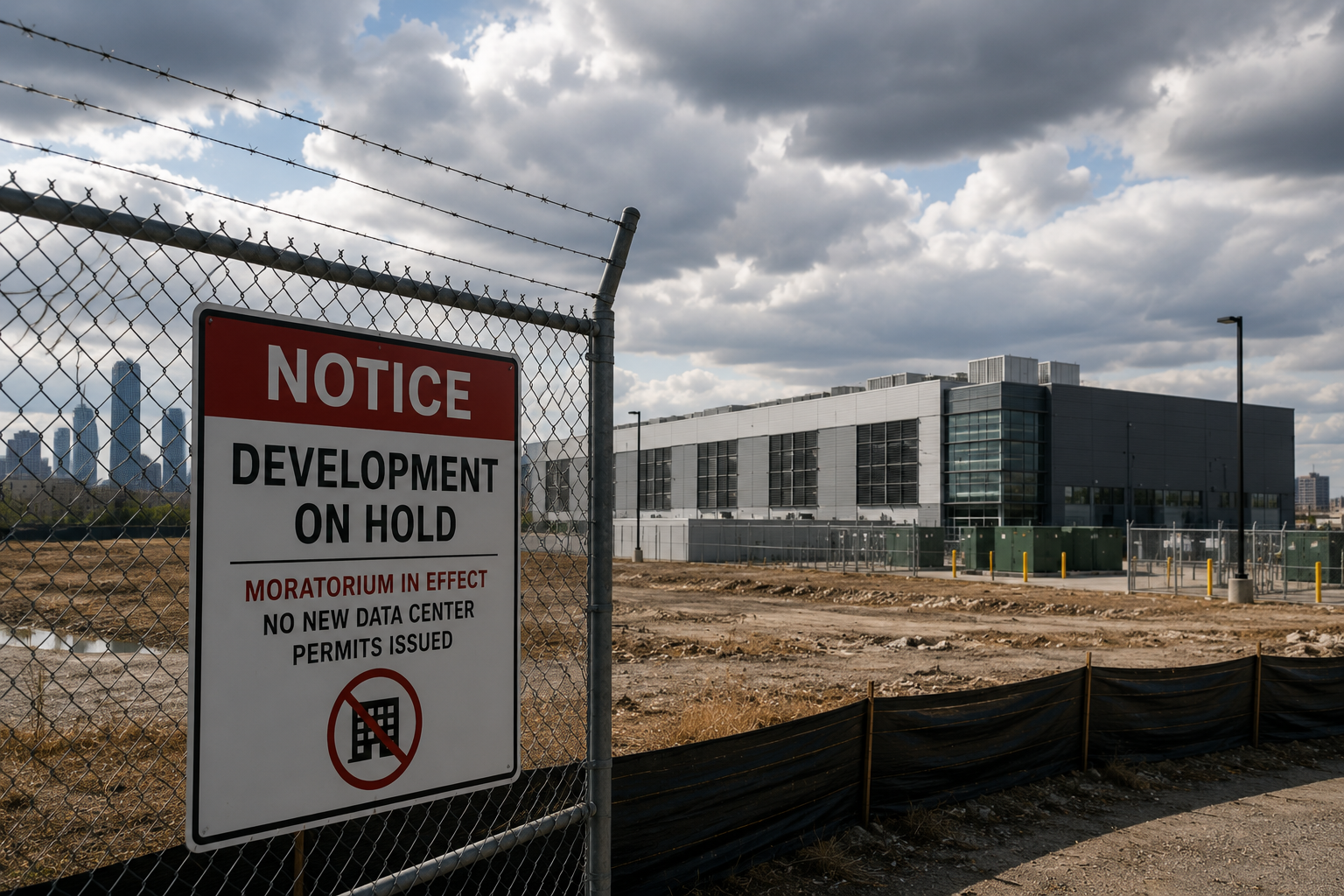
Between May 18 and May 21, Denver, Seattle, Minneapolis, and Maine municipalities advanced binding restrictions on new data center development — a coordination of pace, if not of politics. Bankable inventory just got rarer.
🎧 Catch the Wekkly Podcast (Subscribe on YouTube, Apple, Spotify)➤ SIGNALS
Five days. Four jurisdictions. One direction.
Denver City Council voted unanimously on May 18 for a one-year moratorium on new data-center development, freezing zoning permits and site plans while the city writes rules on energy, water, noise, and siting. CoreSite's DE3 facility, already under construction in Elyria-Swansea, is grandfathered. The two follow-on buildings on the same campus are not. Mayor Mike Johnston is publicly behind the pause.
The same day, Rep. Nancy Mace called for a one-year statewide moratorium in South Carolina, citing energy demand and cost-shifting onto households. Two days later, Seattle's Land Use and Sustainability Committee opened emergency moratorium legislation on "large-load" facilities at or above 10 megawatts, co-developed with Mayor Katie Wilson. A day after that, Minneapolis Council passed an 8–5 six-month moratorium, with a narrow downtown carve-out under 350,000 square feet to preserve a downtown-revitalization path. In Maine, Sanford instituted a 91-day pause and Brunswick and Westbrook advanced their own ordinances after the governor vetoed a statewide bill in April.
This activity sits on top of 14 state-level moratorium bills already pending in 11 states, plus a three-year proposal in Albany. What's different about this week is the binding nature and the breadth. Denver, Seattle, and Minneapolis are not politically interchangeable cities, and they did not coordinate. They responded to the same underlying tension — power, water, and tax-base economics that increasingly don't pencil for residents the way the developer pro forma assumes.
Hyperscaler tenants and their development partners should be accelerating site control in the unrestricted corridors — Northern Virginia, Phoenix, Atlanta, Dallas, Columbus, parts of Iowa and the Carolinas — and re-pricing land options in moratorium-exposed metros toward the optionality value of "if it ever clears."
Allocators in data-center funds should ask sponsors a question that didn't exist 90 days ago: what percentage of your pipeline sits in a jurisdiction that has either adopted or seriously debated a moratorium in the last six months? That number is now an underwriting input — it tracks delivery risk, lease-up timing, and exit liquidity simultaneously.
Construction lenders should expect to see force-majeure and entitlement-failure language tighten on data-center construction loans this quarter. The moratorium wave is now broad enough that "what if the city changes the rules mid-build" is a legitimate credit question, not a hypothetical.
Key Takeaways
Power is the constraint everyone has been talking about. Politics is the constraint that just hardened in a week.
CRE 360 Signal™ — Commercial Real Estate Intelligence
▼ EDITORIAL DESK TOP PICKS
Capital Markets / Debt / Refinancing
Korea Post expands into AI data centers and overseas real estate — Korea Post plans to raise alternative investments to 20% of assets, targeting AI infrastructure and global CRE.
UK CRE lending hits highest level in a decade — New commercial real estate lending volume in the UK surged, intensifying refinancing competition among lenders.
AvalonBay–Equity deal signals changing multifamily credit conditions — GlobeSt says large public apartment REIT consolidation reflects shifting financing dynamics and investor expectations.
Commercial mortgage lending reaches five-year high — CBRE’s Lending Momentum Index climbed to its strongest level since 2021 as multifamily and non-agency lending accelerated.
Kayne Anderson closes $5.12B opportunistic real estate fund — The oversubscribed raise suggests institutional capital is preparing for aggressive CRE deployment.
Office / Leasing / Conversions
AI-driven workforce shifts are reshaping office demand — New office demand is increasingly concentrated in premium assets and AI-linked tenant clusters.
Milwaukee office-to-apartment conversion lands $114M financing — A former office tower secured HUD-backed financing for one of Wisconsin’s largest conversion projects.
San Jose office conversion secures $74.1M financing package — The former Bank of Italy office redevelopment highlights growing lender support for adaptive reuse.
Metro Boston healthcare property trades for $32.1M — Investors continue targeting medical office and healthcare assets as defensive CRE plays.
Los Angeles value-add apartment asset sells for $10M — South Park multifamily demand continues attracting private investors despite broader market volatility.
Retail / Mixed-Use / Consumer Demand
San Antonio lifestyle center acquired by Rio Capital and Triangle Capital — The Legacy retail and mixed-use center sale reflects renewed liquidity for open-air retail assets.
JLL brokers sale of premier San Antonio shopping center — Institutional buyers continue favoring stabilized lifestyle retail properties in high-growth Sun Belt markets.
ICSC 2026 shows retail rebound driven by experiential and lifestyle formats — Retail recovery is increasingly tied to entertainment, dining, and mixed-use experiences.
San Diego retail building refinanced with $24M loan — Life-company lenders remain active in urban retail refinancing for stabilized assets.
Open-air retail continues attracting institutional capital — ICSC reports grocery-anchored and open-air retail assets remain among the strongest-performing property types.
Industrial / Logistics / Data Centers
EdgeConneX announces €3B Italy data-center expansion — The company plans multiple Lombardy campuses totaling more than 300 MW of future AI infrastructure capacity.
Data-center backlash intensifies across U.S. municipalities — Moratoriums, power concerns, and ratepayer pushback are increasingly slowing hyperscale approvals.
AI could add 330M square feet of CRE demand over the next decade — Cushman & Wakefield says AI adoption will reshape demand across office, industrial, and infrastructure assets.
Apartment construction surge offsets decline in single-family starts — Multifamily starts remain resilient as rental housing demand continues supporting development pipelines.
Tejon Ranch reports positive commercial real estate EBITDA in Q1 — The California land and mixed-use developer reported ongoing momentum across its CRE portfolio.

Related coverage
Get The Map for Data Centers Just Got Smaller. in your inbox
Three city councils and a congresswoman moved against new builds in five days.