📢 CRE 360 Signal™.
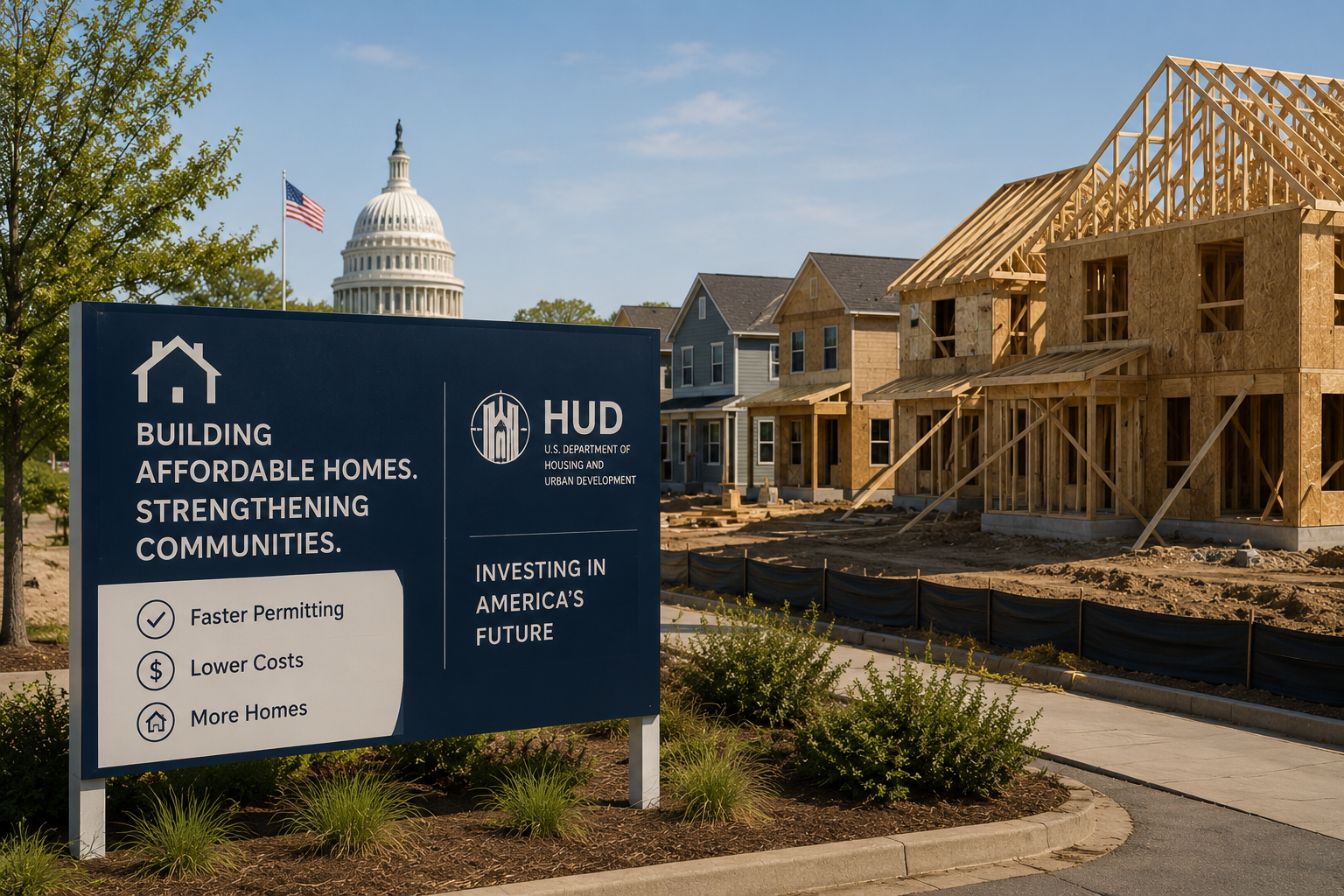
On May 20, HUD released a state-and-local "best practices" report operationalizing the March 13 executive order on housing construction barriers. The document itself is non-binding. The leverage behind it isn't.
🎧 Catch the Wekkly Podcast (Subscribe on YouTube, Apple, Spotify)➤ SIGNALS
Secretary Scott Turner published the State and Local Best Practices for Home Construction Report on May 20 — the operational follow-through to Executive Order 14394, signed two months earlier. The document reads like guidance: faster permitting, fee caps, code relaxation, manufactured-housing acceptance. The mechanism behind it is not guidance. HUD has signaled it intends to make federal grant awards contingent on state and local adoption of these practices.
The numbers HUD attaches to the problem set a marker for the argument. The agency asserts regulatory costs add more than $100,000 to the final price of a new single-family home, and green-energy mandates in some jurisdictions add up to $30,000 to construction cost. The 2025 deregulation effort, HUD claims, is on track to save Americans $212 billion collectively. NAHB endorsed the report the same day — calling it "a practical framework for removing unnecessary regulations that drive up housing costs" — locking the homebuilder lobby into the federal posture.
What changed on May 20 isn't the rhetoric. It's the funnel. Until now, federal pressure on local zoning has been moral suasion at best, congressional gridlock at worst. Tying CDBG, HOME, and adjacent housing funds to compliance posture converts a policy preference into a fiscal cost. A municipality that keeps a slow permitting regime is no longer just choosing slower delivery — it's choosing to leave federal money on the table.
Allocators with for-sale or build-to-rent pipelines should re-rank their target MSAs by likely compliance posture, not just demographic tailwind. A jurisdiction that adopts the HUD framework in 2026 may produce a 6–12 month entitlement compression that flows directly into IRR. One that doesn't, and loses federal funding as a result, will see the funding gap show up in infrastructure capacity — which shows up next in your offsite cost.
Developers should treat this as a planning-cycle input, not a press release. The grant-conditioning mechanism doesn't need new legislation. Identify the federal funding streams your target jurisdictions actually depend on, and build a compliance-posture map. The arbitrage is between municipalities that move first and those that wait to see if HUD is bluffing.
Lenders financing residential construction should be aware that local entitlement risk now has a federal-funding overlay. A jurisdiction's regulatory posture has become a soft credit factor on construction timelines — particularly in mid-tier MSAs where federal grants meaningfully fund the infrastructure that supports new subdivisions.
Key Takeaways
Washington has stopped asking cities to permit faster and started conditioning the check. The map that matters for residential CRE in 2026 isn't where demand is — it's where compliance is.
CRE 360 Signal™ — Commercial Real Estate Intelligence
▼ EDITORIAL DESK TOP PICKS
Capital Markets / Debt / Refinancing
Korea Post expands into AI data centers and overseas real estate — Korea Post plans to raise alternative investments to 20% of assets, targeting AI infrastructure and global CRE.
UK CRE lending hits highest level in a decade — New commercial real estate lending volume in the UK surged, intensifying refinancing competition among lenders.
AvalonBay–Equity deal signals changing multifamily credit conditions — GlobeSt says large public apartment REIT consolidation reflects shifting financing dynamics and investor expectations.
Commercial mortgage lending reaches five-year high — CBRE’s Lending Momentum Index climbed to its strongest level since 2021 as multifamily and non-agency lending accelerated.
Kayne Anderson closes $5.12B opportunistic real estate fund — The oversubscribed raise suggests institutional capital is preparing for aggressive CRE deployment.
Office / Leasing / Conversions
AI-driven workforce shifts are reshaping office demand — New office demand is increasingly concentrated in premium assets and AI-linked tenant clusters.
Milwaukee office-to-apartment conversion lands $114M financing — A former office tower secured HUD-backed financing for one of Wisconsin’s largest conversion projects.
San Jose office conversion secures $74.1M financing package — The former Bank of Italy office redevelopment highlights growing lender support for adaptive reuse.
Metro Boston healthcare property trades for $32.1M — Investors continue targeting medical office and healthcare assets as defensive CRE plays.
Los Angeles value-add apartment asset sells for $10M — South Park multifamily demand continues attracting private investors despite broader market volatility.
Retail / Mixed-Use / Consumer Demand
San Antonio lifestyle center acquired by Rio Capital and Triangle Capital — The Legacy retail and mixed-use center sale reflects renewed liquidity for open-air retail assets.
JLL brokers sale of premier San Antonio shopping center — Institutional buyers continue favoring stabilized lifestyle retail properties in high-growth Sun Belt markets.
ICSC 2026 shows retail rebound driven by experiential and lifestyle formats — Retail recovery is increasingly tied to entertainment, dining, and mixed-use experiences.
San Diego retail building refinanced with $24M loan — Life-company lenders remain active in urban retail refinancing for stabilized assets.
Open-air retail continues attracting institutional capital — ICSC reports grocery-anchored and open-air retail assets remain among the strongest-performing property types.
Industrial / Logistics / Data Centers
EdgeConneX announces €3B Italy data-center expansion — The company plans multiple Lombardy campuses totaling more than 300 MW of future AI infrastructure capacity.
Data-center backlash intensifies across U.S. municipalities — Moratoriums, power concerns, and ratepayer pushback are increasingly slowing hyperscale approvals.
AI could add 330M square feet of CRE demand over the next decade — Cushman & Wakefield says AI adoption will reshape demand across office, industrial, and infrastructure assets.
Apartment construction surge offsets decline in single-family starts — Multifamily starts remain resilient as rental housing demand continues supporting development pipelines.
Tejon Ranch reports positive commercial real estate EBITDA in Q1 — The California land and mixed-use developer reported ongoing momentum across its CRE portfolio.

Related coverage
Get Build Where Washington Says. Or Lose the Money. in your inbox
HUD just turned its grant book into a permit-reform enforcement mechanism.