
➤ SIGNAL
A 10-year, five-fund Harrison Street assembly traded as a single operating platform.
The buyer is pairing an operator (Scion) with institutional equity (Ares) — operations, not financial engineering, is the thesis.
Per-bed pricing, not cap rate, is the unit of value here.
Student housing has quietly become a core institutional food group. Demand is enrollment-driven and counter-cyclical: families prioritize flagship public and brand-name private universities regardless of the macro cycle. Supply is hard to add near campus, where land is scarce and entitlement is slow.
What Scion and Ares bought is scale in operations. At 105,000-plus beds, leasing velocity, renewal management, and parent-guaranty underwriting become a repeatable system rather than a property-by-property exercise. That operational moat is the asset.
The structure matters. An operator-plus-allocator JV lets institutional capital access a management-intensive sector without building the platform itself. Expect more of these pairings as large allocators chase needs-based housing.
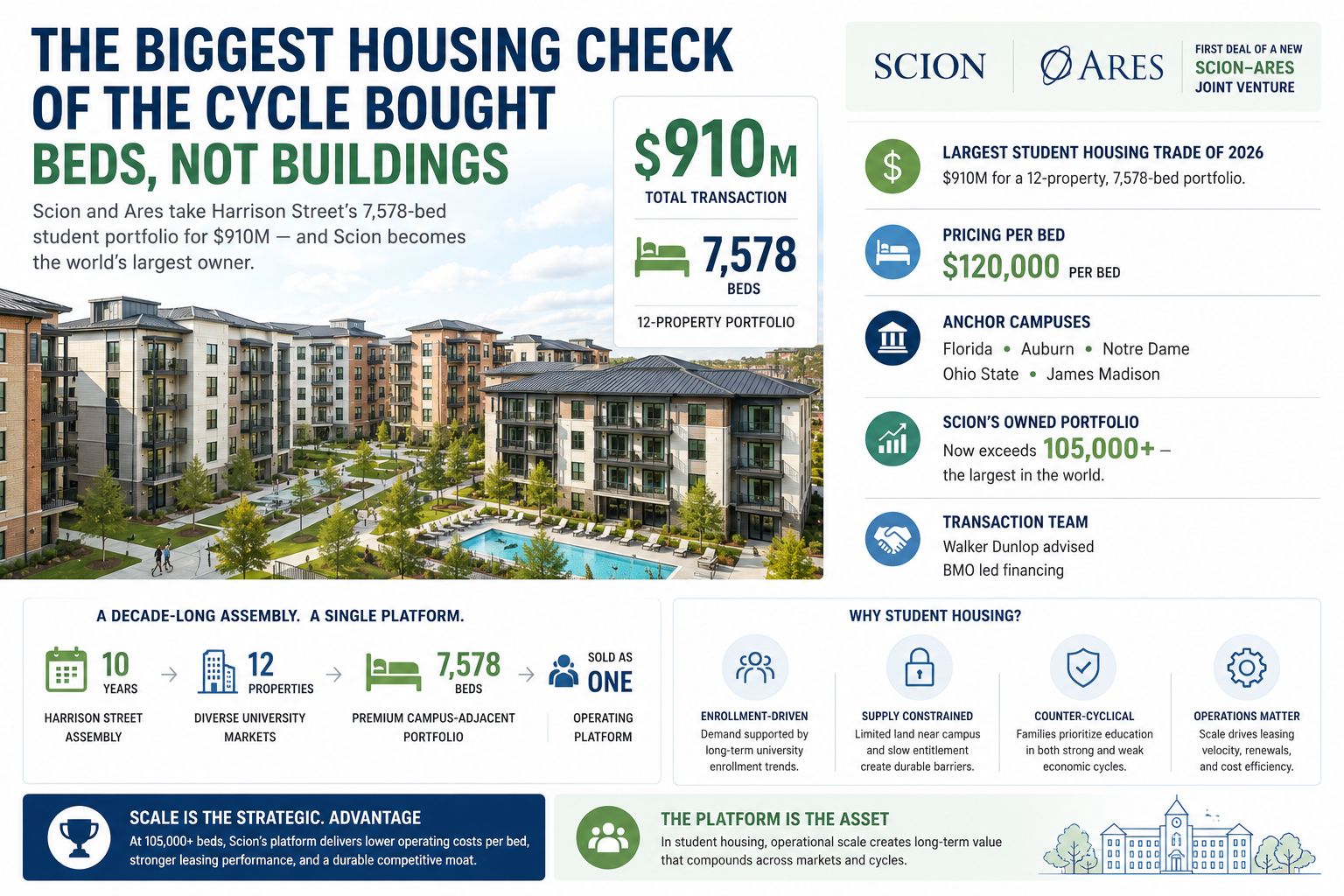
Implications For owners of single campus-adjacent assets, the read is sobering: scale players can underwrite to lower per-bed economics because their operating cost per bed is lower. The edge is operational, and it compounds.
Related coverage
Key Takeaways
- In student housing, the platform is the asset — and the largest operator just got larger.
Multi-Housing News / Commercial Observer / Bloomberg
Never miss a Signal
Get the daily brief that busy CRE professionals rely on.