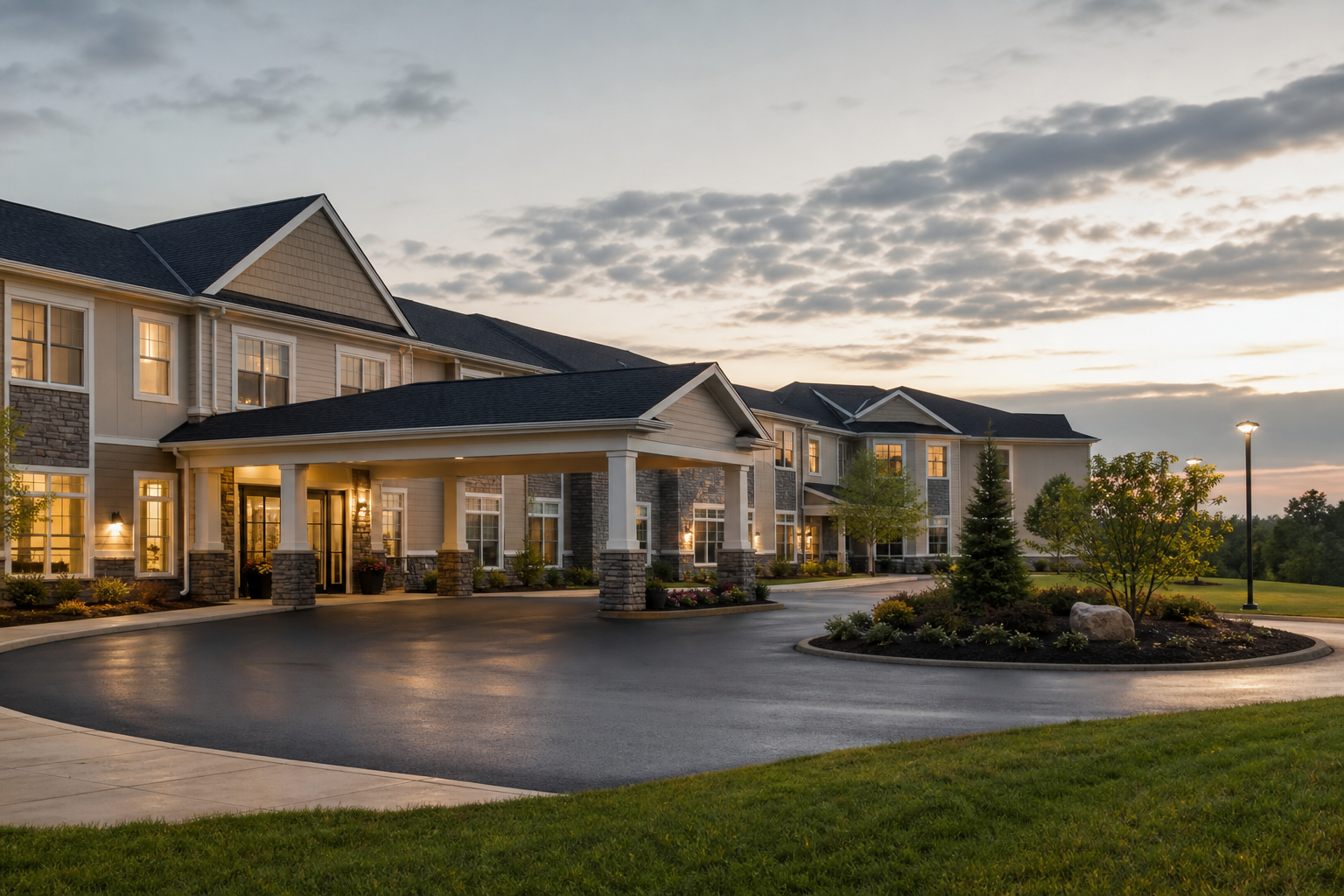
American Healthcare REIT paid a combined $114 million for two seniors-housing communities totaling 182 units in suburban Boston, buying from Berkshire Residential Investments. One asset is the Residence at Penniman Hill, 90 units at 276 Whiting St. in Hingham; the second sits in Bedford. The implied basis of roughly $626,000 per unit is derived from the disclosed price and unit count, not a reported figure.
- The per-unit number is the entire story.
- Two properties, 182 units - a small portfolio priced like a trophy.
- A residential owner sold to a healthcare specialist. That direction matters.
Six hundred twenty-six thousand dollars a unit is multifamily luxury-tower pricing. It was paid for assisted living in two suburban Massachusetts towns.
That number only underwrites if you are not buying apartments. Seniors housing revenue is not rent - it is rent plus a care package, billed monthly, repriced annually, delivered by staff. Revenue per occupied unit runs multiples of conventional multifamily, and so does the expense load.
The seller is the tell. Berkshire Residential Investments is a residential investment manager. American Healthcare REIT is a healthcare operator-owner. The asset moved from a firm that underwrites housing to a firm that underwrites care delivery. That is not a distress trade or an opportunistic flip. It is an asset migrating to the owner whose operating platform matches what the building actually does.
The disclosure gaps are real and should be stated plainly. Without occupancy, no one outside the deal can separate how much of that $626,000 reflects in-place cash flow versus lease-up upside. Without a cap rate, the yield is unknowable.
What is knowable: a public REIT, accountable to public shareholders, signed off on this basis in a metro with among the highest barriers to new seniors housing supply in the country.
Implications
For anyone holding seniors housing bought in the 2018-2021 window, this is a mark worth watching. Not a comp - the disclosure is too thin for that - but evidence that institutional bid depth exists at a level well above where most of that vintage was underwritten.
The underwriting lesson is about what you are actually buying. A seniors housing per-unit price is not comparable to a multifamily per-unit price, and treating them as peers produces nonsense in both directions. The correct comparison set is revenue per occupied unit and margin, not door count.
For developers, the barrier-to-entry math is the point. Suburban Boston does not permit new assisted living easily. When replacement is constrained and demand is demographically locked in, existing stock gets bid toward a number that looks absurd on a per-door basis and defensible on a per-dollar-of-EBITDA basis.
The risk sits in staffing. Every dollar of that basis depends on filling a nursing and care schedule at an assumed wage. Labor is the variable that moves the pro forma, and it does not appear anywhere in a per-unit price.
Related coverage
Key Takeaways
- In seniors housing, price per unit measures almost nothing. Price per dollar of operating income measures everything.
- The asset migrated to the owner whose operating platform matches what the building actually does.
- Every dollar of a $626,000 basis rests on filling a care schedule at an assumed wage.
Commercial Real Estate Direct, August 24, 2026, citing Boston Business Journal - https://crenews.com/2026/08/24/american-healthcare-reit-buys-seniors-housing-portfolio-near-boston-for-114mln/
Never miss a Signal
Get the daily brief that busy CRE professionals rely on.