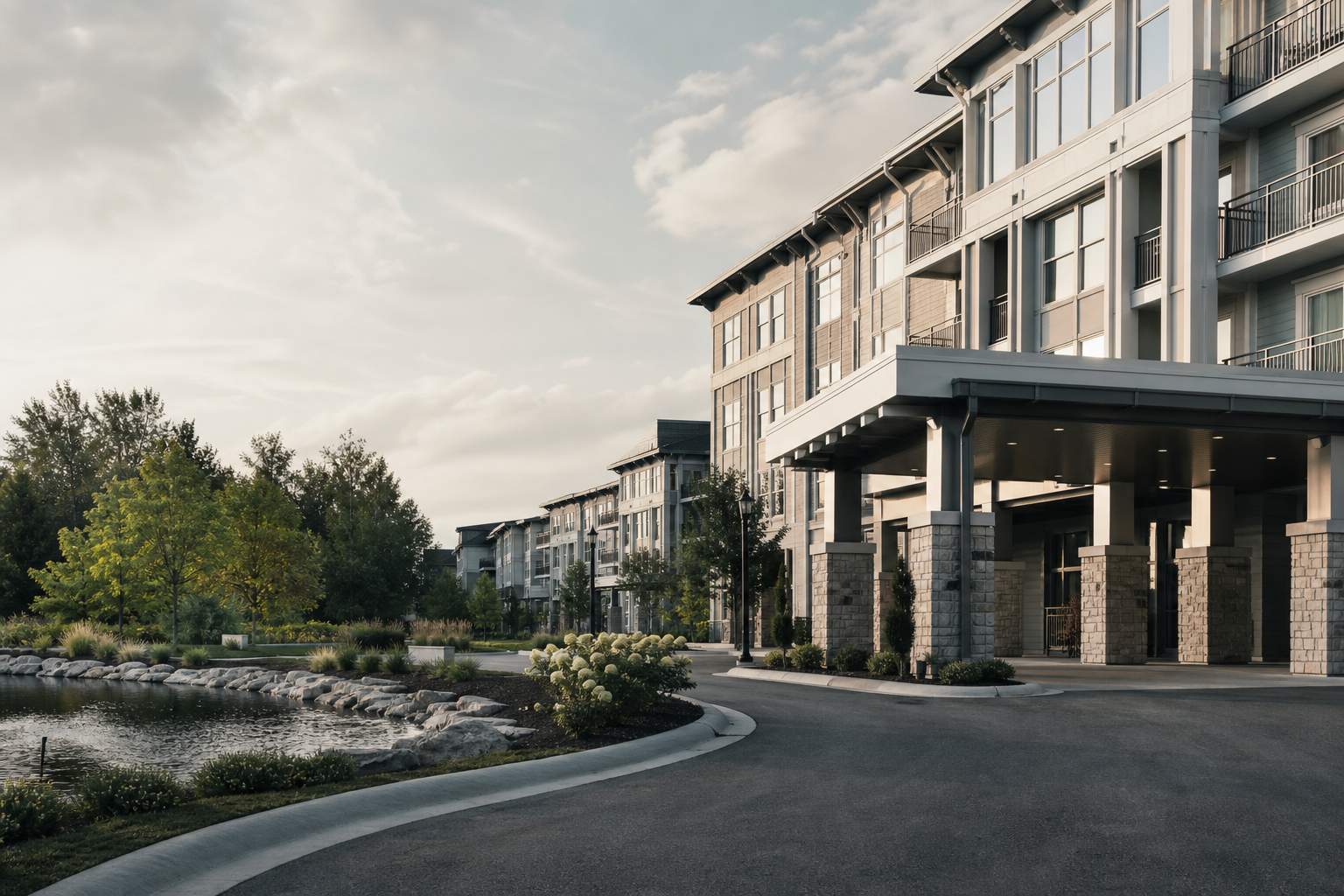
American Healthcare REIT, a Los Angeles-based healthcare REIT, acquired two seniors-housing communities totaling 182 units in suburban Boston from Berkshire Residential Investments for a combined $114 million. One is the Residence at Penniman Hill, 90 units at 276 Whiting St. in Hingham; the second sits in Bedford. No cap rate, occupancy figure or operator was disclosed. The implied ~$626,000 per unit is our calculation from the reported price and unit count.
On the financing side, BWE arranged $40 million of non-recourse debt for Harbert Management Corporation against Cogir of Glen Mills, a 173-unit community in the Philadelphia suburbs. Terms: five-year term, three years interest-only, floating rate, full prepayment flexibility - provided by a regional commercial bank. Harbert acquired the property in 2020, executed a stabilization plan, and recently transitioned management to Cogir Senior Living. Ryan Stoll and Taylor Mokris led for BWE.
Harbert is simultaneously a seller. The firm announced the sale of five seniors-housing communities this month and has raised $510 million for a U.S. senior housing fund. The same manager is refinancing one asset at stabilization while exiting five others - which is what an active, functioning market looks like rather than a one-directional bid.
Implications / Our Read
Start with why the per-unit number is not the scandal it appears to be. Six hundred twenty-six thousand dollars a door is luxury high-rise multifamily pricing, paid for assisted living in two Massachusetts suburbs. That comparison is the error. Seniors housing revenue is not rent. It is rent plus a care package - billed monthly, repriced annually, and delivered by a staffed operation. Revenue per occupied unit runs at a multiple of conventional apartments, and so does the expense load. Judged against the only metric that matters, price per dollar of operating income, the number becomes an ordinary underwriting question rather than a shocking one.
This is where the contradiction with our own recent framing resolves. On August 21 we argued the market had picked its dividing line: how much has to go right, every month, for an asset to pay its loan. Money was setting records on dirt yards and net lease, where the answer is almost nothing. Seniors housing sits at the opposite pole - every unit requires a care plan, a staffing schedule, a licensing regime and a census that turns over faster than any apartment building. And capital is paying up for it regardless.
The reconciliation is that operating intensity is not the risk. Unrewarded operating intensity is. A mall requires constant merchandising and faces structurally declining demand. An office building writes tenant-improvement checks into a shrinking demand base. Seniors housing requires more work than either, but it is aimed at a demand curve that is demographically locked in and effectively cannot be built into fast enough - assisted living in suburban Boston is not a use that gets permitted easily. Work in service of scarcity is compensated. Work in service of a structural decline is not.
Note what capital is buying alongside the buildings. American Healthcare REIT bought from a residential investment manager - the asset migrated to an owner whose platform is built around care delivery rather than housing. Harbert transitioned Cogir of Glen Mills to an institutional operator before refinancing it. In both cases the operating platform moved with, or ahead of, the real estate. That is the same pattern visible in today's Ares self-storage trade, where the building changed hands and the brand changed with it. Across asset classes, the operator is increasingly the thing being acquired.
Stakeholder Lens
Owners holding 2018-2021 vintage seniors housing: institutional bid depth exists well above where much of that paper was underwritten. Disclosure here is too thin to constitute a comp, but the direction is unambiguous.
Developers: the constraint that supports this basis is entitlement difficulty, not construction cost. In markets where assisted living is hard to permit, existing stock gets bid toward numbers that look indefensible per door and reasonable per dollar of EBITDA.
Lenders: the Glen Mills structure is the template for stabilized product - five-year term, three years interest-only, floating, non-recourse, from a regional bank. Regional banks are competing for this paper, which is itself a data point about how the sector is being credit-rated.
Multifamily owners and appraisers: stop benchmarking seniors housing on a per-unit basis against apartments. The two are not the same product and the comparison misprices both.
Anyone underwriting the sector: labor is the variable. Every dollar of a $626,000 basis rests on filling a care schedule at an assumed wage, and that assumption appears nowhere in a per-unit price.
Still Unresolved
The disclosure gaps are material and should not be papered over. No cap rate, no occupancy, no operator and no NOI were released on the American Healthcare REIT transaction, which means nobody outside the deal can separate in-place cash flow from lease-up upside inside that $626,000. The name of the Bedford community was not recoverable from available reporting. On the Harbert side, the five communities being sold have not been individually identified, and no pricing has been disclosed - so whether that firm is rotating within the sector or reducing exposure to it is genuinely unknown. The single largest unmodeled risk across all of it is care-staff wage inflation, which no party disclosed and which would move these pro formas more than any cap-rate assumption.
Related coverage
Key Takeaways
Capital is not avoiding hard work. It is avoiding hard work aimed at shrinking demand.
Operating intensity is not the risk. Unrewarded operating intensity is.
In seniors housing, price per unit measures almost nothing. Price per dollar of operating income measures everything.
Across asset classes, the operator is increasingly the thing being acquired.
Commercial Real Estate Direct, August 24, 2026, citing Boston Business Journal - https://crenews.com/2026/08/24/american-healthcare-reit-buys-seniors-housing-portfolio-near-boston-for-114mln/; Commercial Real Estate Direct, August 24, 2026 - https://crenews.com/2026/08/24/harbert-lines-up-40mln-loan-against-philadelphia-area-seniors-housing-property/; BWE press release - https://bwe.com/press/bwe-secures-40-million-cash-out-refinancing-for-cogir-of-glen-mills-a-class-a-senior-living-community-in-the-philadelphia-msa/; Harbert Management Corporation, August 2026 - https://www.harbert.net/news/august-2026-harbert-management-corporation-sells-five-seniors-housing-communities
Get Capital Just Paid A Record For The Hardest Job In Real Estate in your inbox
Seniors housing is the most operationally intense asset class. Money is bidding it up anyway.