

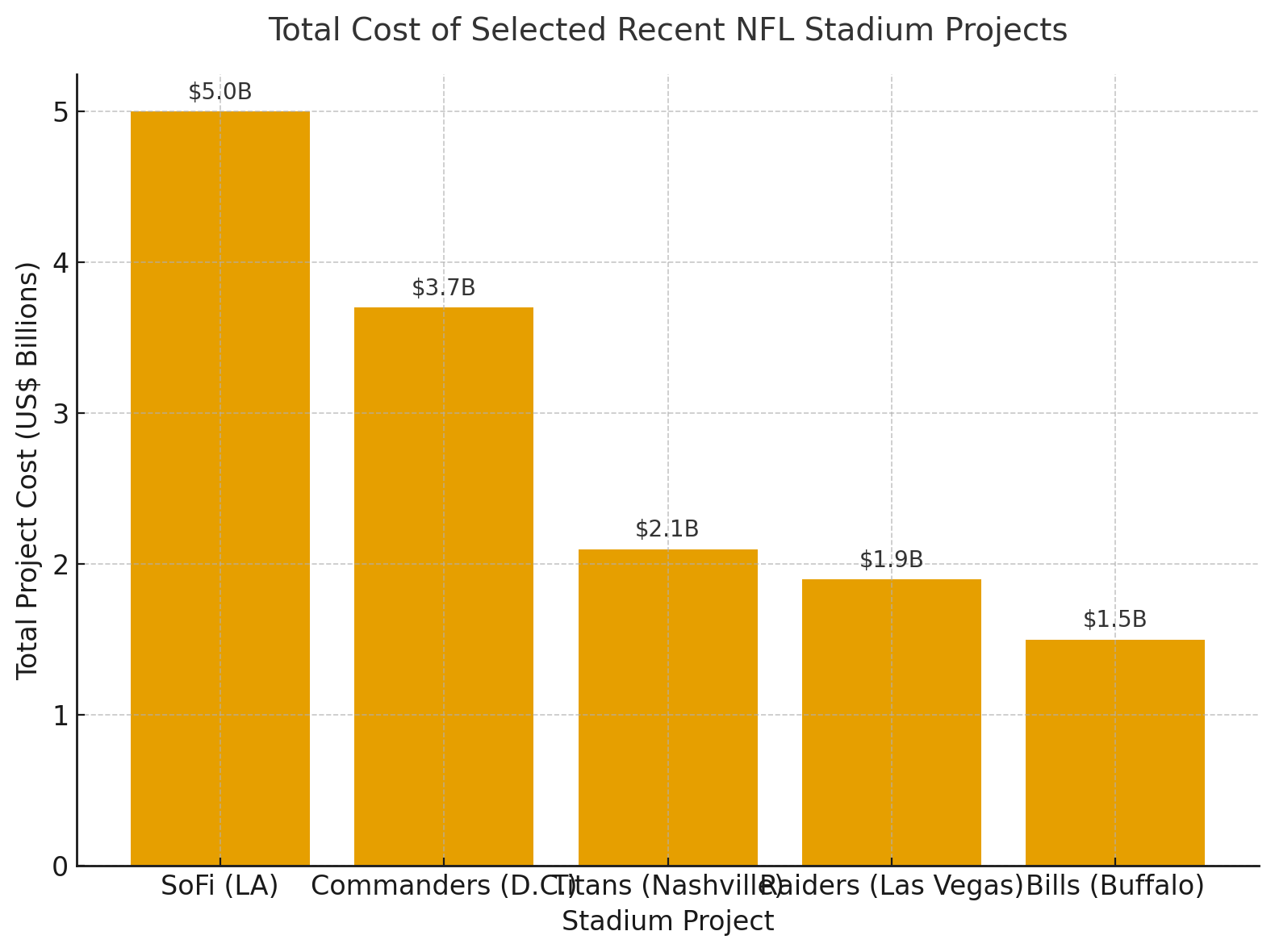
🚨D.C. Council approved an 11–2 deal to redevelop the RFK site into a 65,000-seat NFL stadium anchored by a mixed-use “sports village.” [Source: Reuters]. The $3.7 B plan splits $2.7 B private (stadium) and $1.0 B public (infrastructure, garages, utilities, recreation). [Source: Reuters]. City financing leverages dedicated sports taxes and authority bonds rather than the general fund, while ~20% of 5,000–6,000 planned housing units are affordable. [Source: Washington Post; Reuters]. For CRE, the key is the multi-phase housing/retail pipeline through the 2030s—bankable cash flow that de-risks the stadium and catalyzes the Anacostia waterfront.

Total project cost: $3.7 B (team $2.7 B; city $1.0 B), 11–2 Council approval
Site scale: ~180 acres at former RFK; stadium 65,000 seats; 5,000–6,000 homes with ~20% affordable
Timeline: Break ground 2026; open 2030 NFL season; ~200 events/year planned
Jobs & impact: ~30,000 construction jobs; >$24 B economic activity (city estimate)

Loan Performance. Public side uses dedicated taxes/authority bonds (~5% muni yields typical) to fund horizontals, limiting general-fund exposure; private equity and NFL facilities lending support the vertical. Mixed-use NOI phases (MF, retail, potential hotel) stabilize post-2030, improving DSCR versus standalone venue cash flows.
Demand Dynamics. Urban stadium adjacency can lift footfall for experiential retail and activate waterfront parks; housing absorption depends on phasing and affordability mix, with rent beta moderated by inclusionary set-asides.
Asset Strategies. Phase parcels to deliver utilities/streets early; prioritize residential over destination retail to bank absorption; sequence TI/LC for anchor entertainment after stadium opening; embed green standards to control OPEX.
Capital Markets. Expect bank/REIT appetite for multifamily parcels once entitlements and horizontals are de-risked; retail capital remains selective but improves with pre-leasing to destination anchors; CMBS/CLO optionality post-stabilization.

Stadium alone rarely pencils; mixed-use cash flow is the real estate engine.
Public share (~27%) is lower than several recent NFL deals, easing taxpayer optics.
Financing stance: Tranche infrastructure via authority bonds; pre-sell/forward-fund MF phases.
Caveat: Federal design reviews and sustainability specs can add cost/time.
🛠 Operator’s Lens
Refi. Lock rate hedges for muni and private tranches; size reserves for capex/overruns despite team overrun backstop.
Value-Add. Program year-round events to stabilize district footfall; coordinate park/riverfront activation to lift retail sales.
Development. Escalate hard costs on long-tail phases; hold 10–15% contingencies; front-load utilities and floodplain mitigation.
Lender POV. Favor MF near transit first; retail underwritten on conservative sales PSF with kick-out protections until stadium opens.

Near-term: NCPC/CFA reviews; schematic/design development packages and traffic plans submitted 2025–2026.
Mid-term: RFK demo completes by 2026; vertical stadium structure rises 2028; targeted 2030 opening.
Risk to thesis: Federal design tweaks, labor availability, supply-chain for steel/glass; community pushback on traffic/affordability.

Reuters, WTOP, ENR, The Washington Post, LA Times, Forbes, ESPN

Never miss a Signal
Get the daily brief that busy CRE professionals rely on.