📢Good morning, today’s Signals are brought to you by CRE 360 Signal™.
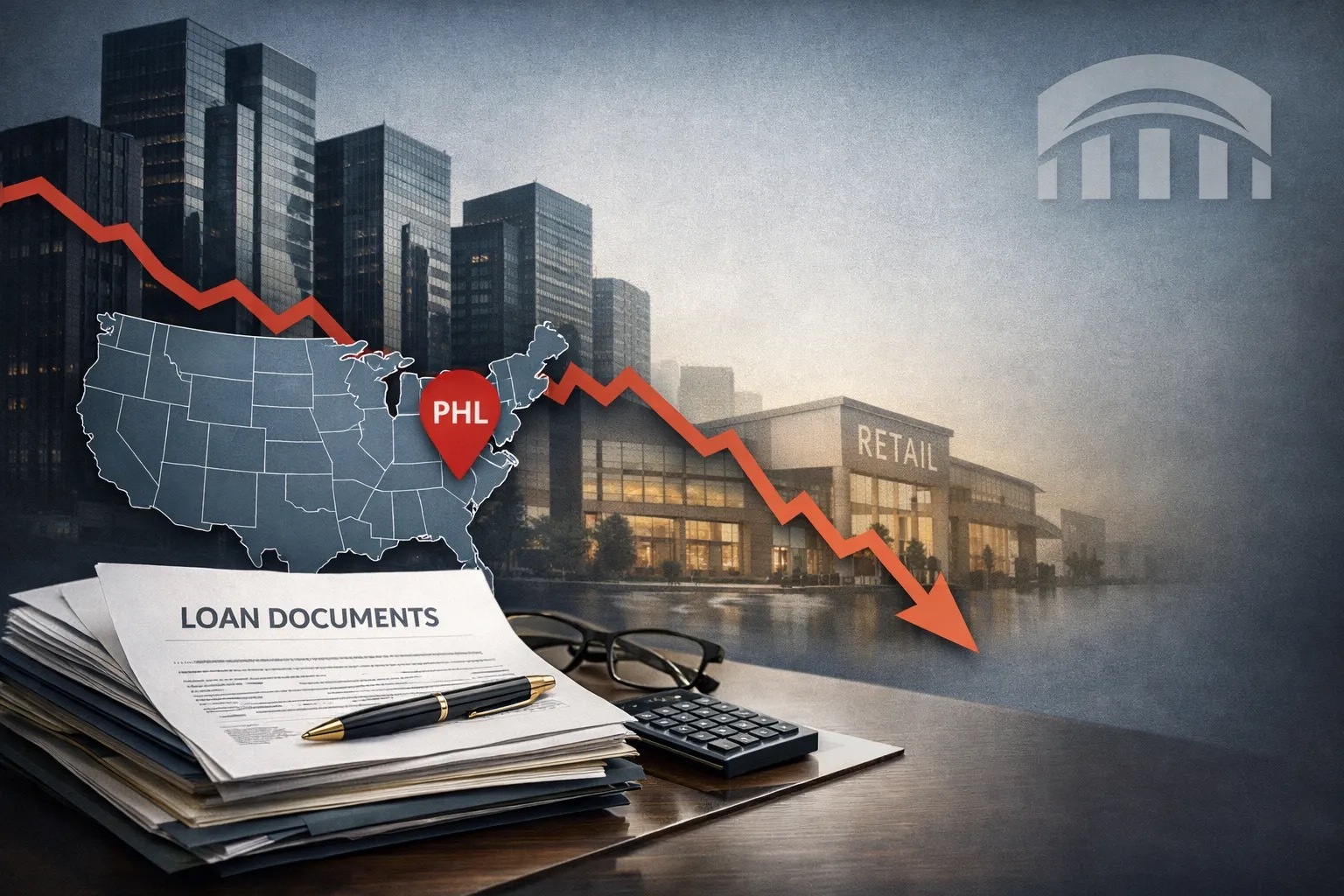
Last week delivered a sharp snapshot of where U.S. commercial real estate actually stands: large institutional debt is quietly changing hands, legacy office losses are finally being realized, and alternative capital is filling gaps where banks remain selective. Apollo’s planned sale of a $9B CRE loan portfolio to Athene confirms insurer appetite for seasoned debt, while CMBS liquidations continue to expose the real cost of older office underwriting. At the same time, record-setting C-PACE financing in Philadelphia shows how projects that pencil operationally can still attract capital — even without traditional balance-sheet lenders.
🎧 Busy to read? Catch the Daily Podcast (Subscribe on YouTube, Apple, Spotify)➤ SIGNAL
Apollo to Sell ~$9B CRE Loan Portfolio to Athene
Apollo Commercial Real Estate Finance agreed to sell its entire ~$9 billion loan book to Athene at near-par value, with closing expected in 2026. The transaction removes risk from a public REIT balance sheet and transfers it to an insurance platform built for long-duration cash flows.
This isn’t new lending — it’s risk migration. Insurers are stepping in where banks and public REITs want off-balance-sheet exposure reduced.
2) CMBS Liquidations Lock in Office Losses
Multiple legacy CMBS office loans were liquidated this month, including a Denver office complex that generated over $110M in losses for bondholders. Junior tranches were wiped; mezzanine classes were heavily written down.
These are realized losses, not watchlists or extensions. Older office assets with compromised cash flow and weak exit paths are done repricing — permanently.
3) $87M C-PACE Financing Closes on Philadelphia Office Project
Nuveen Green Capital closed the largest C-PACE transaction in Pennsylvania history for a major Philadelphia office development, providing long-term, fixed-rate capital tied to energy and infrastructure upgrades.
Projects with defensible operations and efficiency gains can still assemble capital — but often outside traditional senior-loan channels.
Takeaway
Debt side: Large institutional buyers with long‑duration capital (e.g., insurers) are absorbing sizable loan portfolios, reducing balance sheet risk for sellers and validating valuations. At the same time, legacy securitized losses remind lenders and investors that risk pricing must remain disciplined.
Equity side: Survey data points to renewed investor conviction going into 2026, underpinned by stabilizing costs and attractive pricing, which should tighten pricing spreads and increase competition for quality assets.
CRE360.ai — Daily Signals & Commercial Real Estate Intelligence
Part of the 2025 Year-End Intelligence Series.
▼ EDITORIAL DESK TOP PICKS
Green Street News launches real-time U.S. CRE intelligence access — New platform aims to deliver faster data and insights to investors and lenders across commercial property markets.
CMBS expected to have another strong year in 2026 — Borrowing demand through commercial mortgage-backed securities is poised to remain a key financing channel for CRE this year.
Co-working market is roaring back to life — Flexible office demand is resurging as major corporations adopt hybrid and shared workspace solutions.
Global realty capital rebounds with India as strategic market — Institutional investors are shifting allocation toward emerging markets like India amid broader capital flows.
CBRE survey: Most CRE investors plan to buy more in 2026 — Nearly 75 % of investors intend to increase or maintain acquisitions this year as pricing stabilizes and fundamentals strengthen.
Investors preparing to deploy more capital into U.S. CRE markets — A CBRE release finds 95 % of investors plan to maintain or increase allocations, underscoring confidence returning to the sector.
CRE market sentiment turning optimistic for 2026 — Market cycle materials show improving confidence even as macro risks persist.
U.S. CRE finding stability as 2026 begins — Integra Realty Resources reports uncertainty is priced in and lending has rebounded after recent headwinds.
Industrial real estate trends shaping 2026 — Reduced new supply and geopolitical risk are key industrial sector themes while rent growth varies regionally.
Bankrupt Saks to close 62 stores, impacting retail CRE — National retail restructuring affects CRE assets across multiple markets.
Lender wins auction for Miami skyscraper site with $95M bid — Competitive capital markets activity remains in major urban redevelopment plays.
Fed’s decision to hold rates reverberates through CRE capital markets — CRE participants are interpreting the rate pause as a signal for stability in borrowing costs.
Dallas remains top U.S. market attraction for investors in 2026 — CBRE survey shows Dallas, Atlanta, and San Francisco among prime markets for deployment.

Get Debt Is Moving, Risk Is Crystallizing in your inbox
Institutional insurers and long‐duration capital are actively acquiring CRE debt, especially well‐underwritten or diversified portfolios.