


🚨Key Highlights
25 bps cut brings Fed funds range to 3.75–4.00%, totaling 150 bps easing in 12 months.
10-year yield briefly fell below 4.0%, lowest since 2024.
CRE sales $42 B in September (+19% YoY), led by +42% office rebound.
Private-credit inflows $35.9 B Q3, offsetting 8% bank CRE pullback.
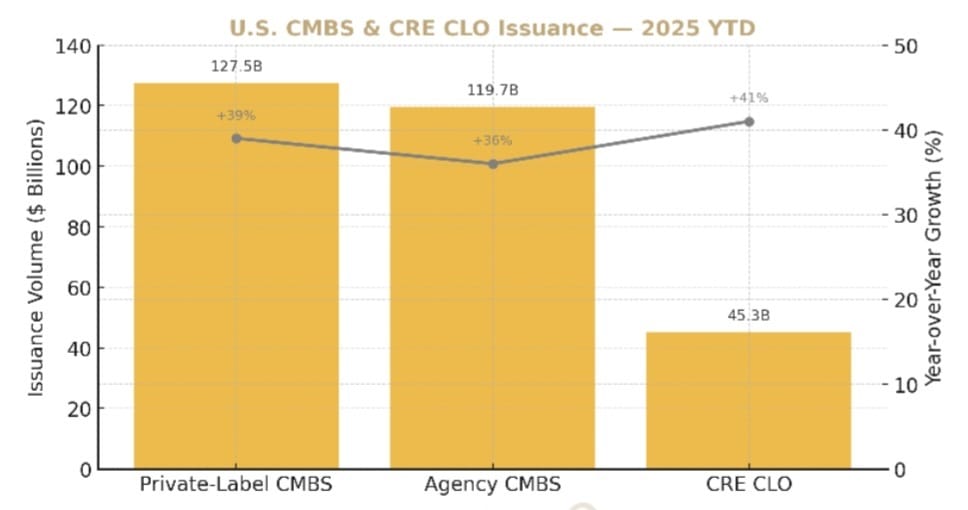
CMBS + CLO issuance $127.5 B YTD, up 39% YoY; spreads steady at +80 / +475 bps.
signal
The Federal Reserve’s second consecutive rate cut—25 bps to a 3.75–4.00% range—confirms a policy pivot but not yet a full easing cycle. The 10-year Treasury’s sub-4% dip immediately compressed CRE borrowing costs and opened a short-lived window for refinancing and debt-cap hedging. Transaction pipelines that had frozen through mid-year are moving again as investors regain price visibility. Yet Powell’s warning that a December cut is “far from certain” reminds markets that relief is conditional, not guaranteed.
Rate Moves and Debt Behavior
Yields snapped lower before stabilizing around 4.1%, restoring roughly 70 bps of affordability versus early summer. The 30-year mortgage average slid to 6.17%, a 13-month low that is spurring refi applications and early rate-lock activity. CRE borrowers are capitalizing: lenders report a visible uptick in forward hedges and term-sheet circulation. Still, the Fed’s restrained tone keeps volatility risk alive. Inflation persistence or labor-market surprises could quickly retrace gains. For now, the window is open—but narrow.
Liquidity Returns to Transactions
September’s $42 billion in CRE trades marks a 19% YoY rise, the first meaningful recovery in deal volume since 2022. Office transactions jumped 42% as sellers met the market on price and buyers regained confidence that peak rates are past. Brokers cite “price discovery equilibrium” and a sharper bid-ask convergence. The Mortgage Bankers Association now projects $827 billion in 2024 originations, +24% YoY, as lower coupons improve debt service coverage. In practice, capital availability—not optimism—is now dictating velocity.
Private Credit Fills the Vacuum
Banks remain cautious—Wells Fargo’s CRE book is down 8% YoY—but alternative lenders are expanding fast. Blackstone Credit alone drew $35.9 billion of Q3 inflows, powering a record $1.24 trillion AUM. Executives describe the “deal dam breaking,” as bridge and transitional loans replace retreating bank capital. Private-loan spreads have edged lower into 7–9% yields, still rich for investors yet cheaper for borrowers. Loss rates remain minimal (0.1%), underscoring disciplined underwriting rather than exuberance. The shift signals a structural re-intermediation of CRE credit.
Securitization Reawakens
CMBS and CRE CLO issuance is surging. Year-to-date private-label volume hit $127.5 billion (+39% YoY), while agency CMBS reached $119.7 billion (+36%). Investors are embracing yield: AAA tranches clear near +80 bps, BBB- at +475 bps. The absence of post-Fed spread widening shows confidence that policy easing will be gradual, not disruptive. Life insurers and debt funds are re-allocating to structured products, providing liquidity for the trillion-dollar 2025 maturity wall. Refinancing math is improving—but only for assets with credible cash flow and equity support.
Underwriting Guardrails and Capital Discipline
With the 10-year near 4.0%, refinancing or hedging now carries strategic urgency. CRE360’s guardrails:
Lock early: Secure fixed debt or rate caps before volatility resumes.
Stress exit caps +50–75 bps above market (~6.4 → 6.9%) to protect valuations.
Maintain ≤65% LTV; use mezz or pref equity for added leverage.
Model SOFR ~4% through 2026 and target ≥1.25× DSCR.
Shop broadly: debt funds, insurers, and credit unions now quote competitively.
The message: execute during the reprieve, but underwrite as if it ends tomorrow.

Rate relief is real but provisional. The Fed has loosened policy by 150 bps without declaring victory on inflation; therefore, financial conditions may stabilize rather than slide further. As capital costs compress, CRE financing will reward preparedness over optimism. Expect a measured uptick in Q4 transactions, led by refinancings and structured recapitalizations. In 2026, the balance of power will tilt toward lenders with flexible mandates and borrowers demonstrating cash-flow durability. Discipline, not exuberance, remains the differentiator.
If rates ease further, discipline—not access—will define advantage.

CREDaily — “Fed Cuts Rates, CRE Markets React” ell Signals Caution on Further Cuts” CRE Finance Council — “Q3 CMBS/CLO Issuance Data” San Francisco Chronicle — “Mortgage Rates Hit 13-Month Low”

Never miss a Signal
Get the daily brief that busy CRE professionals rely on.