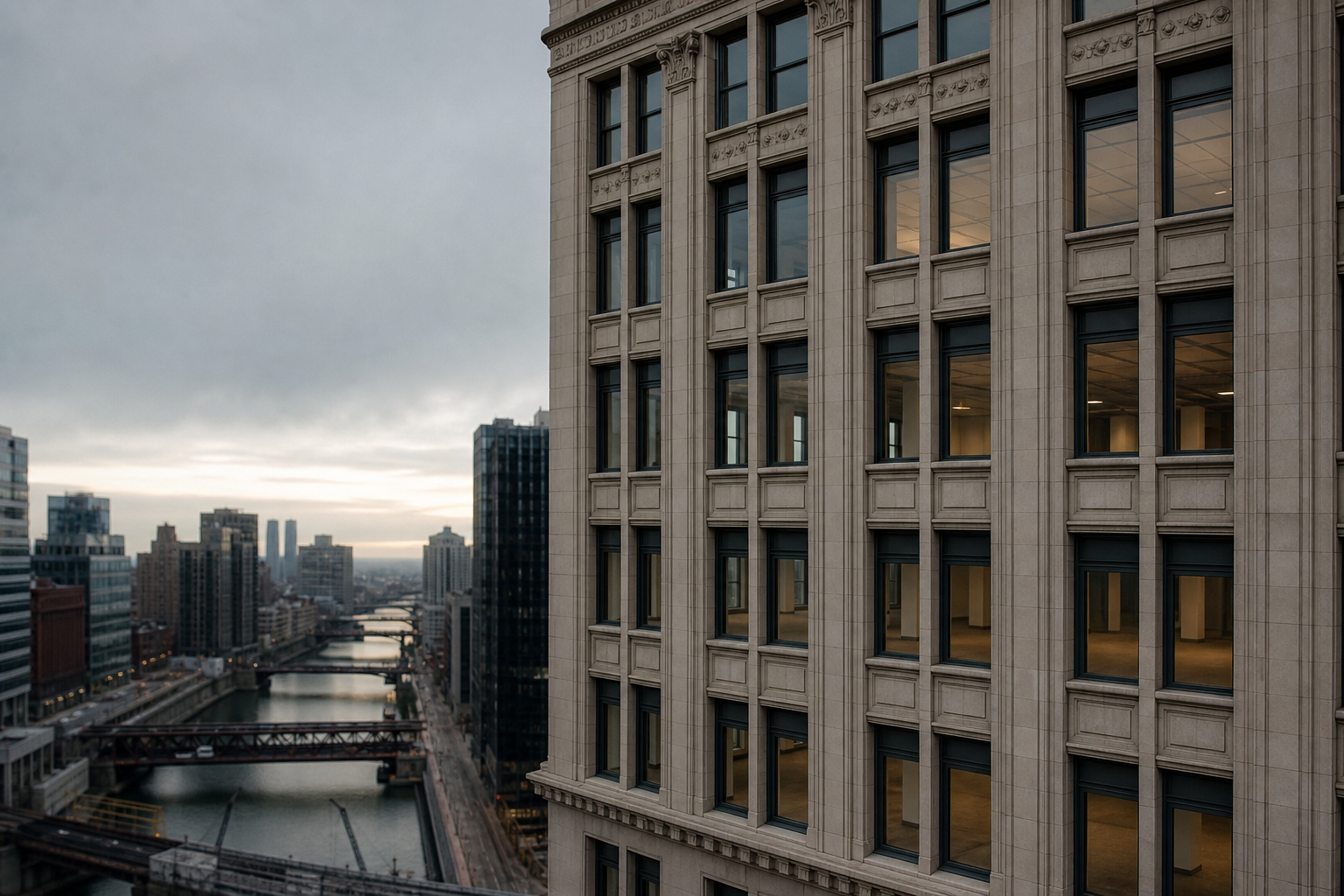
Chicago has been trying to convert LaSalle Street office towers into apartments for three years. This week the first one opened, and it finally puts a number on what that takes.
Bellwether Residences at 79 W. Monroe Street — the landmarked 1905 Rector Building, converted by R2 and Lagfin — delivered 117 units, of which 41 are affordable at 60% AMI. That is 35% of the building, above the program's 30% floor. Total project cost was $64.2 million, against $28 million in TIF and $7.8 million in federal historic tax credits.
The arithmetic, all CRE360 calculations off disclosed figures: $64.2 million across 117 units is $548,718 per unit all-in. Subtract the TIF and the historic credits and the public contributed $305,983 per unit — 55.8% of the capital stack. Private capital covered $242,735 per unit.
Put differently: converting a 1905 office building into housing in the Loop cost more per unit than ground-up construction in most of the country, and the public paid for a majority of it.
Bellwether is also running hot relative to its own program. Against a program average of roughly $178,470 in TIF per unit, Bellwether drew about 34% more — reasonable for a first mover carrying landmark requirements, and a caution for anyone assuming the average is the number. Program-wide, the LaSalle Street initiative covers 6 projects, 1,765 units, and more than $315 million in approved TIF against $900 million-plus in total investment.
Two contradictions in the reporting are not resolved here. One account describes eleven floors converted; another places apartments on floors seven through fourteen, which is eight. The leasing figures use different denominators — 25 of 76 market-rate units in one account, about 25% leased overall in the other. No acquisition basis, rents, or cap rate has been disclosed anywhere.
Implications. This is the cleanest public comp yet for conversion economics, and it says the gap between what an office-to-residential conversion costs and what private capital will fund is roughly half the project. That gap is the entire policy question, in one building.
For developers evaluating conversion candidates elsewhere, the useful test is not whether the building can be converted. It is whether the jurisdiction will write a check for half of it. Where that answer is no, the pipeline does not move regardless of how attractive the floor plate looks.
Related coverage
Key Takeaways
- Office-to-residential conversion does not pencil — it gets subsidized, and here the subsidy was 56% of the stack
- The first question on any conversion candidate is whether the jurisdiction will fund half of it, not whether the floor plate works
- Bellwether drew 34% more TIF per unit than the program mean, so the average understates the next projects
Bisnow, September 9, 2026 · Chicago Sun-Times, September 9, 2026 · City of Chicago, LaSalle Street Reimagined program materials
Never miss a Signal
Get the daily brief that busy CRE professionals rely on.