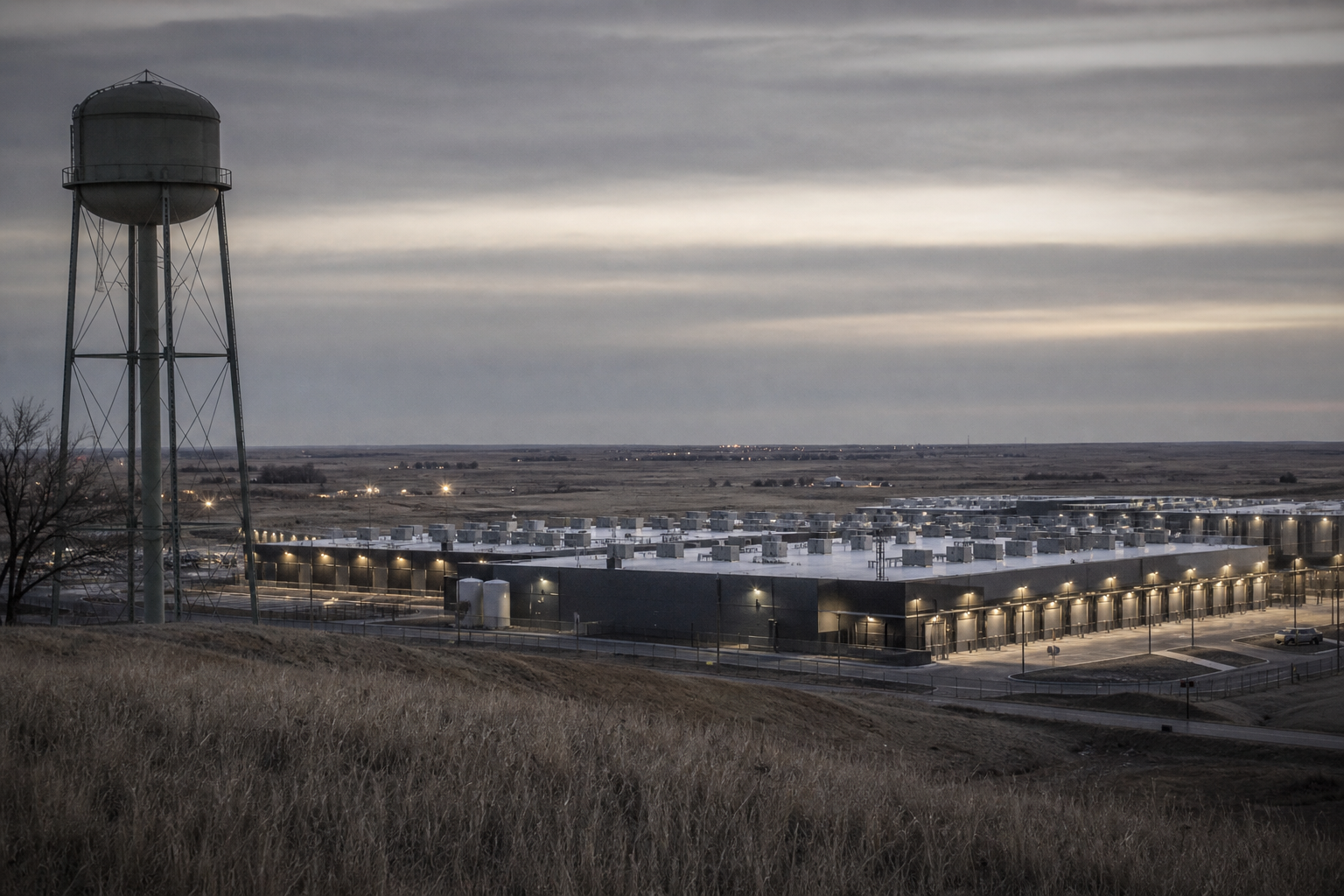
Two things happened in Kearney on Tuesday night, and the order matters. The council wrote the rules for data centers, then approved one.
The Kearney City Council voted 5–0 to approve Worldwide Mission Critical's Tech One Crossing — 368 megawatts at full build-out, replacing an existing 100 MW Marathon Digital bitcoin mine. That is a 3.7x load increase in a town of roughly 33,000 people. The projected load exceeds the combined electricity use of Kearney, Grand Island and Hastings. The council adopted the city's first data-center zoning definition the same night it issued the permit.
The siting logic is the story. This is not greenfield. It is a crypto-to-AI load conversion — an existing bitcoin mine with interconnection already in place, scaled 3.7x. The hardest thing to secure in a data center deal right now is not land or capital. It is grid access with a queue position that already exists. Marathon's mine had one.
The political geography is the counterweight. At least 12 Nebraska counties have passed data-center moratoriums. Kearney moved toward the load while its neighbors moved away from it, and completed both entitlement steps in one sitting.
The gap in the record is significant: no announced tenant. Developers cite non-disclosure agreements, and city leaders acknowledge on the record that they do not know who will occupy it. A municipality has committed its grid to a customer it cannot name.
No capital cost, acreage, or building area has been disclosed. The megawatt figure is the only hard economic input available, and it is corroborated across both sources. Phase 1 is targeted for late 2027, with full build-out around 2030.
Implications. Tertiary markets with existing crypto interconnections are now the shortest path to large-load capacity, and the sites are cheap because the prior use was distressed. Expect more of these conversions before more greenfield campuses.
The underwriting risk is concentration. A city of 33,000 has tied its grid planning to an anonymous counterparty on a four-year build. If the tenant does not materialize, the stranded asset is not the building — it is the interconnection agreement and the political capital spent to secure it.
Related coverage
Key Takeaways
- The scarcest asset in data center development is a grid connection that already exists — and failed bitcoin mines have them
- Tertiary markets with distressed crypto interconnections are the shortest path to large-load capacity
- A city of 33,000 has committed its grid to a counterparty it cannot name
KSNB Local4, September 8, 2026 · Flatwater Free Press, September 8, 2026 · Central Nebraska Today, September 8, 2026
Never miss a Signal
Get the daily brief that busy CRE professionals rely on.