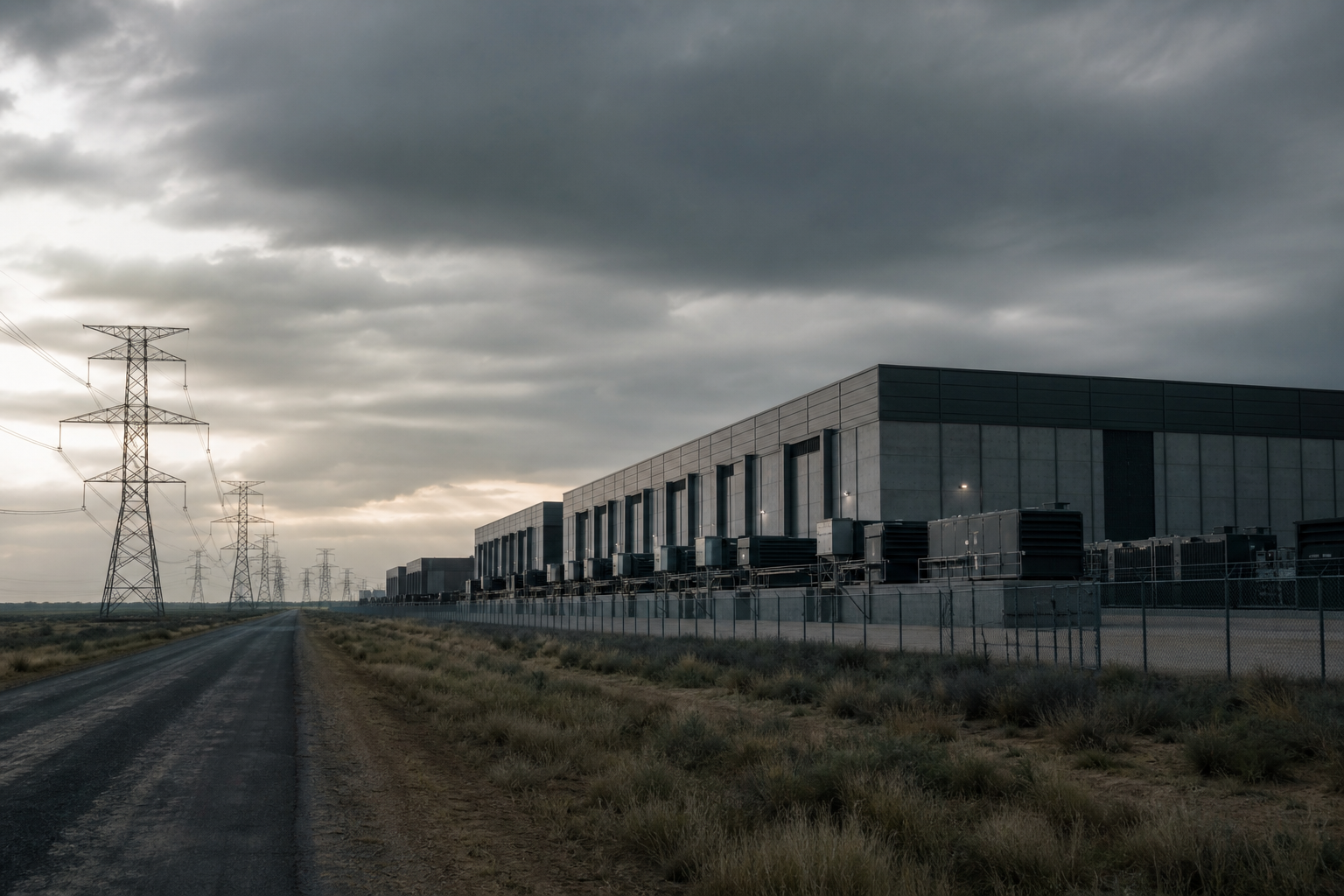
ERCOT issued conditional Batch Zero large-load classifications covering five Galaxy Digital Inc. (NASDAQ: GLXY) projects totaling roughly 4.2 GW at and around the Helios campus in Dickens County, West Texas.
Classified as Base Load: Helios I at 800 MW and Helios II at 830 MW, 1,630 MW combined. Classified as Studied Load: Caspian at 700 MW, Selene at 900 MW and Helios III at 1,000 MW, 2,600 MW combined and subject to further ERCOT capacity allocation. The classifications follow Governor Greg Abbott's August 3, 2026 directive requiring ERCOT to audit and verify data-center large loads before advancing Batch Zero.
The math. Only 38.5% of the 4,230 MW carries a Base Load classification. The remaining 61.5% is Studied Load, meaning capacity is not guaranteed. Helios has grown from 160 acres in 2022 to more than 2,200 acres, a 13.75x land expansion. Phase I, 200 MW leased to CoreWeave on a 15-year near-triple-net, was financed in August 2025 with a $1.4B facility at 80% loan-to-cost, implying roughly $1.75B of project cost or about $8.75M per MW.
This is not a transaction and there is no purchase price. It is a grid-access decision, and grid access is now the binding constraint on data-center development in Texas — ahead of land, ahead of capital, ahead of tenant demand.
The distinction between Base Load and Studied Load is the whole story. Base Load means ERCOT has accepted the load into its planning assumptions. Studied Load means the project must still compete for capacity that may not be allocated. Those are not two flavors of approval. They are approval and maybe.
A governor's directive in August produced an audit in September that let roughly six of every ten megawatts through only conditionally. That sequence — political intervention, regulatory audit, partial classification — is now a repeatable template, portable to every state where hyperscale load is colliding with retail ratepayers.
Implications. For anyone underwriting a data-center site, interconnection queue position has stopped being a diligence checkbox and become the primary risk. A signed lease and a funded construction facility do not create deliverable power. Land assembled ahead of a firm classification is a call option on grid capacity, priced as if the option were already exercised. That is a specific, quantifiable exposure that belongs in a capital stack conversation, not a footnote.
Uncertainty. No dollar figure was disclosed. The $8.75M per MW cost basis is a CRE360 derivation from the August 2025 Phase I financing terms, not a company or ERCOT figure, and per-MW cost is not linear across phases. Studied Load classification may be upgraded, reduced or denied, and no timeline was published. CoreWeave lease economics have been reported in a wide range across sources and are not used here.
Related coverage
Key Takeaways
- In Texas, the interconnection queue now prices the deal — six of every ten megawatts came back conditional.
Galaxy Digital Inc. release via PR Newswire, September 8, 2026 · ERCOT Market Notice M-A080326-01 · Office of Governor Greg Abbott directive to ERCOT, August 3, 2026 · Percentage split, per-MW cost basis and land-expansion multiple are CRE360 derivations
Never miss a Signal
Get the daily brief that busy CRE professionals rely on.