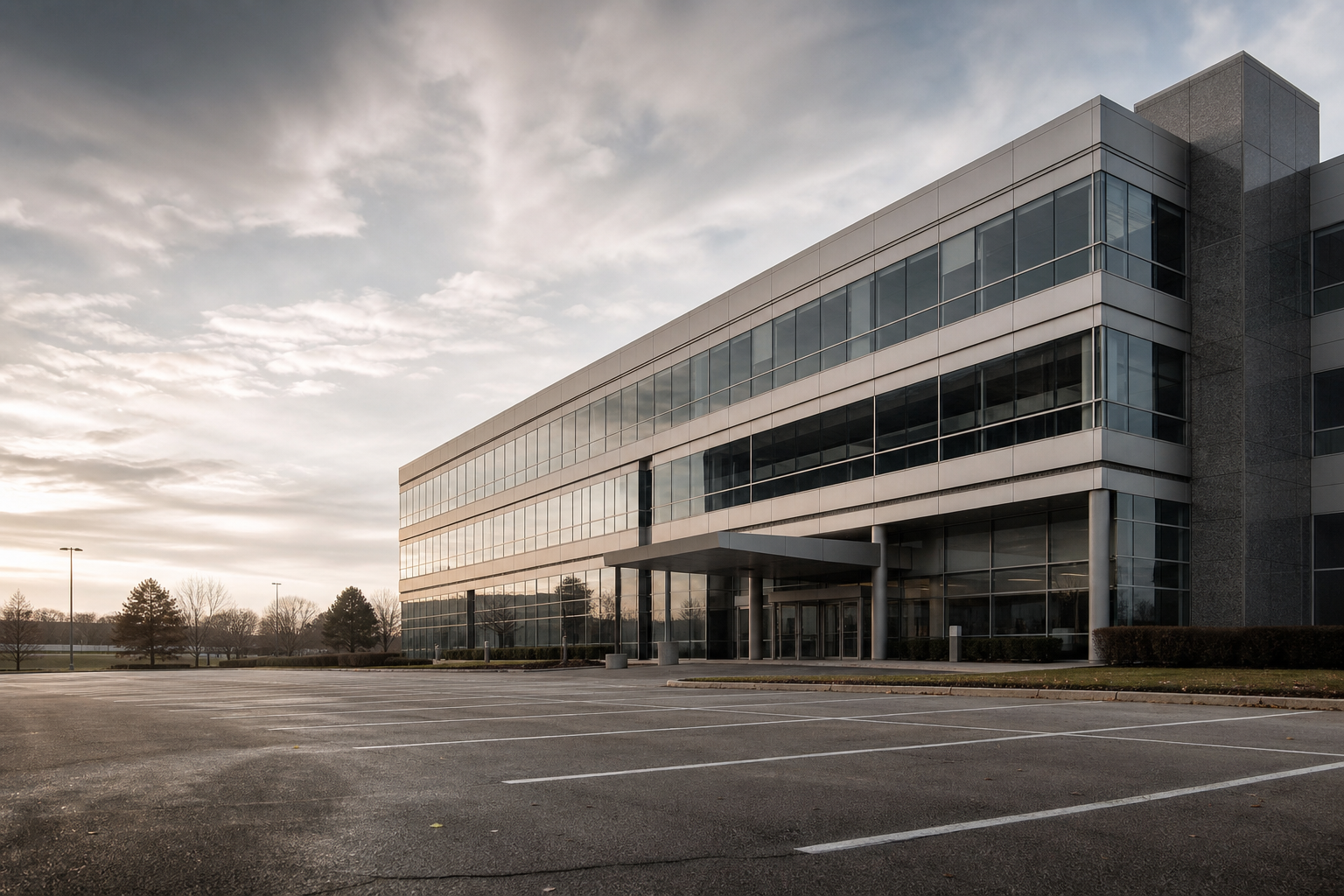
Brandywine Realty Trust agreed to sell 3151 Market Street, Philadelphia — 441,000 square feet in Schuylkill Yards — for $240 million, or $544 per square foot. The company's Form 8-K discloses the property is 4% leased. A $57.3 million mortgage is repaid at closing and Brandywine expects roughly $168 million in net proceeds. The buyer posted a $5 million non-refundable deposit, with closing scheduled for September 30, 2026.
The buyer is Burlington Stores, relocating its headquarters from New Jersey. It will spend $130 million more on fit-out — $370 million all-in, or $839 per square foot — and move 1,500 employees while hiring roughly 500 more.
Brandywine underwrote the building as life sciences and financed part of it with an $87.3 million C-PACE facility from Nuveen Green Capital, the largest in Pennsylvania history when it closed in January 2026. It reached 4% leased. CBRE put national lab and R&D vacancy at a record 23.8% in Q1 2026.
Compare that with what institutional capital paid this week for leased core. Hamilton Square in Washington D.C. — 278,000 square feet, 100% leased to IBM and GE — traded at $453 per square foot. Burlington paid 20% more per foot for a building that is 96% empty.
An investor would have priced 3151 Market as a lease-up: discount the vacant floors, underwrite years of concessions, demand a basis below replacement cost. A corporate buyer solves for cost per employee instead — here about $185,000 of real estate per seat across 2,000 jobs. And you can only build 441,000 square feet to your own specification in a building that is empty.
The structure confirms it was negotiated rather than marketed. Thirty days from agreement to scheduled closing, backed by non-refundable money, is not what a competitive process produces.
Implications. Owner-users are now the top of the bid stack for large-format office. For anyone holding a big, empty, well-located building, the exit may not be an opportunistic fund at a distressed basis — it may be a corporation at a premium, triggered by a relocation decision that has nothing to do with your cap rate. For Brandywine it is a clean recycle out of an asset that would not lease. For lenders on speculative life-sciences product, recovery value may sit outside the sector entirely.
Still unresolved: Brandywine's all-in development cost was not disclosed, which is the number that would show whether $240 million is a recovery or a write-down. The sale is scheduled, not closed.
Related coverage
Key Takeaways
- When the buyer is the tenant, vacancy stops being a discount and becomes the reason the deal works
- Burlington paid 20% more per foot for a 96% empty building than institutional capital paid this week for fully leased D.C. core
- Investors solve for yield on in-place income; corporations solve for cost per seat — about $185,000 each here
- A 30-day close backed by non-refundable money means this was negotiated, not marketed
Brandywine Realty Trust Form 8-K, SEC EDGAR, agreement dated Aug 31 2026 · Philadelphia Inquirer, Sept 3–4 2026 · CBRE U.S. Life Sciences Figures Q1 2026 · Per-foot and per-seat figures are CRE360 calculations from disclosed inputs
Never miss a Signal
Get the daily brief that busy CRE professionals rely on.