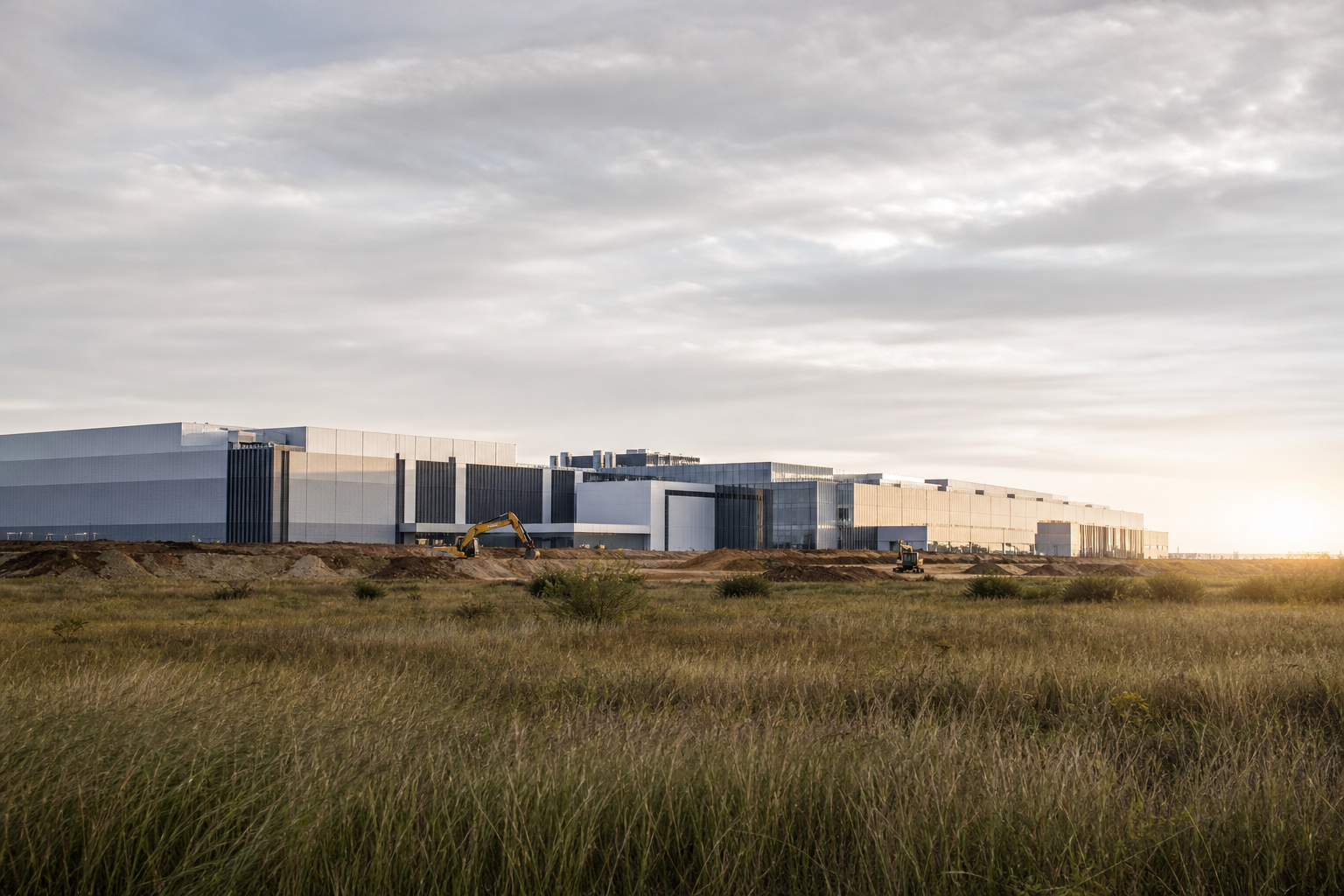
The Signal. In the first three weeks of July, three bitcoin miners signed some of the largest, longest, highest-credit leases in U.S. commercial real estate — and almost none of them were reported as real estate. TeraWulf locked roughly 19 billion dollars of contracted revenue with Anthropic on a ~20-year lease for about 401 megawatts at a former aluminum smelter in Hawesville, Kentucky, with power scheduled to go live in 2027. CleanSpark signed a 20-year triple-net lease for 175 megawatts in Sandersville, Georgia — an estimated 6.6 billion dollars — and handed the tenant exclusivity over an 885-megawatt Texas pipeline. Galaxy contracted CoreWeave for the full 800 megawatts of gross power at its West Texas Helios campus, on 15-year terms expected to generate more than 1 billion dollars in average annual revenue.
The most valuable thing in a data-center deal is no longer the building. It is the permitted, grid-connected power underneath it — and the operators who already own it are turning themselves into the highest-credit landlords in commercial real estate.
The through-line is power, not property. TeraWulf's Kentucky site is a decommissioned smelter with roughly 480 megawatts already connected to the grid. In a market where new large-load interconnections now take years, that existing hookup — not the shell that sits on it — is the scarce, monetizable asset. Galaxy's Helios has since expanded to 1.63 gigawatts of approved capacity, with a path to 3.6.
And the market has noticed what these companies have become. TeraWulf's high-performance-computing leasing overtook its mining revenue in the first quarter. Bernstein now counts every major U.S.-listed miner as an AI-infrastructure play, and CoinShares projects AI could reach up to 70% of miner revenue by year-end, from roughly 30% in January.
Implications / Our Read. Strip away the crypto tickers and these are net-lease deals — 15-to-20-year, triple-net, take-or-pay-style contracts to hyperscale-credit counterparties, at durations and escalators that office and retail simply cannot offer anymore. That is the exact profile institutional net-lease and infrastructure capital has been chasing. It is being originated, at scale, entirely outside the traditional net-lease channel.
The deeper shift is what defines the real estate in a data-center deal. The developer's historic edge — land, entitlement, vertical construction — is being subordinated to one variable: interconnected, low-cost, permitted power. The miners' accidental advantage is that they spent the last cycle acquiring exactly that. Cheap industrial land near cheap power, built out with substations and grid connections for mining, turns out to be pre-assembled AI infrastructure. The stranded asset became the strategic one.
That reframes a lot of obsolete real estate. Decommissioned smelters, shuttered mills, retired power plants, heavy-industrial sites with legacy electrical service carry an option most owners are not pricing: the interconnection queue they skip. In a two-to-four-year hookup environment, an existing 400-megawatt tie-in is worth more than the buildings around it.
It also connects to where net-lease capital is going. This same week, listed single-tenant net-lease cap rates barely moved — buyers refusing to compress yield, pricing tenant credit and lease duration over headline return. The discipline in listed net lease and the frenzy in AI-infrastructure leasing are the same trade: long-duration credit. The best of that paper is now being written on megawatts, not square feet.
Stakeholder lens. For developers, the competitive edge has moved from construction capability to grid position — securing interconnection and power capacity is the deal now, and the vertical is commodity. For owners of stranded heavy-industrial sites, the mandate is to re-underwrite legacy power as data-center optionality before someone else prices it for you. For net-lease and infrastructure investors, the highest-credit, longest-duration leases in the market are being originated by counterparties you may not screen as real estate — and the mispricing is in that gap. For lenders, the counterparty is increasingly a hyperscale AI tenant on a 20-year contract, a different and in some ways stronger credit than most net-lease paper, provided the tenant's own demand curve holds.
Related coverage
Key Takeaways
The unit of value has moved from the building to the megawatt — permitted, grid-connected power is the asset, and stranded industrial sites are the new land bank
The open risks are duration and delivery: whether young AI tenants sustain 20-year terms, and whether the grid energizes the megawatts already contracted
Whether hyperscale AI demand sustains the 15-to-20-year lease terms these deals assume — the contracts are long, the technology cycle is short, and the counterparties are young. Also open: whether the grid can actually deliver the power that has been contracted, since a signed lease on a queued interconnection is not the same as energized megawatts, and whether a wave of stranded-site conversions floods what looks today like a scarce supply of power-ready land. What is settled is that the unit of value in the AI real-estate trade has moved from the building to the megawatt.
CoinDesk — Bitcoin miner TeraWulf soars on a $19 billion AI data-center lease with Anthropic, July 6, 2026; Cryptonomist — CleanSpark data center lease worth $6.6B turns Bitcoin miner into AI landlord, July 14, 2026; PR Newswire — Galaxy Completes Phase I of Its Helios Data Center Campus, Delivering 133 MW of Critical IT Load to CoreWeave, July 2026; Bitcoin.com — Miners Beat Bitcoin by 70% in 2026 as TeraWulf Locks $12.8B in AI Contracts, 2026; CoinShares / Bernstein commentary on miner AI revenue mix, 2026
Get The Miners Became Landlords in your inbox
The AI boom's best real estate trade is a 20-year power lease — and bitcoin miners are writing it.