The Signal:
- Public land is being converted into master-planned density at institutional scale.
- The Mountain West keeps attracting ground-up capital while coastal cores stall.
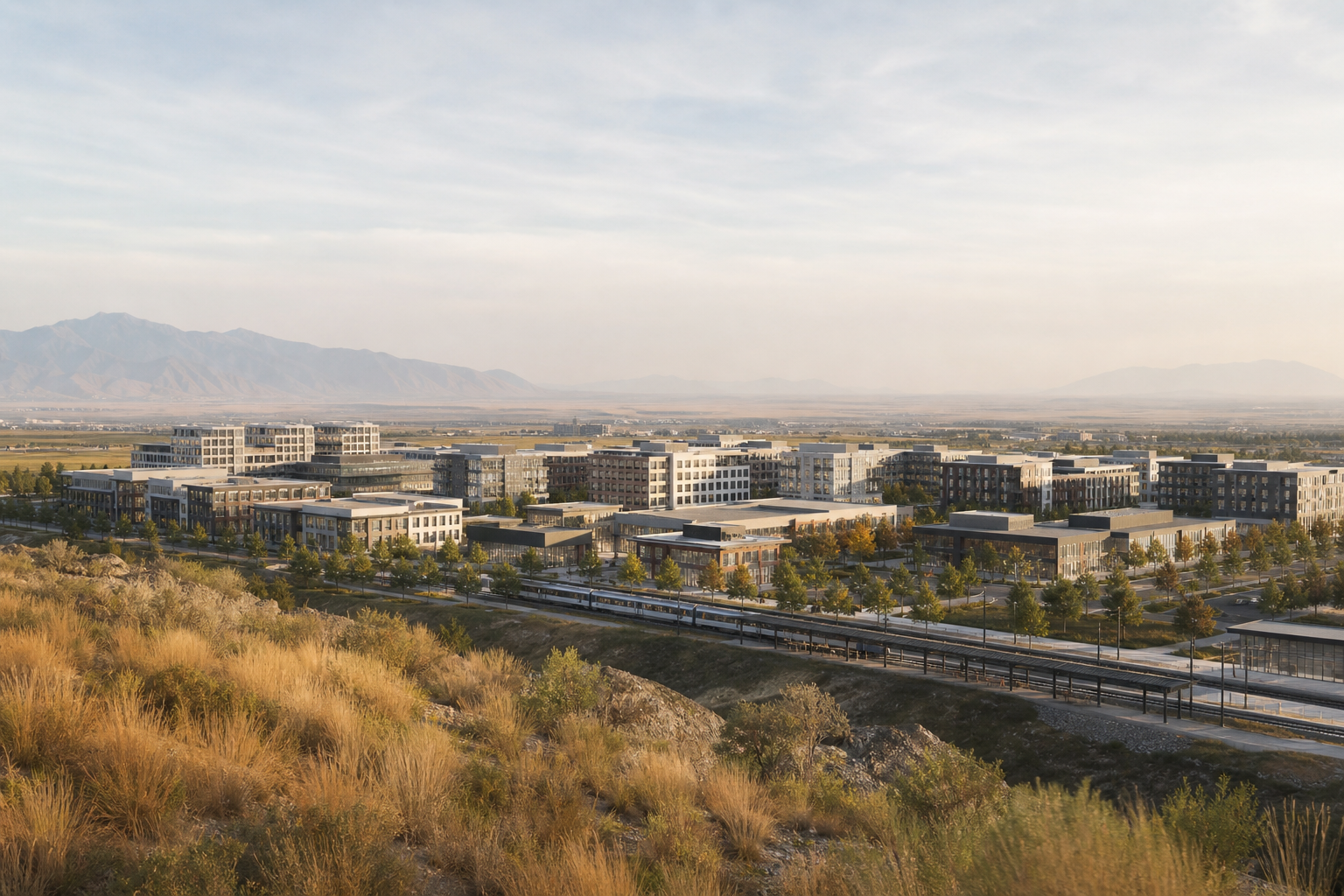
The Point broke ground on August 6, 2026 on 104 acres in Draper, Utah, the first phase of a 600-acre redevelopment of the former state prison site. Total program value is about 2.3 billion dollars.
The program spans 3,000 housing units, 2.5 million square feet of office, 350,000 square feet of retail, two hotels, a 5,000-seat performance venue and 16 acres of parks, with a design brief centered on walkability, transit access and public space.
Ground-up mixed-use at this scale is rare in 2026, when most large developments are stalled on cost and financing. The Point clears the bar because the land basis is effectively state-contributed and the phasing spreads risk across a decade, letting each parcel underwrite to its own market.
The program mix is a bet on the Mountain West growth story, office demand that still exists where population and in-migration are rising, anchored by housing and experiential retail. It is the anti-thesis to the distressed coastal office narrative.
Implications: For developers, control of low-basis entitled land is the whole game. For municipalities, public-land redevelopment adds supply without sprawl. For investors, phased master plans convert one mega-bet into a series of market-timed calls.
Related coverage
Key Takeaways
- When land is cheap and phasing is patient, big mixed-use still pencils, and it is happening in the Mountain West, not on the coasts.
- Public land is becoming master-planned density at institutional scale
- A state-contributed land basis and decade-long phasing are why it pencils
- The Mountain West still draws ground-up capital as coastal cores stall
Building Design and Construction - A 2.3 Billion, 104-Acre Mixed-Use Development Breaks Ground South of Salt Lake City, August 2026
Never miss a Signal
Get the daily brief that busy CRE professionals rely on.