📢 CRE 360 Signal™.
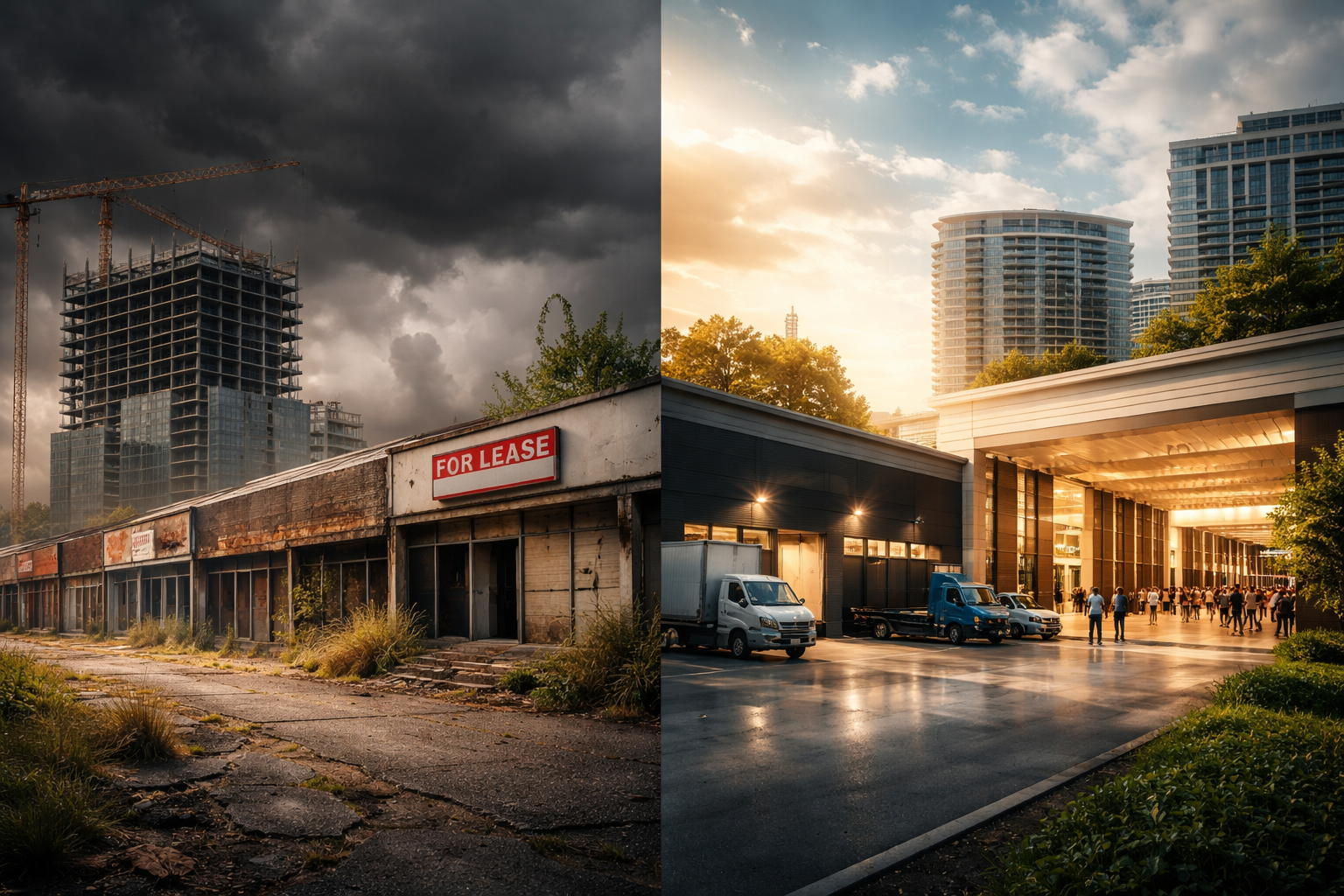
This week’s activity doesn’t point to a frozen CRE market — it reveals a market under pressure, separating by asset quality and execution strength. Refinancings are still happening, but only where sponsors can support the deal beyond the asset itself. Industrial continues to trade, though at tighter margins, while retail and office distress is moving from expectation to reality through servicing, loan sales, and restructuring.
At the asset level, the pattern is clear: properties with stable operations and strong sponsorship are surviving the reset, while overleveraged or operationally weak assets are being pushed into forced outcomes. Distress is no longer theoretical — it is building into a visible pipeline that will drive transaction volume over the next cycle.
🎧 Busy to read? Catch the Daily Podcast (Subscribe on YouTube, Apple, Spotify)➤ SIGNALS
1) Brookfield Secures $1.3B Refinance on Manhattan Office Portfolio
❝Brookfield closed a $1.3B refinancing on a portfolio of Manhattan office assets.
Financing replaces near-term maturities on high-profile but challenged office properties.
Lenders required additional equity support and structural protections.
Deal execution signals continued lender willingness for top-tier sponsorship despite office headwinds.
This deal looks like a win for office, but it’s actually a warning. Brookfield didn’t refinance because the assets are strong — it refinanced because it has the balance sheet to support them. That distinction matters. Lenders are still exposed to office but are forcing sponsors to share more downside risk through equity injections and tighter terms. This model doesn’t scale across the broader market. Most office owners don’t have this flexibility. Expect a widening divide: institutional assets get refinanced, while everything else moves toward restructuring or sale. Office liquidity exists — but it’s sponsor-driven, not asset-driven.
2) Prologis Expands Industrial Footprint With $800M Portfolio Acquisition
❝Prologis acquired an $800M portfolio of logistics assets across key U.S. distribution markets.
Portfolio includes last-mile facilities in high-demand urban corridors.
Acquisition aligns with strategy to scale in supply-constrained logistics hubs.
Reflects continued institutional conviction in industrial fundamentals despite moderating rent growth.
Industrial remains the most liquid and institutionally favored asset class. This is not a speculative buy — it’s a scale play in a sector that still works. Even with rent growth slowing, industrial fundamentals are predictable enough to support large capital deployment. But here’s the risk: pricing hasn’t reset as much as other sectors, which compresses forward returns. Groups like Prologis can justify that through operating efficiencies and long-term holds. Most investors can’t. Expect continued acquisitions, but with tighter yield thresholds and less margin for error. Industrial is still attracting capital — but returns are getting thinner as competition intensifies.
3) Private Equity Targets Retail Distress With $500M Fundraise
❝Oaktree Capital Management launched a $500M fund focused on distressed retail assets.
Strategy targets discounted acquisitions and recapitalizations of underperforming centers.
Fund will focus on re-tenanting, repositioning, and mixed-use conversions.
Investor demand reflects growing appetite for opportunistic retail strategies.
Distress is becoming institutionalized — capital is being raised specifically to buy it. This is where cycles turn. When large managers raise dedicated distress funds, it signals that pricing is finally approaching levels where risk can be underwritten. But retail is tricky — repositioning requires leasing execution, capex, and often zoning changes. This isn’t passive investing. The opportunity is real, but so is the execution risk. Many of these deals will underperform if consumer demand softens or leasing timelines stretch. Expect more capital chasing distress — but not all of it will be rewarded. Distress is no longer avoided — it’s becoming a target strategy for institutional capital.
4) CMBS Special Servicing Rate Rises Again, Driven by Office Defaults
❝CMBS special servicing rate increased to over 9.5%, the highest level since 2021.
Office assets account for the majority of new transfers to special servicing.
Rising rates and refinancing gaps are driving borrower distress.
Multifamily distress is also emerging, particularly in overlevered Sunbelt markets.
Distress is accelerating through formal servicing channels, not just isolated deals. Special servicing is where problems become unavoidable. Once loans transfer, outcomes narrow: restructure, foreclose, or sell. The rising rate confirms what the market has been signaling — distress is broadening beyond office into other leveraged sectors. The key issue now is volume. As more loans enter servicing simultaneously, resolution capacity gets stretched, slowing the process but increasing eventual severity. Expect a pipeline of forced transactions building behind the scenes. Distress is no longer anecdotal — it’s systemic and moving into execution phase.
5) Starwood Offloads $1B+ CRE Loan Portfolio at Discount
❝Starwood Property Trust sold a $1B+ portfolio of CRE loans at a discount to par.
Portfolio included office and mixed-use assets with elevated risk profiles.
Buyers consisted primarily of private credit and opportunistic debt funds.
Transaction reflects growing secondary market liquidity for distressed debt.
Lenders are beginning to actively sell problem loans rather than extend and pretend. This is a meaningful shift. For the past two years, most lenders avoided selling loans because it forced losses onto balance sheets. That’s changing. Selling at a discount cleans up exposure but resets valuations lower across the market. The buyers — typically debt funds — are underwriting to control positions and restructuring scenarios, not stabilization. This creates a pipeline of future asset takeovers. Expect more loan sales as regulatory and capital pressures increase, particularly tied to office and transitional assets. The market is moving from delay to disposition — debt is starting to clear at real pricing.
6) Hospitality Debt Refinancing Picks Up as Lenders Re-Engage
❝Hospitality refinancing activity increased with new loan originations for stabilized hotel assets.
Lenders are focusing on urban and resort properties with strong RevPAR recovery.
Financing structures include lower leverage and higher debt service coverage requirements.
Borrowers are often required to inject fresh equity to close refinancing gaps.
Hospitality is re-entering the financing market — but under tightened underwriting and lower leverage. Hotels were written off during the pandemic and early rate hikes, but operational recovery is now translating into financing access. That said, this is not easy capital. Lenders are demanding real performance, not projections, and requiring equity support. This creates a filter: strong operators refinance, weak ones fall behind. The sector is stabilizing, but unevenly. Expect more refinancings — alongside select distress in underperforming assets that can’t meet new underwriting thresholds.
Weekly Synthesis — What Actually Matters
The market is being filtered, not frozen. Refinancing now exposes weak deals instead of saving them, while execution risk is breaking value-add strategies that rely on leasing, timing, or heavy capex. Distress is moving into real transactions through servicing and loan sales, creating a visible pipeline.
Bottom line:
Assets that perform survive.
Assets that don’t → get reset through restructuring or sale.
CRE 360 Signal™ — Commercial Real Estate Intelligence
▼ EDITORIAL DESK TOP PICKS
Capital Markets / Debt / Macro
“Lenders tighten terms as office loan stress deepens” — Banks are requiring fresh equity and rejecting extensions on underperforming office assets.
“CRE CLO issuance picks up as credit markets reopen” — Structured debt is returning as a key financing tool for transitional assets.
“Private credit funds step in as banks pull back from CRE lending” — Alternative lenders are filling the gap in higher-risk deals.
“CMBS delinquency rate rises again in Q1 2026” — Office loans continue to drive distress across securitized debt markets.
“Insurance costs are becoming a deal-breaker in CRE underwriting” — Rising premiums are materially impacting feasibility across multiple asset classes.
Transactions / Deals
“Blackstone sells $1B industrial portfolio to institutional buyer” — Large-scale logistics trades continue as institutional capital rotates into stabilized assets.
“Chicago office tower trades at deep discount to prior valuation” — A major Loop asset sold for less than half of its previous peak price.
“Houston multifamily portfolio changes hands for $300M” — Strong Sun Belt demand continues to support apartment transactions.
“Retail center in Florida sells amid strong tenant demand” — Grocery-anchored assets remain one of the most liquid retail product types.
“Life science campus secures refinancing amid strong leasing” — Lenders continue to favor specialized asset classes with stable tenant bases.
Office / Leasing
“Office leasing rebounds slightly in select gateway markets” — Trophy assets are outperforming while commodity office continues to struggle.
“Sublease space declines as companies stabilize footprints” — Availability is tightening in some metros as tenants commit to long-term space decisions.
“Office-to-residential conversions accelerate in major cities” — Cities are pushing adaptive reuse as a solution to vacancy and housing shortages.
Industrial / Logistics
“Industrial demand stabilizes after record expansion cycle” — Leasing volume is normalizing as new supply enters the market.
Multifamily
“Apartment supply wave peaks, pushing vacancy higher” — New deliveries are temporarily softening rent growth in major metros.
“Institutional investors doubling down on workforce housing” — Demand fundamentals are driving long-term capital into affordable segments.
Retail
“Retail vacancy remains near historic lows despite economic uncertainty” — Limited new construction continues to support occupancy levels.
Development / Construction
“Construction costs flatten as supply chain pressures ease” — Developers are seeing more predictable pricing for materials and labor.
Technology / Market Direction
“AI adoption transforming CRE underwriting and asset management” — Firms are integrating predictive analytics to improve deal evaluation and operations.

Related coverage
Get Capital Doesn’t Exit — It Reprices Risk Weekly Signal in your inbox
Refinancing, acquisitions, and distress funds reveal a CRE market splitting by capital strength and asset conviction.