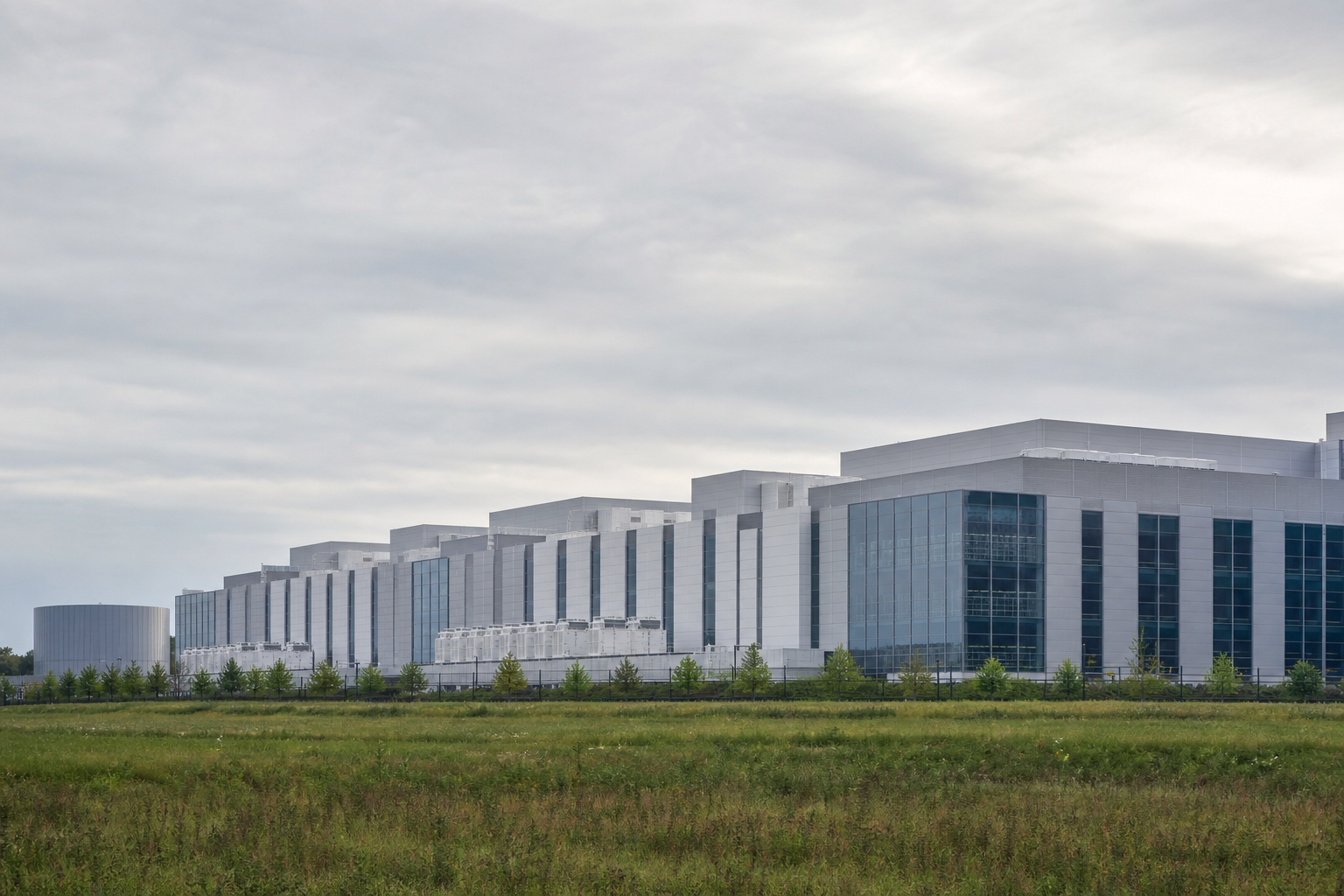
Microsoft's global data-center capacity today is approximately 12 GW. The target is more than 38 GW by 2032 — a 3.17x expansion covering owned and leased facilities and excluding capacity rented from neocloud providers such as CoreWeave. Roughly 2 GW is AI-specific compute today; AI is projected at nearly one-third of the 38 GW by 2032.
Capital expenditure and finance leases run approximately $175B adjusted for calendar 2026, with about $50B guided for Q1 FY2027. The resulting footprint is described as larger than New York State's peak electricity consumption.
Twenty-six gigawatts of net new capacity across six years is roughly 4.33 GW per year, sustained. AI compute grows about 6.3x against an overall build of 3.17x. At a conventional $9–12M per MW all-in, 26,000 MW implies $234B–$312B of construction.
The stated driver is not ambition but scarcity. Azure ran short of capacity and turned away AI and cloud business across 2025 and 2026 — revenue that existed, arrived, and could not be served. A capacity plan written under that constraint is a different document from one written to chase a market.
What makes the figure legible to real estate is the unit. Gigawatts are not square feet. A 38 GW target is a statement about interconnection queues, substation capacity, transformer lead times and generation siting long before it is a statement about land. The building is the cheap part.
That reordering already shows in the price data. The August producer price index put switchgear and industrial controls at +12.3% year over year, transformers at +7.6%, and electronic components at +27.6%. Aluminum fell 4.4% in a single month. The bill of materials that sets construction cost has rotated toward the electrical package, and this is the demand curve sitting underneath it.
For anyone underwriting a data-center shell, the scarce input is no longer the site. It is the queue position and the equipment order. A developer who controls both has an asset; one who controls only dirt has an option.
Implications
The number that matters is 4.33 GW a year, every year, from one company. Grid interconnection, not capital, is the binding constraint on that pace, and every developer competing for the same substations is now bidding against a published schedule. Expect power procurement — behind-the-meter generation, long-dated PPAs, queue positions acquired as assets — to become the underwriting line item that separates deals that close from deals that stall.
Flags: sourced to a Bloomberg report, not a Microsoft press release. This is a corporate capacity plan, not a CRE transaction. Treat 38 GW as a target, not a commitment. The figure excludes neocloud rentals, so total compute exposure is larger than the owned-and-leased number implies.
Key Takeaways
- When a tenant publishes its power requirement in gigawatts, the site stops being the scarce input and the interconnection queue becomes the asset
- Twenty-six gigawatts across six years is about 4.33 GW per year, sustained — roughly $234B to $312B of construction at conventional cost per megawatt
- Secure interconnection and long-lead electrical equipment before securing tenants; the sequence has inverted
Bloomberg News, September 10, 2026 — Microsoft data-center capacity plan · TechTimes, September 11, 2026 · Dataconomy, September 11, 2026 · Technology.org, September 11, 2026 · U.S. Bureau of Labor Statistics, Producer Price Index, August 2026 (USDL 26-1495), preliminary
Never miss a Signal
Get the daily brief that busy CRE professionals rely on.