


🚨Key Highlights
$141 M class settlement challenged by four state AGs.
Greystar’s $50 M share equals ≈35 % of total payout.
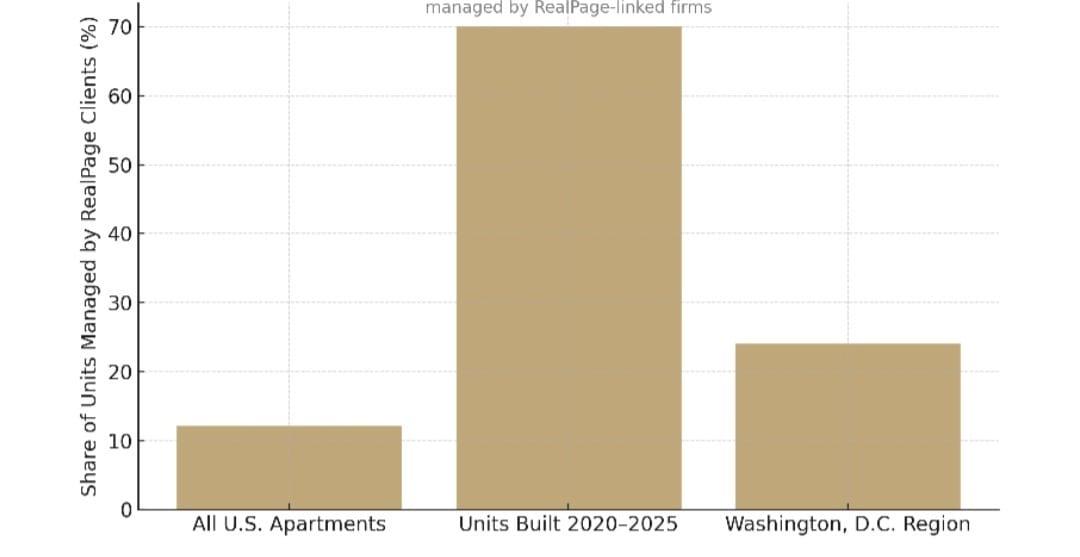
12 % of U.S. apartments linked to RealPage clients.
70 % of units built since 2020 used affected systems.
Rent gains of 25 %+ cited in DOJ filings.
Cap-rate drift: +25 bps since Q2 on legal uncertainty.
Signal
Attorneys general from D.C., Maryland, New Jersey and Kentucky have asked a federal judge to reject the proposed $141 million RealPage rent-fixing settlement, arguing that it grants “meager relief” and could impede their own suits. The objection extends a two-year campaign to redefine how algorithmic pricing fits within antitrust law — and raises the question of how much of recent rent growth was technology-driven rather than market-made.
For investors, this is not only a legal story. It’s a valuation reset.
Algorithmic Pressure and Portfolio Exposure
Roughly 600 landlords — covering 4.5 million units — used RealPage’s revenue management platform. A Washington Post analysis found that firms named in these suits manage 12 % of U.S. apartments and an outsized 70 % of units delivered since 2020. One DOJ-cited landlord raised rents 25 % in 11 months after adopting the system.
The implication: a measurable NOI premium may be at risk of reversal if courts deem such coordination anti-competitive. On balance, underwriting assumptions must revert to organic rent drivers: income growth, supply absorption, and tenant retention.
Settlements and Signaling Effect
Greystar’s $50 million payment — about 35 % of the total — anchors a broader $142 million multi-party settlement covering 26 managers. Most agreed to stop feeding rent data into the software, effectively phasing out algorithmic pricing in new leases.
In turn, market pricing is likely to decentralize. The immediate result could be slower rent inflation across major metros that had adopted revenue management systems most aggressively — notably in the Sun Belt and Pacific Northwest.
Capital Market Translation
Multifamily valuations already face headwinds from the 10-year Treasury hovering near 4.3 %. Since the RealPage litigation expanded, multifamily cap rates have widened ≈ 25 bps, with lenders applying legal-risk premiums of 5–10 bps to affected portfolios.
Still, abundant equity dry powder — particularly from core-plus funds — may limit broader repricing. As one private-debt executive noted, “If rent tech disappears, underwriting discipline replaces it; capital just prices the uncertainty.”
Operational and Compliance Costs
For operators, the next 18 months will demand manual pricing judgment. Compliance reviews, software modifications, and potential tenant claims could lift operating expenses 5–10 bps on yield. Managers are retraining leasing teams to base rents on submarket comps rather than peer-data feedback loops.
Meanwhile, state AGs’ persistence — and a D.C. trial set for 2027 — suggests this scrutiny won’t fade quickly. In practice, portfolio audits and independent rent verification will become standard in lender due-diligence checklists.
Market Behavior Reset
Absent algorithmic cohesion, rent growth may normalize toward 2–3 % annually in Class A segments that had averaged 5 %+. Class B/C communities, less reliant on pricing software, could gain share through steadier occupancy. Owners emphasizing service quality, energy retrofits, and community amenities may capture the next margin gains once price leadership dissipates.
Nonetheless, compressed DSCRs and fixed-rate maturities could expose owners who underwrote aggressive rent ramps. Select distress opportunities may surface by mid-2026 as NOI forecasts are revised.

The pending Tennessee ruling on the settlement will set precedent. If the court sides with the AGs, settlements could swell beyond $200 million and prolong the chill on algorithmic pricing. Meanwhile, RealPage is expected to introduce “compliance modes” with manual-override features — a signal that technology providers are pivoting toward transparency rather than predictive rent targeting.
Policy follow-through could extend to other property types — self-storage, student housing — where dynamic pricing now proliferates. Investors should track whether federal guidance codifies limits on data pooling, as this would formalize a new underwriting baseline for income growth.
Transparency is the new premium — pricing power must now be earned, not engineered.

Reuters — States push back on RealPage settlement. Washington Post — How rent algorithms reshaped apartment pricing. Insurance Journal — DOJ rent-fixing filings detail landlord gains.

Never miss a Signal
Get the daily brief that busy CRE professionals rely on.