📢Good morning, today’s Signals are brought to you by CRE 360 Signal™.
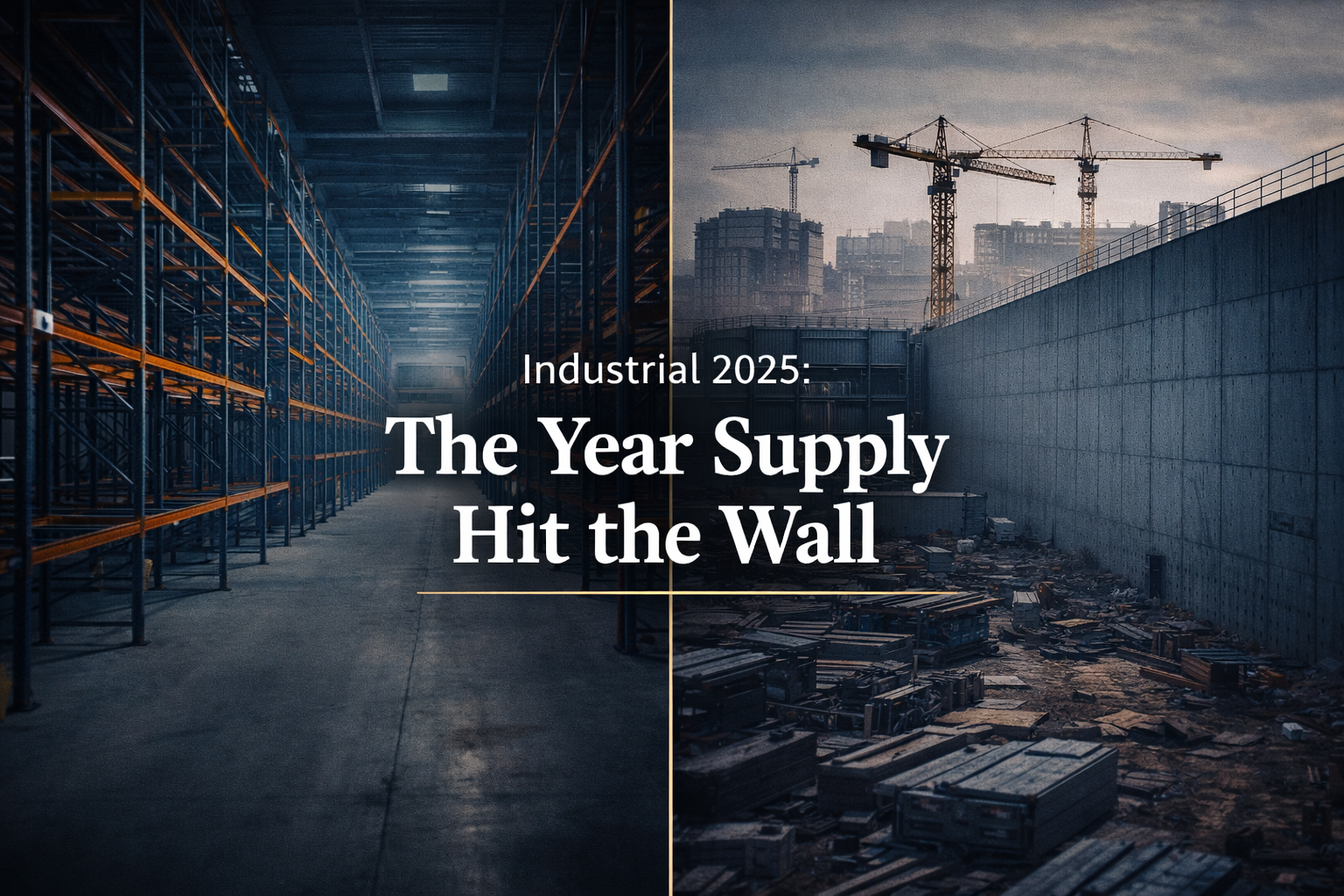
Industrial real estate hit a long-awaited equilibrium in 2025. Demand remained structurally strong, but two years of heavy deliveries finally caught up, pushing vacancy to mid-6% levels before stabilizing. Much of the sector’s movement in 2025 was not about weakening fundamentals — it was about digesting an unprecedented volume of new product. Occupiers prioritized modern, high-specification logistics facilities, while older buildings with functional obsolescence struggled. With construction activity pulling back sharply and demand drivers intact, the sector enters 2026 positioned for renewed tightening after a necessary cooldown.
🎧 Busy to read? Catch the Daily Podcast (Subscribe on YouTube, Apple, Spotify)➤ SIGNAL
➤Key Highlights
Vacancy stabilized around 6.6% in Q3 2025, marking a pause after two years of upward movement as supply tapered and demand remained durable.
Flight to quality intensified — modern warehouses built since 2022 recorded 200+ million sq. ft. of positive absorption, while older stock saw significant move-outs.
Net absorption remained resilient, with 53.3 million sq. ft. taken up in Q3 and 79 million sq. ft. year-to-date, though still below the pace needed to offset the large supply wave.
Over 1 billion sq. ft. of new industrial space delivered since early 2023; roughly 400 million sq. ft. remained vacant entering 2024, weighing on rent growth.
Rent growth flattened, following a ~3–4% decline in 2024; many markets experienced minimal rent movement as they digested new delivery backlogs.
Construction starts dropped sharply, putting 2025 completions on track to fall by roughly half versus 2024 — a key stabilizing force for vacancy heading into 2026.
3PLs dominated leasing (≈35% of all deals), while e-commerce penetration toward 25% of core retail sales continued driving logistics demand.
2026 outlook improves as new supply falls off, absorption accelerates, and rents begin to re-expand — with Class A logistics hubs positioned to outperform.
2025 Performance
The industrial sector transitioned toward balance in 2025 after years of rapid expansion. National warehouse vacancy held around 6.6% in Q3, finally stabilizing after more than two years of increases. Robust leasing activity persisted — but it shifted heavily toward newer, high-tech facilities, while older buildings lagged. Modern warehouses delivered since 2022 generated more than 200 million sq. ft. of positive absorption, even as many legacy properties recorded significant move-outs.
Overall absorption remained solid: 53.3 million sq. ft. in Q3 and 79 million sq. ft. year-to-date. Yet this demand level couldn’t fully keep pace with the 1 billion sq. ft. of space delivered since early 2023. Roughly 400 million sq. ft. of that new inventory was still vacant heading into 2024, putting pressure on rent growth.
By late 2025, the supply surge finally began to slow. Fewer project starts meant deliveries fell materially, with 2025 completions on track to be roughly half of 2024’s level. This helped halt vacancy expansion. Rent growth flattened across many markets — following a ~3–4% decline in 2024 — as the sector worked through its backlog of new space. Still, asking rents remained far above pre-pandemic levels, and effective rents held up thanks to limited concessions compared to prior cycles. Core logistics hubs, particularly in Southern California and the Northeast, maintained Class A vacancy at or below 3%, underscoring the bifurcation between modern and obsolete stock.
Demand Drivers & Tenant Behavior
Occupier demand remained healthy, supported by structural shifts in supply chain strategy. Total leasing volume in 2025 is on track to exceed 800 million sq. ft., slightly below pandemic-era highs but well above pre-2020 norms.
3PLs accounted for roughly 35% of all leasing, driven by retailers and manufacturers outsourcing logistics to manage volatility and control costs. E-commerce penetration continued upward — approaching 25% of core retail sales — driving additional demand for distribution and fulfillment centers.
Geopolitical and supply chain resiliency themes shaped tenant decisions. Nearshoring and “China+1” strategies pushed activity into U.S. border regions and Midwest distribution corridors. Markets such as Houston, Dallas, Kansas City, and Louisville saw increased warehouse demand tied to expanded North American manufacturing.
A significant occupier trend was flight to quality. Companies used the period of higher availability to upgrade into mega-distribution centers with advanced automation capabilities. Conversely, older warehouses — particularly those with low clear heights or outdated sprinkler systems — recorded over 100 million sq. ft. of negative absorption in 2024 and continued softening in 2025. Many landlords of aging facilities began evaluating renovations or partial repositioning as user demand shifted decisively toward modern product.
Capital Markets & Pricing
Industrial remained a favored asset class for investors, though pricing adjusted from 2021’s peak. Green Street data show industrial values down modestly year-over-year as of mid-2025. Cap rates expanded from the frothiest high-3% levels into the mid-4% to low-5% range by 2025 for prime assets, largely due to higher borrowing costs.
Even with these shifts, liquidity stayed healthy. Industrial continued to lead transaction activity across major property types. In the net-lease space, industrial comprised 53% of all STNL volume over the past year. Large operators like Prologis continued acquiring logistics portfolios, signaling long-term conviction in the sector’s fundamentals.
Lenders grew cautious on speculative development, driving the pullback in new starts. However, industrial benefited from the lowest loan delinquency rates among major CRE categories, and lenders generally remained willing to refinance or extend loans on high-quality, stabilized assets. Rent expectations — though more moderate than in 2021–22 — still supported investor underwriting, especially in coastal markets with scarce land and power capacity.
Policy & Regulatory Factors
Industrial’s regulatory environment in 2025 reflected the tension between economic development and community impact.
Environmental regulations tightened in key logistics hubs such as the Inland Empire, where air-quality rules impose fees on large distribution centers and some municipalities explored temporary moratoria on warehouse development. Requirements for rooftop solar on new commercial buildings — now mandated in California — increased construction and compliance costs.
Trade policy continued influencing industrial demand. Persistent U.S.–China trade tensions and potential tariff escalations motivated manufacturers and distributors to diversify sourcing. Nearshoring into Mexico remained a major catalyst, benefiting U.S. border markets.
Labor stability provided relief: the 2023 West Coast port labor agreement prevented disruptions through 2025, supporting smooth logistics operations. Meanwhile, some states pursued logistics-friendly incentives, offering tax credits or infrastructure support to attract major distribution and manufacturing facilities.
In short, industrial sat at the crossroads of environmental standards, supply chain reconfiguration, and labor policy, and 2025 reinforced this intersection.
➤ 2026 Outlook - Industrial
The industrial sector is positioned for a renewed expansion phase by late 2026. As the large volume of new supply delivered in 2023–25 is gradually absorbed, vacancy is expected to tighten, particularly in markets past their peak delivery cycles.
Absorption should accelerate, driven by:
ongoing e-commerce expansion
renewed inventory-building and resiliency strategies
nearshoring-driven manufacturing patterns
sustained 3PL growth
Rent growth is projected to reaccelerate into the mid-single digits, once the bulk of the 400+ million sq. ft. of recent vacant space is leased. High-barrier coastal markets should outperform due to land scarcity and power constraints, while select Sun Belt and Midwest corridors tied to reshoring trends may see outsized leasing momentum.
Older product will continue to face headwinds until the market works through modern inventory. Redevelopment and functional repositioning are expected themes for 2026–27.
Overall, industrial enters 2026 with strong structural demand, a shrinking pipeline, and rents poised to resume upward movement, marking a shift from digestion back into expansion.
Industrial didn’t cool in 2025 — supply finally caught up, revealing a split market where modern logistics space thrives and obsolete stock struggles.
CRE360.ai — Daily Signals & Commercial Real Estate Intelligence
Part of the 2025 Year-End Intelligence Series.
▼ EDITORIAL DESK TOP PICKS
❝Why are restaurant closures surging in the DC area—and why are midpriced spots taking the hardest hit?
A once-iconic Sears store became apartments—and now the $29M sale closes a long-running foreclosure saga.
A subtle change in Trump’s marijuana policy may have ripple effects far beyond cannabis—real estate could be one of them.
🛍️Retail
❝A $102M refinance just unlocked new momentum for a six-state self-storage portfolio—here’s why BlackRock’s backing matters.
From a data-center boom stretching into 2026 to easing mortgage rates and slipping durable goods orders—three signals that could shape how today’s market opens.
Even as backlash grows over power and water use, a Bay Area data center project is moving ahead—raising bigger questions about regulation in California.
🏭Industrial
❝Hotel operators felt the squeeze in 2025 from wild demand swings and rising costs—but labor trends hint at a brighter side.
Barry Sternlicht’s tips and surprising drops in hotel demand dominated the headlines—here’s what everyone was reading this year.
🛏️Hospitality
❝A 59-unit former Sears-turned-apartments just sold for $29M—closing the chapter on a long foreclosure saga in Chicago’s North Side.
Lefferts is breaking ground again—Miami Beach’s North Beach welcomes its newest condo project.
Elevest teams up with Rise48 Equity to snag 263 apartments in North Carolina—what’s next for these Chapel Hill and Greensboro communities?
🏘️Multifamily
❝San Francisco sees its biggest quarterly drop in office availability—but plenty of space is still up for grabs for expanding tech firms.
As downtown LA bounces back, Uncommon Developers and Colliers time their office tower renovation perfectly—could lower vacancy rates signal a turning point?
San Antonio’s office market is feeling the pinch—mid-tier spaces are lagging as building age shapes today’s demand.
🏙️Office
❝UK government backs off—farmers get a win in the inheritance tax battle.
🏙️Distress

Get Industrial 2025 Recap & 2026 Outlook in your inbox
Overview of industrial performance in 2025 and what to expect in 2026