


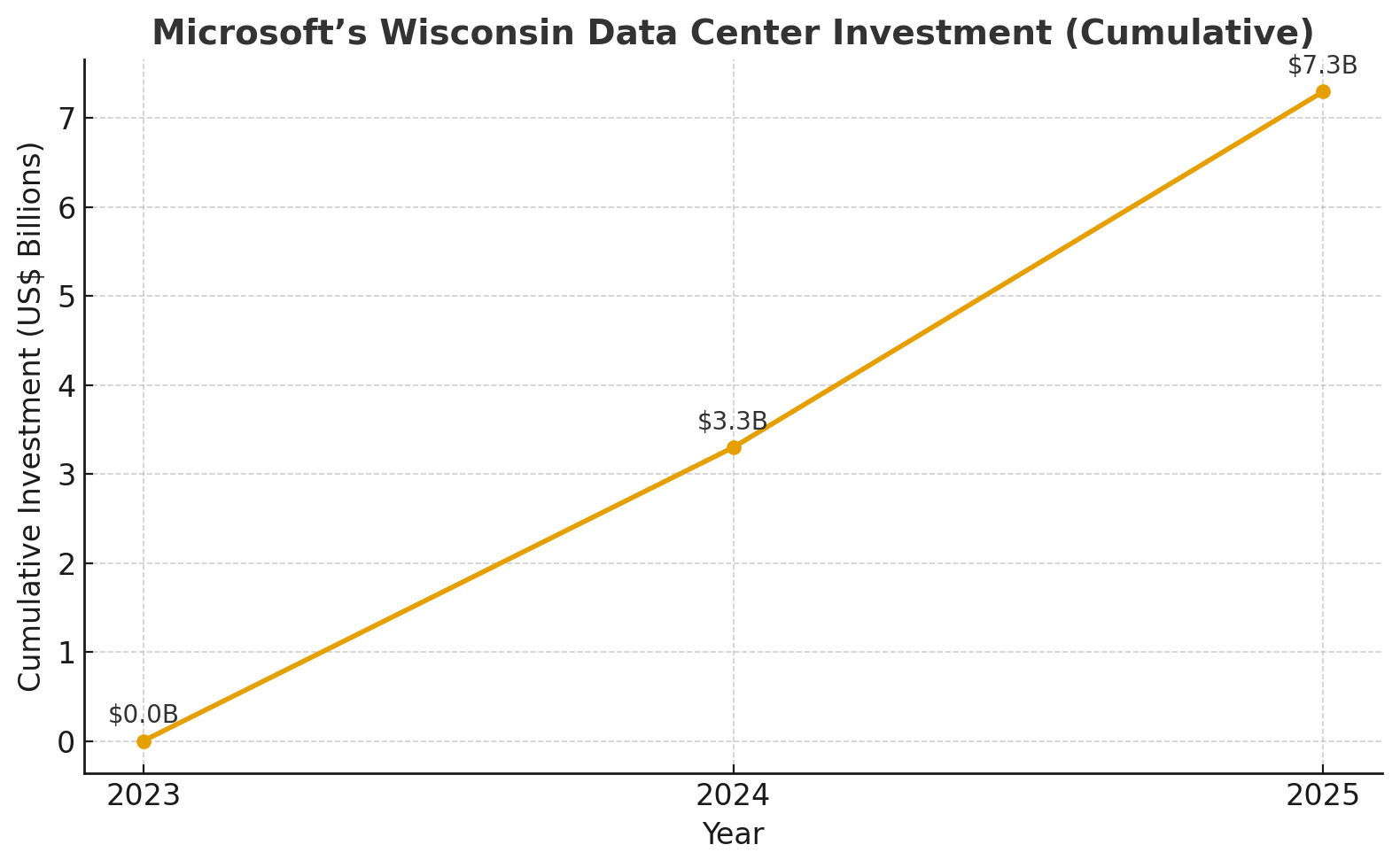
🚨Microsoft will double its Wisconsin AI data center campus to $7 B, funding construction of two hyperscale facilities in Mount Pleasant. The expansion underscores the corporate-capex-driven AI arms race, with Microsoft pre-paying for grid upgrades and committing to local renewables. For CRE, this signals continued institutional demand for specialized infrastructure with cap rates in the mid-5s, insulated from debt costs. Wisconsin gains one of the largest private projects in its history, transforming a failed Foxconn site into a digital anchor.

Microsoft Wisconsin data center investment: $7.3 B cumulative (2023–2025)
Hyperscale cloud capex: $240 B in 2024 (+44% YoY)
Data center core cap rates: ~5.0–5.5% mid-2025

Loan Performance. Traditional CRE underwriting is less relevant here: Microsoft self-funds, eliminating DSCR and maturity risk. If structured as a sale-leaseback, AA+ credit plus triple-net structure could command strong DSCR margins and stable cash-on-cash yields.
Demand Dynamics. AI workloads drive unprecedented absorption of power and land. Tenant risk is low; the constraint is utility capacity. Competitive clustering in the Midwest could spike land and interconnect demand.
Asset Strategies. Investors seeking exposure should prepare for TI/LC refresh cycles aligned to chip upgrades. Alternative reuse is limited; value-add hinges on power density and cooling retrofits.
Capital Markets. Mid-5% cap rates for stabilized hyperscale assets attract infra funds. Expect inbound JV offers and sale-leaseback proposals. Spreads vs. 10Y (~4.3%) are tight, but covenant quality keeps execution strong.

Equity-funded hyperscale builds sidestep high-rate headwinds.
Midwest emerging as strategic AI cluster.
Data center cap rates resilient in mid-5s.
Execution risk lies in power delivery, not leasing.
🛠 Operator’s Lens
Refi. Not applicable; balance sheet funding eliminates debt rollover.
Value-Add. For third-party investors, value rests in power expansions and tech refresh capital.
Development. Schedule float is critical; long-lead electrical equipment is the gating factor.
Lender POV. If syndicated, banks would price this as infra debt at narrow spreads given Microsoft’s credit.

Phase 1 delivery in 2026; Phase 2 by 2027.
Regional competition likely: AWS, Google scouting Midwest locations.
Regulatory risk: PJM/MISO may impose special tariffs on hyperscale users.
Long-term: next-gen cooling, hydrogen/diesel phase-out, and federal AI policy incentives will shape economics.

Reuters, Data Center Frontier, Avison Young, Green Street

Never miss a Signal
Get the daily brief that busy CRE professionals rely on.