📢 CRE 360 Signal™.
The U.S. rental market is showing early signs of moderation, with slightly longer lease-up times and reduced competition per unit. However, conditions remain tight overall, and several markets—particularly those with limited new supply and high lease retention—continue to experience elevated competition, highlighting a growing divergence between supply-constrained and supply-heavy regions.
🎧 Busy to read? Catch the Daily Podcast (Subscribe on YouTube, Apple, Spotify)➤ SIGNALS
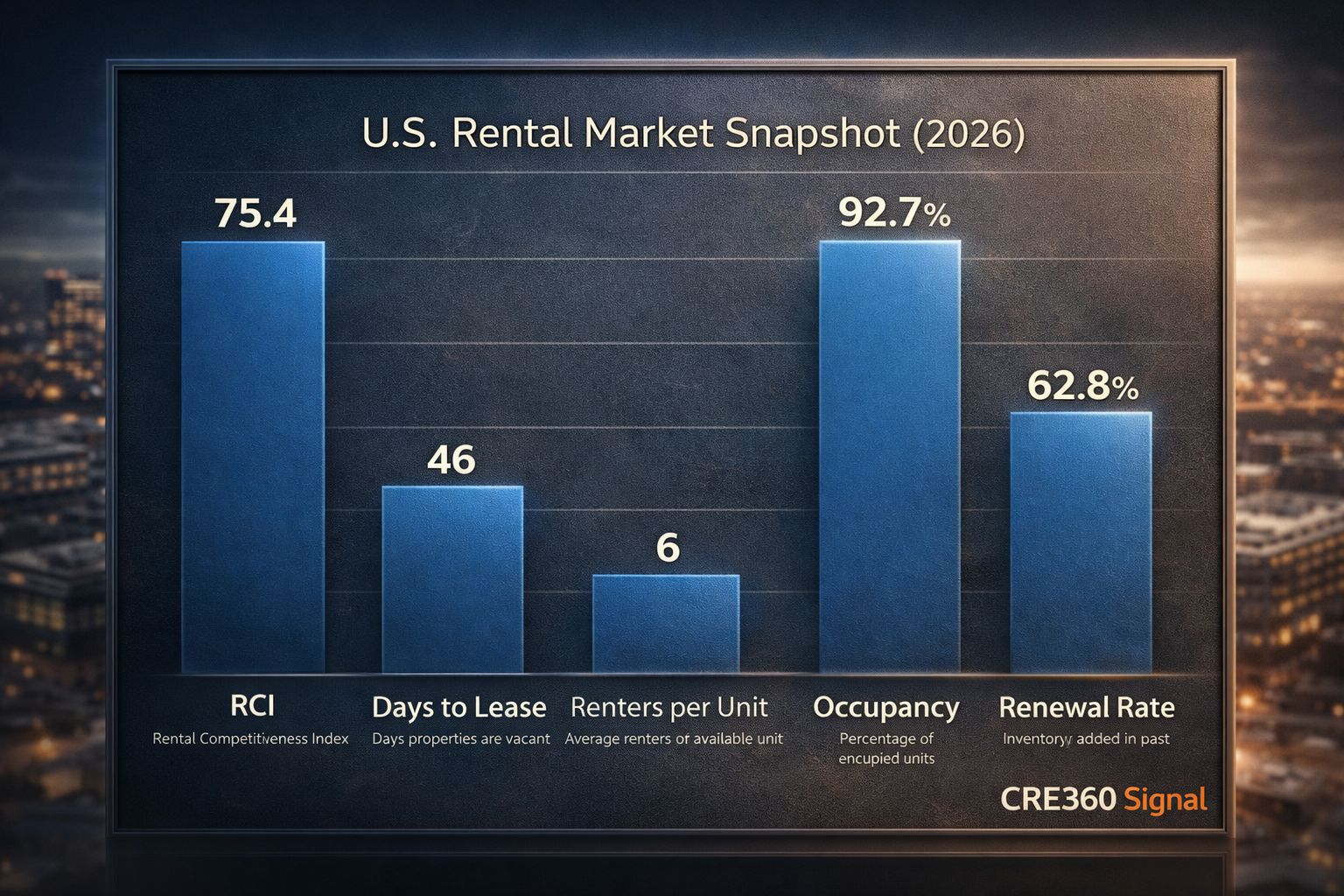
The U.S. rental market is beginning to show signs of moderation, but the shift remains uneven across regions and asset types. According to recent data from RentCafe, national rental competitiveness has softened slightly, with the Rental Competitiveness Index declining from 75.7 to 75.4 YoY.
Leasing conditions have eased modestly. Apartments now take an average of 46 days to lease, compared to 43 days last year, while the number of renters competing per unit has declined from seven to six. Despite this, overall market conditions remain tight, with occupancy at 92.7% and lease renewal rates holding at 62.8%.
New supply remains limited, with only 0.6% of total inventory delivered over the past 12 months. This constraint continues to support pricing and occupancy levels, even as demand normalizes.
However, beneath the national averages, a clear divergence is emerging.
Several large metropolitan markets continue to exhibit elevated competition. Miami remains the most competitive large market, with 13 renters per available unit and an RCI of 90.5. Chicago has recorded the largest year-over-year increase, with its index rising 9.5 points to 88.8, supported by high occupancy and faster lease-up times.
Other markets, including San Francisco and Atlanta, have also seen rising competitiveness, driven by localized demand factors such as return-to-office trends, sector-specific growth, and reduced supply additions.
Smaller markets are demonstrating similar or even stronger conditions. Wichita leads all markets with an RCI of 91, while Amarillo and Lafayette show high occupancy and rapid absorption, supported by limited new construction and stable tenant bases.
Conversely, several markets are experiencing more noticeable easing. Southwest Florida recorded the largest decline in competitiveness, while parts of Los Angeles, Brooklyn, and Washington, D.C., are seeing slower leasing activity and reduced renter competition. In these areas, increased supply and shifting demand dynamics are providing renters with more options.
Regionally, the Midwest has emerged as a focal point of rental tightness. Multiple markets in the region rank among the most competitive, driven by limited development activity, relatively affordable rents, and high lease renewal rates. In many cases, a large share of tenants are choosing to remain in place, further restricting available inventory.
Key Takeaways
National rental conditions are softening, but remain fundamentally tight
Supply constraints—not demand strength—are driving competitiveness in top markets
High lease renewal rates are limiting available inventory across key regions
Midwest markets are outperforming due to stability and limited new development
Smaller markets are showing elevated competitiveness, signaling potential supply gaps
Markets with new supply are experiencing faster normalization and tenant leverage
CRE 360 Signal™ — Commercial Real Estate Intelligence
▼ EDITORIAL DESK TOP PICKS
Capital Markets / Debt / Macro
“Lenders tighten terms as office loan stress deepens” — Banks are requiring fresh equity and rejecting extensions on underperforming office assets.
“CRE CLO issuance picks up as credit markets reopen” — Structured debt is returning as a key financing tool for transitional assets.
“Private credit funds step in as banks pull back from CRE lending” — Alternative lenders are filling the gap in higher-risk deals.
“CMBS delinquency rate rises again in Q1 2026” — Office loans continue to drive distress across securitized debt markets.
“Insurance costs are becoming a deal-breaker in CRE underwriting” — Rising premiums are materially impacting feasibility across multiple asset classes.
Transactions / Deals
“Blackstone sells $1B industrial portfolio to institutional buyer” — Large-scale logistics trades continue as institutional capital rotates into stabilized assets.
“Chicago office tower trades at deep discount to prior valuation” — A major Loop asset sold for less than half of its previous peak price.
“Houston multifamily portfolio changes hands for $300M” — Strong Sun Belt demand continues to support apartment transactions.
“Retail center in Florida sells amid strong tenant demand” — Grocery-anchored assets remain one of the most liquid retail product types.
“Life science campus secures refinancing amid strong leasing” — Lenders continue to favor specialized asset classes with stable tenant bases.
Office / Leasing
“Office leasing rebounds slightly in select gateway markets” — Trophy assets are outperforming while commodity office continues to struggle.
“Sublease space declines as companies stabilize footprints” — Availability is tightening in some metros as tenants commit to long-term space decisions.
“Office-to-residential conversions accelerate in major cities” — Cities are pushing adaptive reuse as a solution to vacancy and housing shortages.
Industrial / Logistics
“Industrial demand stabilizes after record expansion cycle” — Leasing volume is normalizing as new supply enters the market.
Multifamily
“Apartment supply wave peaks, pushing vacancy higher” — New deliveries are temporarily softening rent growth in major metros.
“Institutional investors doubling down on workforce housing” — Demand fundamentals are driving long-term capital into affordable segments.
Retail
“Retail vacancy remains near historic lows despite economic uncertainty” — Limited new construction continues to support occupancy levels.
Development / Construction
“Construction costs flatten as supply chain pressures ease” — Developers are seeing more predictable pricing for materials and labor.
Technology / Market Direction
“AI adoption transforming CRE underwriting and asset management” — Firms are integrating predictive analytics to improve deal evaluation and operations.

Related coverage
Get Rental Market Fractures as Supply Reshapes Competition in your inbox
Cooling spreads nationally, but supply-constrained markets remain tight, exposing widening divergence across U.S. rental conditions.