📢 CRE 360 Signal™.
For two years the data center story was about money: who had the equity, who could write the lease, how high cap rates would stay. In 2026 the story has quietly changed. The capital is there. The land is there. What's missing is power — and the deals are now being won and lost on grid access, not balance sheets.
🎧 Catch the Wekkly Podcast (Subscribe on YouTube, Apple, Spotify)➤ SIGNALS
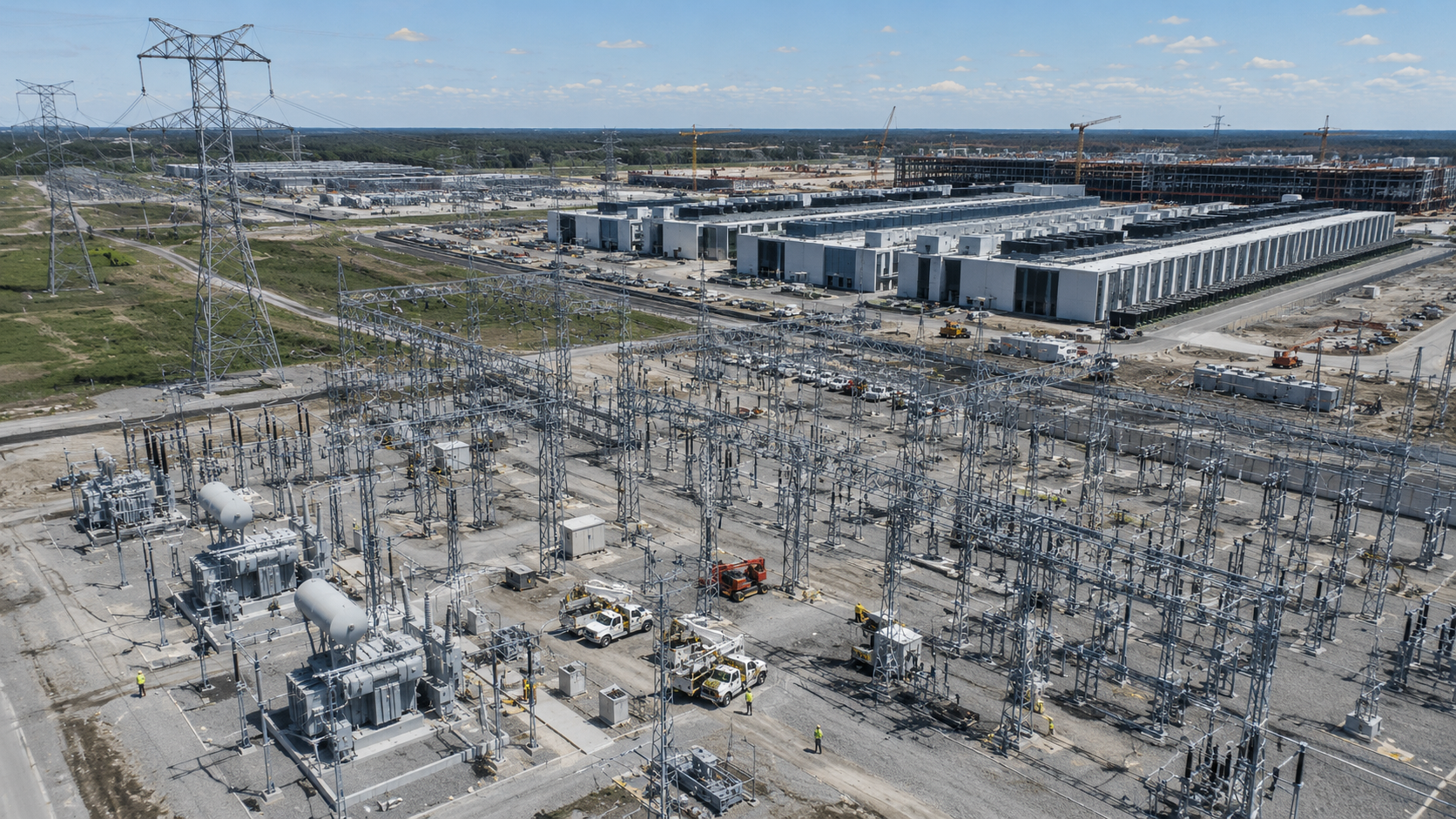
Power availability has overtaken land and location as the top site-selection factor for data center development — a reversal of the traditional sequence where developers secured a parcel and arranged utilities afterward. Today, megawatts come first.
The delay risk is now measured in years. Interconnection queues and substation lead times are extending some project timelines by 24 to 72 months. Over a span that long, the variables a sponsor cannot control — interest rates, equipment pricing, hyperscaler demand — all have room to move.
Costs are climbing in parallel. A standard facility runs near $488 per square foot, while AI-optimized builds clear $1,100 per square foot as power density, cooling and electrical infrastructure scale up. Tariff-exposed steel, aluminum and copper kept hard-cost inflation running ahead of the broader economy. And the demand isn't slowing: roughly 10.2 gigawatts of additional U.S. capacity sit in the pipeline.
IMPLICATIONS
The mispricing risk in this cycle isn't valuation — it's schedule. A signed hyperscaler lease and a funded equity stack used to mean a deal was de-risked. They no longer do, because neither controls the in-service date. If the power-on date is governed by a utility's interconnection queue, the most important number in the pro forma is the one the sponsor has the least authority over.
That inverts diligence. Site control should be evaluated against grid headroom before anything else — available capacity, queue position, substation proximity, and the utility's own build timeline. The premium parcel in 2026 isn't the cheapest land or the best fiber; it's the site with secured, deliverable megawatts and a credible energization date.
It also changes who wins. Developers with utility relationships, early queue positions, or control of power-adjacent land hold an edge that capital alone can't replicate. A latecomer with more money still waits in the same line. That's a durable moat, and it's why power-secured sites are trading at a premium to raw entitled land.
The exposure to flag: a 24-to-72-month energization window is a long time to carry land, debt and pre-development cost against a lease that may reprice or a tenant whose own AI demand forecast shifts. The discipline is to underwrite to the trough of that window, not the promise at the end of it.
STAKEHOLDER LENS
Developers: Lead with power procurement; treat grid access as the first feasibility gate, not a later checklist item.
Lenders: Stress-test the energization date independently of the construction schedule; a build can finish and still sit dark.
Investors: Pay up for secured megawatts. A power-on date is worth more than a discount on land.
Utilities: Now effectively gatekeepers of CRE's fastest-growing asset class — and a counterparty risk in every deal.
Key Takeaways
Whether utilities and regulators can expand grid capacity fast enough to clear the queue — and who ultimately pays for the upgrades. If large-load tariffs shift the interconnection cost onto data center developers, the $/MW math changes again.
In data centers, the question is no longer "can we finance it" — it's "when can we energize it." Underwrite to the power-on date.
CRE 360 Signal™ — Commercial Real Estate Intelligence
▼ EDITORIAL DESK TOP PICKS
1. Commercial Real Estate Lending Activity Reaches Five-Year High. CBRE's Lending Momentum Index reached its strongest level since 2021, signaling increased lending activity across CRE sectors.
2. Commercial & Multifamily Borrowing Increased 52% in Q1 2026. MBA reported commercial and multifamily mortgage borrowing rose 52% year-over-year in the first quarter.
3. Kayne Anderson Closes $5.12 Billion Opportunistic Real Estate Fund. The firm announced the final close of an oversubscribed opportunistic equity fund with $5.12 billion in commitments.
4. CMBS Special Servicing Rate Reaches 11%. Trepp data shows the CMBS special servicing rate climbed to approximately 11% in May.
5. FDIC Reports Rising Nonperforming Commercial Real Estate Loans. The FDIC's Q1 banking report showed continued deterioration in nonfarm nonresidential CRE credit performance.
6. I Squared Acquires Data Center Portfolio From Cogent. I Squared Capital agreed to acquire U.S. data center assets from Cogent for approximately $225 million.
7. Edged Secures Nearly $2 Billion for U.S. Data Center Expansion. Edged announced approximately $2 billion in financing to support its U.S. data center development pipeline.
8. Prime Data Centers Breaks Ground on $3 Billion Phoenix Campus. Prime Data Centers started construction on three buildings within its $3 billion Metro Phoenix development.
9. PJM Accelerates Timeline for New Data Center Power Connections. PJM announced changes designed to speed up power delivery to large-scale data center projects.
10. AI Could Add 330 Million Square Feet of CRE Demand. Cushman & Wakefield projects AI-related growth could generate 330 million square feet of demand over the next decade.
11. JLL Arranges $300 Million Sale of FedEx Industrial Portfolio. A multi-state FedEx logistics portfolio traded for approximately $300 million.
12. Colliers Brokers $140 Million Industrial Facility Sale. A 1.6 million-square-foot industrial property in Tennessee sold for $140 million.
13. Newmark Arranges Sale and Financing of Logistics Portfolio. Newmark completed the sale and acquisition financing of a 1.38 million-square-foot shallow-bay logistics portfolio.
14. Industrial Asset in Northern Virginia Data Center Corridor Sells for $42 Million. Marcus & Millichap closed the sale of two industrial properties located within Northern Virginia's data center market.
15. ACRE Provides $351 Million Refinance for Multifamily Portfolio. ACRE supplied refinancing for a multifamily portfolio spanning four states.
16. HUD Expands Role in Multifamily Finance. HUD announced updates designed to increase its participation in multifamily lending programs.
17. Freddie Mac Issues Affordable Housing Forward Commitment. Freddie Mac provided a forward commitment supporting the development of new affordable housing in Arizona.
18. Avison Young Arranges $404 Million Permanent Loan in Manhattan. The firm secured financing for The Archive, a 479-unit multifamily property in Manhattan.
19. U.S. Office Vacancy Falls to 17.6%. Yardi Matrix reported national office vacancy declined modestly in April 2026.
20. Law Firms Continue Driving Premium Office Leasing. Savills reported legal-sector tenants remain among the most active users of high-end office space.

Get The Constraint Isn't Capital Anymore in your inbox
In data centers, the scarce input has become electrons — and the clock that matters is power-on