📢 CRE 360 Signal™.
The cost line that sinks the most deals isn't interest — it's hard cost. And in early 2026 it broke out again. Nonresidential construction input prices rose at roughly a 12.6% annualized rate over the first two months of the year, the fastest pace since the supply-chain crisis of early 2022. The difference now: the engine is tariffs, which don't ease on their own.
🎧 Catch the Weekly Podcast (Subscribe on YouTube, Apple, Spotify)➤ SIGNALS
Nonresidential construction input costs finished 2025 up 3.2% year-over-year, then accelerated sharply. January 2026 alone ran at a 7.1% annualized rate, and the first two-month stretch hit about 12.6% annualized — territory not seen since 2022.
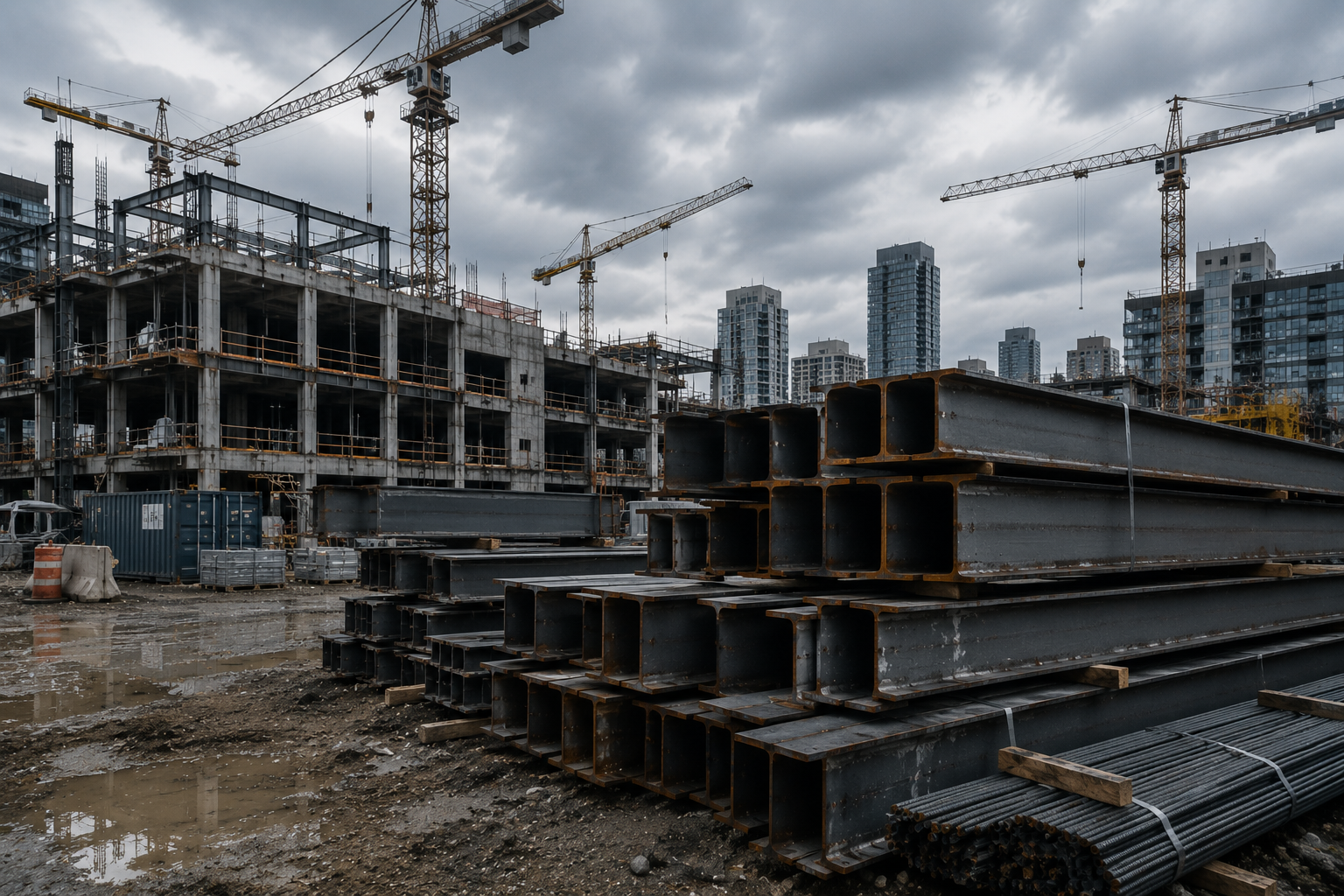
The pressure is concentrated in tariff-exposed metals. Steel mill products rose roughly 20.7% year-over-year through January; the ENR 20-city steel index was already up 11.9% across 2025. The tariff schedule is the through-line: 50% on steel, aluminum and copper, 25% on derivative products, and 15% on electrical and industrial equipment — transformers, panelboards, conduit — that sits on the critical path of nearly every build.
The downstream effect is visible in deal flow. Contractors report projects cancelled or scaled back over the past year because material quotes blew through budgets set only months earlier.
Implications
This is a structural re-rating of hard cost, not a transitory spike. Tariffs are a policy floor under prices, and a floor doesn't melt when demand softens the way a supply-chain backlog did. Any pro forma built on 2024 or 2025 cost assumptions is now understated — and the gap compounds on long-lead, metals-heavy programs.
The cruelest exposure is timeline. A data center, hospital or industrial build with a 24-to-36-month schedule is buying steel, copper and switchgear at prices that are still climbing, against rents and exit caps fixed at underwriting. The longer the build, the wider the scissor between locked revenue and unlocked cost.
The defensible response is procurement strategy, not optimism. Early buy-out and material escrow on metals and equipment, hard caps and shared-savings clauses in GMP contracts, and explicit tariff-escalation language move risk off the owner's balance sheet. The sponsors who survive this will be the ones who treated the equipment package like a commodity hedge, not a line item.
There's a capital-allocation read too. As ground-up math gets harder, existing, well-located assets gain relative value — you can't tariff a building that's already standing. Repositioning and acquisition pencil better against new construction when replacement cost is rising this fast.
Stakeholder Lens
Developers: Re-baseline every active budget to 2026 metals pricing; lock buy-outs early. Lenders: Stress contingency against a 10%+ hard-cost move, not the historical 3–5%. Owners/operators: Rising replacement cost is a tailwind for in-place assets and existing-stock acquisition.
Key Takeaways
Whether tariff rates hold, escalate, or get carved out by sector remains a policy variable no underwriting can predict. Treat the current schedule as the base case and the direction of change as a risk, not a forecast.
You can hedge a rate. You can't hedge a tariff you didn't price — and right now, most pro formas didn't..
CRE 360 Signal™ — Commercial Real Estate Intelligence
▼ EDITORIAL DESK TOP PICKS
1. Commercial Real Estate Lending Activity Reaches Five-Year High. CBRE's Lending Momentum Index reached its strongest level since 2021, signaling increased lending activity across CRE sectors.
2. Commercial & Multifamily Borrowing Increased 52% in Q1 2026. MBA reported commercial and multifamily mortgage borrowing rose 52% year-over-year in the first quarter.
3. Kayne Anderson Closes $5.12 Billion Opportunistic Real Estate Fund. The firm announced the final close of an oversubscribed opportunistic equity fund with $5.12 billion in commitments.
4. CMBS Special Servicing Rate Reaches 11%. Trepp data shows the CMBS special servicing rate climbed to approximately 11% in May.
5. FDIC Reports Rising Nonperforming Commercial Real Estate Loans. The FDIC's Q1 banking report showed continued deterioration in nonfarm nonresidential CRE credit performance.
6. I Squared Acquires Data Center Portfolio From Cogent. I Squared Capital agreed to acquire U.S. data center assets from Cogent for approximately $225 million.
7. Edged Secures Nearly $2 Billion for U.S. Data Center Expansion. Edged announced approximately $2 billion in financing to support its U.S. data center development pipeline.
8. Prime Data Centers Breaks Ground on $3 Billion Phoenix Campus. Prime Data Centers started construction on three buildings within its $3 billion Metro Phoenix development.
9. PJM Accelerates Timeline for New Data Center Power Connections. PJM announced changes designed to speed up power delivery to large-scale data center projects.
10. AI Could Add 330 Million Square Feet of CRE Demand. Cushman & Wakefield projects AI-related growth could generate 330 million square feet of demand over the next decade.
11. JLL Arranges $300 Million Sale of FedEx Industrial Portfolio. A multi-state FedEx logistics portfolio traded for approximately $300 million.
12. Colliers Brokers $140 Million Industrial Facility Sale. A 1.6 million-square-foot industrial property in Tennessee sold for $140 million.
13. Newmark Arranges Sale and Financing of Logistics Portfolio. Newmark completed the sale and acquisition financing of a 1.38 million-square-foot shallow-bay logistics portfolio.
14. Industrial Asset in Northern Virginia Data Center Corridor Sells for $42 Million. Marcus & Millichap closed the sale of two industrial properties located within Northern Virginia's data center market.
15. ACRE Provides $351 Million Refinance for Multifamily Portfolio. ACRE supplied refinancing for a multifamily portfolio spanning four states.
16. HUD Expands Role in Multifamily Finance. HUD announced updates designed to increase its participation in multifamily lending programs.
17. Freddie Mac Issues Affordable Housing Forward Commitment. Freddie Mac provided a forward commitment supporting the development of new affordable housing in Arizona.
18. Avison Young Arranges $404 Million Permanent Loan in Manhattan. The firm secured financing for The Archive, a 479-unit multifamily property in Manhattan.
19. U.S. Office Vacancy Falls to 17.6%. Yardi Matrix reported national office vacancy declined modestly in April 2026.
20. Law Firms Continue Driving Premium Office Leasing. Savills reported legal-sector tenants remain among the most active users of high-end office space.

Get The Pro Forma Is Already Wrong in your inbox
Construction input costs are rising at the fastest pace since 2022 — and tariffs are the engine